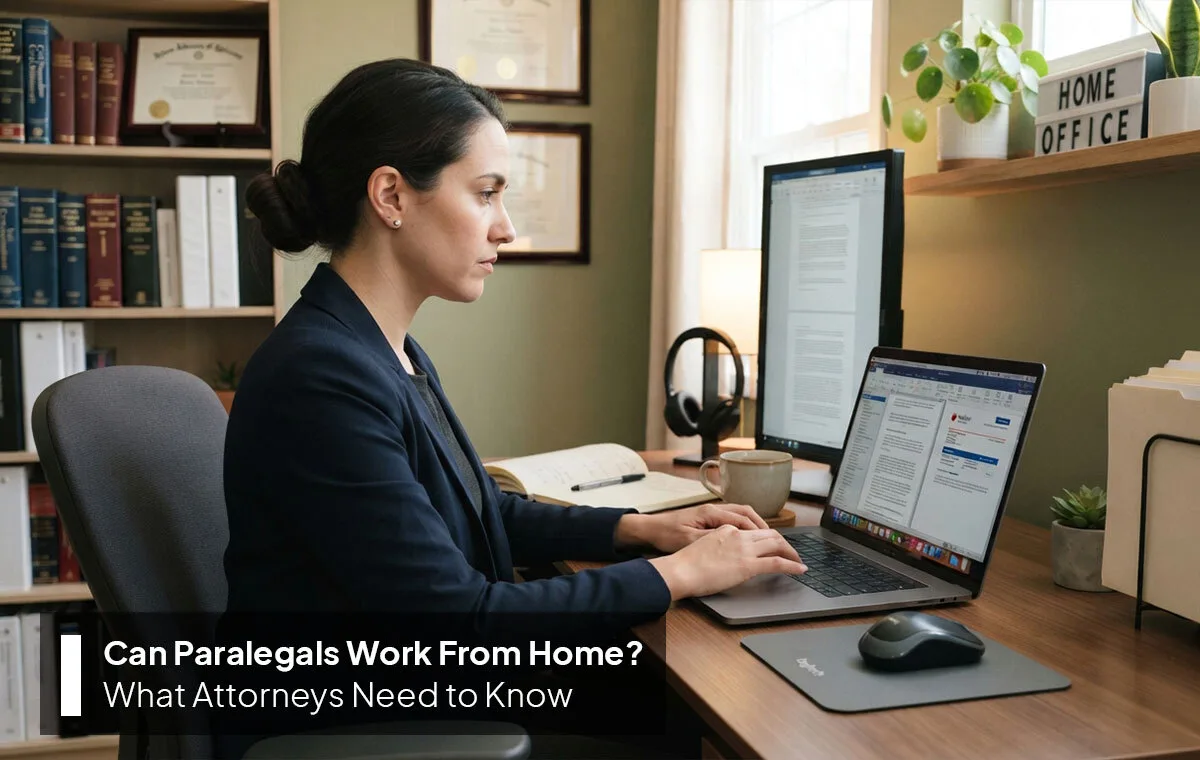
Can paralegals work from home? Yes, many paralegal tasks can be done remotely when the law firm has secure tools, clear supervision, defined client communication rules, and a written workflow for assigning, reviewing, and approving work.
But here is the part attorneys should not ignore: remote paralegal work is not automatically safe just because the task can be done online.
A paralegal can organize files from home. They can support research from home. They can prepare draft documents from home. They can track discovery, update matter notes, and prepare attorney review packets from home.
The real question is not only can paralegals work from home.
The better question is whether your firm has the structure to let them work from home without creating risk, confusion, or more review work for the attorney.
That is the difference between smart remote support and messy delegation.
Can paralegals work remotely?
Can paralegals work from home in a real law firm setting? Yes, if the work is digital, document-based, research-supported, or workflow-driven.
A remote paralegal may help with:
- Case file organization
- Legal research support
- Draft preparation
- Discovery tracking
- Document collection
- Matter summaries
- Exhibit lists
- Client document checklists
- court filing preparation
- attorney review packets
- deadline tracking
- case chronology building
The U.S. Bureau of Labor Statistics says paralegals and legal assistants support lawyers by maintaining and organizing files, conducting legal research, and drafting documents.
Most of that work does not require sitting beside the attorney every day.
It requires accuracy, access, process, and supervision.
What work fits best?
Can paralegals work from home on every task? No.
Some work fits remote support better than others.
Remote work is usually best for tasks that are document-heavy, deadline-driven, research-based, or easy to review through a case management system.
Good remote tasks include:
| Task | Why it works remotely |
| File organization | Documents can be labeled and stored digitally |
| Legal research support | Research can be reviewed by the attorney |
| Draft preparation | Drafts can move through approval workflows |
| Discovery tracking | Deadlines and responses can be tracked in tools |
| Case chronologies | Records can be summarized remotely |
| Exhibit prep | Files can be organized before attorney review |
| Client document collection | Missing items can be tracked with checklists |
Can paralegals work from home successfully? Yes, when the task has a clear input, clear output, and clear review point.
Remote work fails when the firm sends vague instructions and expects the paralegal to guess.
What needs supervision?
Can paralegals work from home without attorney supervision? No, not in the way law firms should think about it.
Remote does not remove the attorney’s responsibility.
ABA Model Rule 5.3 covers responsibilities regarding nonlawyer assistance, which is an important reminder that lawyers must supervise nonlawyer work in a way that aligns with professional obligations.
That means the attorney should keep control over:
- legal advice
- legal strategy
- final document approval
- court filings
- client representation decisions
- settlement decisions
- final research conclusions
- ethics and compliance decisions
- sensitive client communication
A remote paralegal can prepare, organize, draft, research, and track.
The attorney reviews, decides, advises, and approves.
That boundary is what makes remote legal support workable.
What about confidentiality?
Can paralegals work from home while handling confidential information? They can, but only when access and security rules are serious.

Law firms should not treat remote access casually.
A good setup should include:
- Secure logins
- Role-based permissions
- Password management
- Two-factor authentication
- Approved devices
- Approved file storage
- No personal email for client files
- Clear rules for downloads
- Secure communication channels
- Immediate access removal after offboarding
In my opinion, confidentiality is where firms should be strict from day one.
Not harsh.
Strict.
Remote support should not mean client files are floating through personal inboxes, random downloads folders, and unapproved devices. A paralegal working from home needs the same discipline as someone in the office, just with better digital controls.
Which firms benefit most?
Can paralegals work from home for every practice area? Many can, but the best fit depends on workflow.
Remote paralegal support works especially well for firms with document-heavy or deadline-heavy work.
| Practice area | Remote paralegal support |
| Immigration | Document collection, forms support, case tracking |
| Family law | Discovery organization, hearing prep, client document tracking |
| Personal injury | Medical records, demand package support, case chronology |
| Litigation | Discovery tracking, exhibit prep, filing coordination |
| Estate planning | Draft packet support, intake review, checklist management |
| Business law | Contract support, due diligence organization, entity records |
| Real estate law | Transaction checklists, closing document support |
Can paralegals work from home for litigation? Yes, but deadlines and review points need to be tight.
Can paralegals work from home for immigration? Yes, especially when documents, forms, and client follow-ups are organized inside a clear workflow.
The practice area matters, but the system matters more.
What tools are needed?
Can paralegals work from home without proper tools? Technically, maybe. Practically, no.
A remote paralegal needs the right digital environment.
Common tools may include:
- Clio
- MyCase
- PracticePanther
- Filevine
- Microsoft 365
- Google Workspace
- Dropbox
- Adobe Acrobat
- DocuSign
- LawPay
- court e-filing portals
- legal research tools
- secure task management tools
O*NET says paralegal tasks include preparing legal documents, researching laws, maintaining case files, and gathering evidence.
Those tasks can be done remotely only if the firm has a clean system for files, assignments, approvals, and communication.
A tool is not a workflow.
A tool is where the workflow lives.
What should onboarding include?
Can paralegals work from home well in the first week? Only if onboarding is not lazy.
A remote paralegal should not be thrown into active matters without context.
A strong first 30 days should include:
- Practice-area overview
- Tool access
- Confidentiality rules
- File naming rules
- Document template review
- Attorney review process
- Client communication boundaries
- Deadline tracking process
- Sample completed work
- Weekly feedback check-ins
- Escalation rules
This is where I see firms make the biggest mistake.
They hire someone capable, then give them scattered instructions.
A remote paralegal can only be as organized as the system they are working inside.
What should stay in-office?
Can paralegals work from home all the time? It depends on the firm.
Some tasks may still require in-office or local support.
That may include:
- Physical file handling
- Mail processing
- In-person trial support
- Court runner tasks
- notarization coordination
- Physical exhibit preparation
- Onsite client meetings
- Office-specific admin work
This does not make remote paralegal support weaker.
It just means the firm should not pretend every task is remote-friendly.
If the work is physical, local, or court-adjacent, remote support may need to be paired with someone onsite.
What can go wrong?
Can paralegals work from home and still create more work for the attorney? Yes, if the role is poorly designed.
Common problems include:
- unclear supervision
- messy file access
- no deadline system
- vague assignments
- late attorney feedback
- weak confidentiality rules
- too much client communication without scripts
- no review process for drafts
- no standard document naming
- no defined escalation rules
Most remote paralegal failures are not caused by remote work.
They are caused by unclear delegation.
If the attorney cannot explain what good work looks like, the paralegal will have to guess. Guessing is where errors start.
How much does it cost?
Can paralegals work from home as a lower-cost alternative to in-office hiring? Often, yes, especially when the firm does not need full-time onsite support.
BLS reports that the median annual wage for paralegals and legal assistants was $61,010 in May 2024. BLS also reports about 39,300 projected openings each year on average over the decade.
That salary benchmark matters.
Small firms may need paralegal-level help before they can justify a full-time local employee.
Remote hiring can create flexibility because the firm can match support to workload. A firm may need 15 to 25 hours a week of strong paralegal support, not a full-time in-office role.
That is where remote paralegal hiring can make sense.
How should attorneys decide?
Can paralegals work from home for your firm? Ask these questions first:
- Is most of the work digital?
- Are files already organized?
- Do you use case management software?
- Can the attorney review work clearly?
- Are deadlines tracked in one place?
- Are client communication rules written?
- Are confidentiality rules documented?
- Does the work require physical office presence?
- Is there enough recurring work to justify support?
- What should never be delegated?
If the answer to most of these is yes, remote support may work well.
If the answer is no, the firm may need to fix workflow before hiring.
Where Anywhere Talent fits
Anywhere Talent helps firms hire vetted global professionals for remote legal support, admin, finance, operations, customer support, sales, marketing, and executive support.
For firms asking whether paralegals work from home, the answer is not just yes or no.
The real answer depends on the role, practice area, tools, supervision style, and workflow.
Anywhere Talent helps firms define the support needed before hiring. That may include litigation support, immigration document coordination, family law discovery help, estate planning packet prep, case chronology work, filing coordination, or client document collection.
The goal is to match the person to the work, not just hire someone with a legal support title.
Final takeaway
So, can paralegals work from home?
Yes, when the firm has clear tools, secure access, attorney supervision, written workflows, and defined boundaries around client communication and legal judgment.
A remote paralegal can support research, drafts, case files, discovery, matter summaries, client document collection, and attorney preparation. But the attorney still owns legal advice, final review, legal strategy, and professional responsibility.
In my opinion, remote paralegal support works best when the firm stops thinking of it as “remote help” and starts treating it as a serious legal support system.
If your firm needs paralegal-level support but does not need a full-time in-office hire, Anywhere Talent can help you find vetted remote legal support that fits your tools, practice area, and workflow.
Book a free consultation with Anywhere Talent to build remote legal support before casework starts falling behind.