Remote work trends 2026 show that companies are no longer hiring virtual assistants only for basic admin. They are hiring global support to protect founder time, manage digital workflows, improve customer follow-up, support AI tools, and keep distributed teams moving without adding more full-time local overhead.
That shift matters because the future of virtual assistants is not about cheap task help.
It is about role fit.
A business may still need calendar support, inbox management, data entry, research, and admin. But in 2026, the stronger hiring question is different:
Can this person own a workflow, communicate clearly across time zones, use AI responsibly, and reduce pressure on the team?

That is where remote work trends 2026 will change hiring decisions.
Remote work trends 2026: what is changing?
Remote work trends 2026 are being shaped by four big changes: AI adoption, global hiring, async communication, and rising pressure on lean teams.
Founders want more output without building bloated teams. Operators want clearer ownership. Employees want flexibility without burnout. Customers still expect fast replies and clean follow-through.
Gallup found that fully remote workers can be more engaged than other work groups, but they can also report higher stress and lower overall thriving. That tells us remote work is not automatically healthy or unhealthy. The system around the work matters.
This is why hiring virtual assistants is becoming more strategic.
Companies are not only asking, “Can we hire remote help?”
They are asking, “What kind of remote help will make the business easier to run?”
Trend 1: Virtual Assistants become Workflow Owners
One of the biggest remote work trends 2026 is the move from task-based support to workflow ownership.
A task-based assistant waits for assignments.
A workflow-focused assistant owns a recurring part of the business. This shift in remote work trends 2026 highlights why modern founders are prioritizing complete process management over basic task execution.
For example:
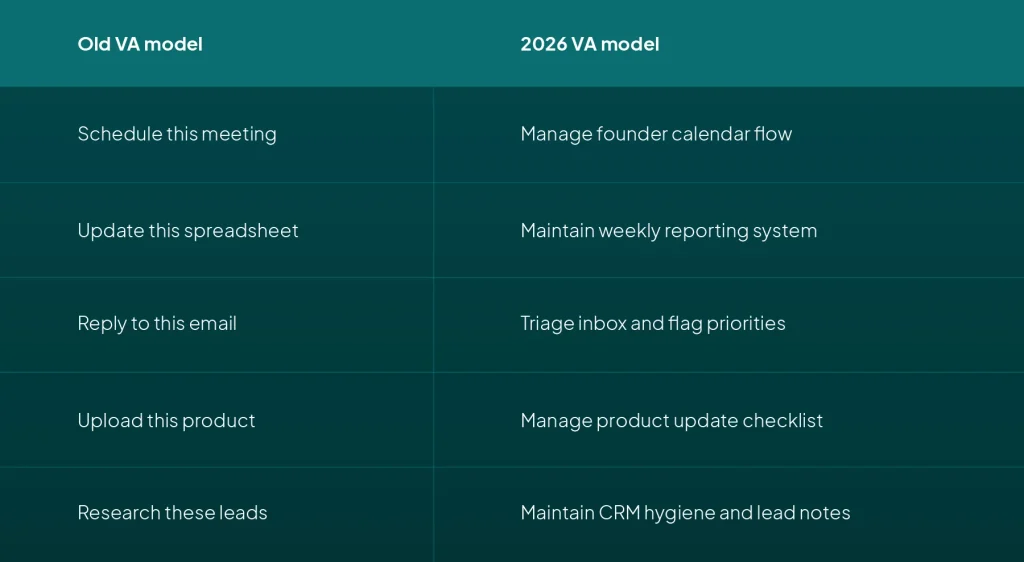
This change matters because founders do not need more people waiting for instructions.
They need support that reduces the number of things living in their head.
The future of virtual assistants is moving toward ownership, not just availability.
Trend 2: AI makes human assistants more valuable
Some companies assume AI will reduce the need for virtual assistants.
Remote work trends 2026 suggest a different reality.
AI can summarize meetings, draft replies, organize notes, create checklists, and speed up routine work. But AI still needs human judgment, quality control, context, and follow-through.
McKinsey’s 2025 AI research points to companies redesigning workflows around AI, not simply replacing every human role. AI creates value when organizations rethink how work is done, not when they add tools without ownership.
That is where virtual assistants become more useful.
A strong assistant can use AI to move faster, but still check accuracy, follow up with people, understand tone, escalate sensitive issues, and protect the workflow.
In 2026, the best assistant may not be the person who avoids AI.
It may be the person who knows how to use AI without letting quality drop.
Trend 3: async communication becomes a hiring skill
Another major part of remote work trends 2026 is async communication.
Distributed teams cannot depend on everyone being online at the same time. Time zones, client needs, and flexible schedules make that unrealistic.

Microsoft’s 2025 Work Trend Index found that employees are interrupted every two minutes during core work hours by meetings, emails, or notifications. For remote teams, that means more messages are not the answer. Better communication systems are.
This changes what companies should look for in a virtual assistant.
The right hire should be able to:
- Write clear updates
- Flag blockers early
- Summarize decisions
- Leave useful handoffs
- Ask specific questions
- Keep project tools updated
- Respect response-time rules
A virtual assistant who communicates clearly can save hours across time zones.
A vague assistant can make remote work feel slower than it needs to be.
Trend 4: global talent becomes normal, not experimental
Remote work trends 2026 also show that global talent is no longer a backup option.
For many companies, it is part of the hiring strategy.
The World Economic Forum’s Future of Jobs Report 2025 gathered input from more than 1,000 employers representing over 14 million workers across 55 economies. The report focuses on how technology, skills, and workforce transformation will reshape jobs through 2030.
That matters for virtual assistant hiring because the talent market is no longer limited to one city.
A founder in New York can hire operations support from Latin America. A company in the U.S. can hire a finance admin from the Philippines. A growing team can hire marketing coordination, customer support, or executive assistance from global professionals.
The advantage is not only cost.
It is access.
Remote work trends 2026 point toward companies building teams based on skill, communication, and role fit, not just geography.
Trend 5: specialized VAs replace general help
General admin support still matters.
But the future of virtual assistants is becoming more specialized.
Companies increasingly need assistants who understand specific functions:
| Role type | What they support |
| Executive assistant | Calendar, inbox, meetings, founder prep |
| Finance assistant | Invoices, receipts, vendor records, reports |
| Ecommerce assistant | Listings, orders, returns, customer support |
| Marketing assistant | Content calendars, campaign admin, reporting |
| Sales assistant | CRM updates, lead follow-ups, pipeline notes |
| Operations assistant | SOPs, task tracking, internal coordination |
This connects directly to remote work trends 2026 because businesses want support that can plug into real workflows faster.
A general assistant may help with broad tasks. A specialized assistant can reduce training time, spot issues earlier, and support the function with better judgment.
Trend 6: Productivity is measured differently
In older remote teams, productivity was often measured by hours online.
Remote work trends 2026 push companies toward output, ownership, response quality, and workflow health.
The wrong question is:
“Was this person online all day?”
The better questions are:
- Did the work move?
- Were updates clear?
- Were customers supported?
- Did the assistant reduce founder workload?
- Did the workflow become easier to manage?
- Were blockers flagged early?
This is especially important for virtual assistants because the role often sits inside daily operations.
If the assistant is only measured by hours, the business may miss the real value.
A great assistant does not just “work time.”
They reduce friction.
Trend 7: Burnout prevention affects hiring decisions
Remote work trends 2026 are also connected to workload sustainability.
Many teams are lean. Founders, managers, and high performers often carry too much admin because the company delays hiring support.
That creates silent pressure.
A founder handles scheduling, reporting, follow-ups, CRM updates, customer emails, and internal reminders. None of those tasks alone looks huge. Together, they become a second job.
This is where virtual assistant hiring becomes a burnout prevention strategy.
The right assistant can remove recurring operational work before it drains the people who should be focused on strategy, sales, client experience, or leadership.
Hiring support is not always about growth.
Sometimes it is about protecting the team you already have.
Trend 8: AI plus human support becomes the strongest model
Remote work trends 2026 will not be about AI replacing every assistant.
The stronger model is AI plus human support.
AI can help with:
- First drafts
- Meeting summaries
- Data cleanup
- Research support
- Email drafts
- Calendar suggestions
- Task summaries
- Judgment
- Communication
- Follow-through
- Escalation
- Client context
- Quality control
- Relationship awareness
This combination is important for AI virtual assistant ROI.
AI can reduce the time required for some tasks. But a human assistant makes sure the task is actually completed, checked, and moved forward.
That is where the future of virtual assistants becomes more valuable, not less.
What companies should hire for in 2026
Remote work trends 2026 should change the hiring checklist.
Instead of only asking whether someone can complete admin tasks, companies should ask whether the person can operate inside a distributed team.
Look for:
| Hiring signal | Why it matters |
| Clear writing | Better async communication |
| Tool comfort | Faster onboarding |
| Role-specific experience | Less training time |
| Ownership mindset | Less founder follow-up |
| AI literacy | Better productivity |
| Time-zone discipline | Smoother handoffs |
| Privacy awareness | Safer remote work |
| Problem flagging | Fewer surprises |
These are not nice-to-have traits.
They are the skills that make remote support actually work.
Where Anywhere Talent fits
At Anywhere Talent, we see these changes every day.
Companies are not just asking for a virtual assistant anymore. They are asking for reliable global talent who can support a specific part of the business, communicate clearly, and settle into the team without creating more management pressure.
That is exactly where the hiring model matters.
The right global professional should match the workflow, not just the job title. A founder who needs executive support should not hire the same profile as an ecommerce brand that needs product listing and customer support help.
Remote work trends 2026 make one thing clear: the best hiring decisions will come from role clarity.
The clearer the role, the better the match.
How to make the right hiring decision
Before hiring a virtual assistant in 2026, answer these questions:
- Which workflow is slowing us down?
- Does this work need general support or domain experience?
- How much time is the founder or team losing each week?
- Can AI support part of the task?
- What still needs human judgment?
- What tools will the assistant use?
- What does success look like after 30 days?
- Who will manage the role?
These questions prevent companies from hiring too vaguely.
They also help decide whether the business needs a general assistant, specialized assistant, AI-enabled assistant, or managed global talent partner.
Final takeaway
Remote work trends 2026 show that virtual assistant hiring is becoming more strategic.
The future is not about finding the cheapest remote help. It is about finding global professionals who can own workflows, communicate clearly, use AI responsibly, and reduce pressure on founders and teams.
The future of work is leaner, more distributed, more AI-supported, and more dependent on strong communication. That means the future of virtual assistants will belong to people who bring judgment, ownership, and role-specific skill.
If your business is growing and the wrong work is still sitting with your founder, managers, or high performers, Anywhere Talent can help you find vetted global professionals who fit the workflow and support the way your team actually works.
Book a free consultation with Anywhere Talent to build a future-ready remote support team that can grow with your business.