A virtual legal assistant is a remote support professional who helps law firms with legal admin, client communication, scheduling, document organization, billing support, intake, calendar management, and daily law office operations. A remote paralegal usually handles more substantive legal support, such as legal research, draft preparation, discovery organization, case summaries, and matter-level document review under attorney supervision.
That difference matters more than most firms realize.
I have seen small law firms hire for the wrong title because they were overwhelmed, not because they had clearly defined the role.
The attorney says, “I need legal help.”
But what kind?
If the phones are messy, intake is slow, consultations are not being scheduled, invoices are delayed, and client follow-ups are falling behind, the firm may need a virtual legal assistant.
If discovery is scattered, case files need legal review, drafts need preparation, legal research is slowing attorneys down, and matter summaries are missing, the firm may need a remote paralegal.
Both roles are useful.
But they are not the same hire.
What is a virtual legal assistant?
A virtual legal assistant is remote legal admin support for a law firm. This person helps the firm stay organized, responsive, and operational without needing to sit inside the office.

A virtual legal assistant may handle:
- Client intake support
- Appointment scheduling
- Calendar management
- Email organization
- Document collection
- File naming and storage
- Billing reminders
- Invoice support
- CRM or case management updates
- Follow-up emails
- Meeting notes
- Consultation reminders
- Client communication routing
O*NET describes legal secretaries and administrative assistants as professionals who perform secretarial duties using legal terminology, procedures, and documents. It also lists tasks like organizing case files, preparing legal correspondence, scheduling appointments, preparing invoices, proofreading legal documents, and assisting attorneys with information collection.
That is close to where a virtual legal assistant fits in most modern law firms.
The role is not just “general VA support.”
It is law firm admin support with legal workflow awareness.
What is a remote paralegal?
A remote paralegal is a trained legal support professional who helps attorneys with more substantive legal work from outside the office.
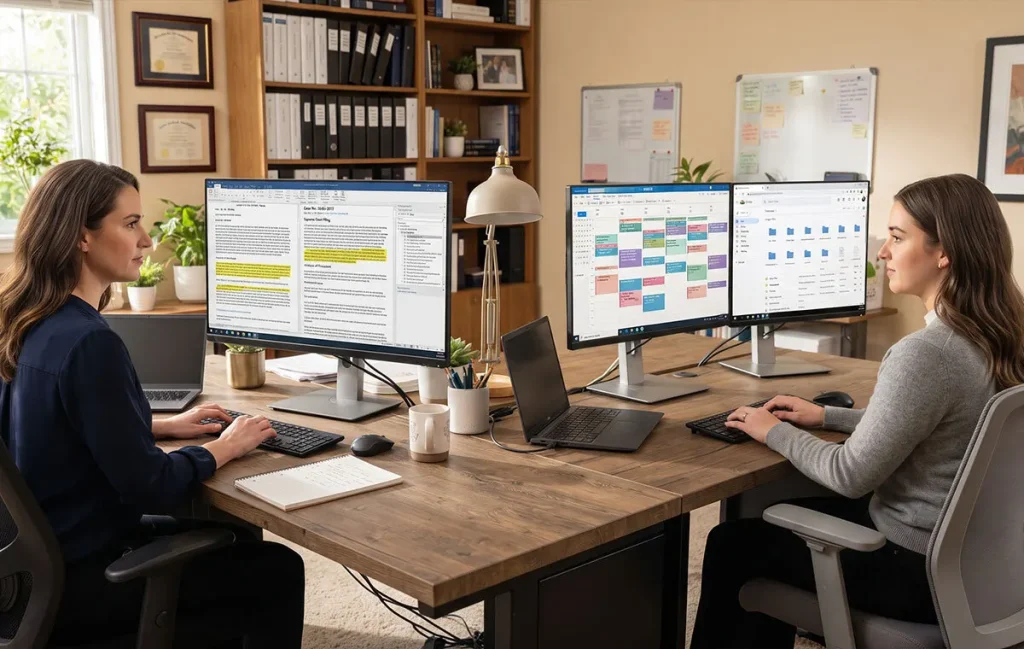
The U.S. Bureau of Labor Statistics says paralegals and legal assistants support lawyers by maintaining and organizing files, conducting legal research, and drafting documents.
A remote paralegal may help with:
- legal research support
- discovery tracking
- case chronology preparation
- draft pleadings or forms for attorney review
- exhibit preparation
- matter summaries
- trial preparation support
- court filing coordination
- records review
- deposition preparation support
- client document review
- legal template management
A remote paralegal works closer to the legal substance of the matter.
They still need attorney supervision.
They should not give legal advice, make strategy decisions, or replace final attorney review.
But they can help attorneys move legal work forward faster.
What is the real difference?
The simplest difference is this:
A virtual legal assistant supports the law firm’s operations.
A remote paralegal supports the legal work inside the matters.
Here is the cleanest way to compare them.
| Need | Better fit |
| Client intake follow-up | Virtual legal assistant |
| Consultation scheduling | Virtual legal assistant |
| Attorney calendar management | Virtual legal assistant |
| Billing reminders | Virtual legal assistant |
| Email organization | Virtual legal assistant |
| Legal research support | Remote paralegal |
| Discovery organization | Remote paralegal |
| Case chronology | Remote paralegal |
| Draft preparation for attorney review | Remote paralegal |
| Exhibit preparation | Remote paralegal |
This is why the role should start with the workflow, not the title.
A law firm that needs admin relief should not overhire for paralegal-level support.
A law firm that needs casework support should not underhire with a general assistant.
Why do firms confuse them?
Firms confuse the two roles because legal support titles are messy.
Some job boards use “legal assistant” and “paralegal” almost interchangeably. Some firms call everyone a legal assistant. Others reserve paralegal for people with specific education, certification, or substantive case experience.
The American Bar Association has historically used legal assistant and paralegal closely together in its definition, describing the role as someone qualified by education, training, or work experience who performs delegated substantive legal work for which a lawyer is responsible.
But in day-to-day hiring, many law firms use virtual legal assistant to mean remote legal admin support.
That is the practical distinction this blog is making.
In my opinion, firms should stop hiring by title alone.
The better question is: what work is actually falling behind?
When should you hire a virtual legal assistant?
Hire a virtual legal assistant when the firm’s daily operations are slowing down attorney time, client response time, or intake flow.
Common signs include:
- Calls are missed
- Leads are not followed up quickly
- Consultations are not scheduled smoothly
- Client documents are not collected on time
- Attorney calendars are messy
- Emails are sitting unanswered
- Billing reminders are inconsistent
- Case management software is not updated
- Clients keep asking for basic status updates
- Admin tasks are being handled by attorneys at night
This is where a virtual legal assistant can make a firm feel lighter almost immediately.
The attorney is not necessarily buried in legal research.
They are buried in everything around the work.
That is the difference.
When should you hire a paralegal?
Hire a remote paralegal when the firm needs support with legal workflow, not only admin workflow.
Signs include:
- discovery is hard to track
- case files are disorganized
- drafts are always rushed
- attorneys need research support
- matter summaries are missing
- hearing packets are prepared last minute
- client documents need deeper review
- case chronology work is falling behind
- filing preparation needs legal process knowledge
- attorneys are doing paralegal-level work themselves
BLS reports that the median annual wage for paralegals and legal assistants was $61,010 in May 2024. That salary benchmark matters because paralegal support is a skilled professional role, not basic admin.
A small firm may need that skill set before it is ready for a full-time in-house hire.
That is where remote support can make sense.
What should each role own?
A virtual legal assistant should own recurring legal admin.
A remote paralegal should own structured legal support tasks under attorney review.
| Work area | Virtual legal assistant | Remote paralegal |
| Intake | Collects info, schedules consults | Reviews matter-specific documents if trained |
| Calendar | Manages appointments and reminders | Tracks legal deadlines if assigned |
| Documents | Organizes and labels files | Prepares drafts and summaries |
| Client communication | Sends reminders and routes updates | Communicates only within approved boundaries |
| Billing | Sends reminders and updates records | May track matter-related billing notes |
| Research | Basic admin research | Legal research support |
| Case prep | Assembles basic files | Builds chronologies, exhibits, summaries |
This is the table I would use for the blog because it directly prevents confusion.
If a task needs legal reasoning, attorney review, or practice-area knowledge, it probably belongs closer to the paralegal side.
If a task keeps the firm organized and responsive, it may fit the virtual legal assistant side.
What should not be delegated?
Neither role should replace the attorney.
That includes:
- giving legal advice
- making legal strategy decisions
- deciding whether to accept a client
- approving final legal documents
- appearing in court
- negotiating legal outcomes
- interpreting ethics rules independently
- signing legal filings without authority
- making final settlement recommendations
- creating attorney-client strategy without review
ABA Model Rule 5.3 covers responsibilities regarding nonlawyer assistance, which is an important reminder that lawyers must supervise nonlawyer support in a way that aligns with professional obligations.
This is where remote hiring needs structure.
The problem is not that support is remote.
The problem is unclear boundaries.
Which role saves more time?
Both roles save time, but they save different kinds of time.
A virtual legal assistant saves operational time.
They protect the attorney from scheduling, intake admin, email follow-up, client reminders, file setup, and recurring coordination.
A remote paralegal saves legal support time.
They protect the attorney from doing every research task, draft prep task, file review task, and case organization task personally.
The better hire depends on where the attorney is losing time.
If the firm is losing leads because follow-up is slow, hire a virtual legal assistant.
If cases are slowing down because legal documents and matter details are messy, hire a remote paralegal.
If both are happening, the firm may need both roles eventually, but not necessarily at the same time.
How should small firms decide?
Small firms should decide by listing the work that is currently falling through the cracks.
Start with this simple test.
If most of the work sounds like communication, scheduling, intake, file setup, billing reminders, and admin follow-up, start with a virtual legal assistant.
If most of the work sounds like discovery, research, drafting, exhibits, legal documents, case summaries, and matter analysis, start with a remote paralegal.
If the list is mixed, split the tasks into two columns before hiring.
This prevents the classic mistake: hiring one person and expecting them to be admin assistant, paralegal, intake coordinator, billing assistant, and operations manager all at once.
That rarely works.
A strong legal support system is built one clear role at a time.
What skills matter most?
For a virtual legal assistant, look for:
- Clear written communication
- Client service skills
- Scheduling discipline
- Email organization
- Familiarity with law firm tools
- Attention to detail
- Document handling comfort
- Confidentiality awareness
- Responsiveness
- Ability to follow process
For a remote paralegal, look for:
- legal research ability
- practice-area familiarity
- document drafting support
- case organization
- deadline tracking
- detail orientation
- legal software comfort
- strong writing
- ability to summarize records
- attorney review discipline
BLS lists communication skills, detail orientation, organizational skills, interpersonal skills, and research skills as important qualities for paralegals and legal assistants.
Those skills also matter in remote legal support.
The best remote legal hire is not the person who says yes to everything.
It is the person who knows when to ask a better question.
What tools help both roles?
Both roles may work inside similar tools, but they use them differently.
Common tools include:
- Clio
- MyCase
- PracticePanther
- Filevine
- LawPay
- Microsoft 365
- Google Drive
- Dropbox
- Adobe Acrobat
- DocuSign
- Calendly
- Zoom
- court e-filing portals
- legal research platforms
A virtual legal assistant may use these tools for scheduling, intake, document collection, billing support, and client follow-up.
A remote paralegal may use them for matter tracking, document preparation, discovery support, exhibit organization, and attorney review packets.
The tool does not define the role.
The workflow does.
What can go wrong?
The biggest mistake is hiring a virtual legal assistant and expecting paralegal-level work without checking experience.
The second mistake is hiring a remote paralegal and burying them in admin work that does not use their skill set.
Other problems include:
- unclear supervision
- no written workflows
- poor file naming rules
- weak access controls
- no client communication boundaries
- late attorney feedback
- vague task assignments
- no deadline system
- hiring by title instead of task list
Most legal support problems are not people problems at first.
They are role design problems.
If the firm cannot explain what the person owns, the hire will probably struggle.
Where Anywhere Talent fits
Anywhere Talent helps firms hire vetted global professionals for legal support, admin, operations, finance, customer support, sales, marketing, and executive support.
For a virtual legal assistant role, that means helping the firm find someone who can manage legal admin, client communication support, scheduling, intake, document organization, and daily law office workflows.
For a remote paralegal role, that means helping the firm find someone with stronger legal workflow experience, practice-area fit, research support ability, draft support skills, and matter organization discipline.
The key is not just hiring someone remote.
The key is hiring the right role for the right problem.
Anywhere Talent helps define the workflow first, then match the support profile to the firm’s actual needs.
Final takeaway
A virtual legal assistant and a remote paralegal can both help a law firm operate better, but they solve different problems.
A virtual legal assistant is usually the better fit when the firm needs help with intake, scheduling, client communication, document collection, billing reminders, email organization, and daily admin.
A remote paralegal is usually the better fit when the firm needs help with legal research, discovery, drafts, case summaries, exhibits, matter records, and legal workflow support under attorney supervision.
The best choice depends on where the attorney’s time is being lost.
If your firm is growing and legal admin is slowing you down, Anywhere Talent can help you find a vetted virtual legal assistant who fits your workflow.
If your firm needs deeper case support, we can help you define that too.
Book a free consultation with Anywhere Talent to build the right legal support structure before the wrong tasks keep landing back on the attorney’s desk.
FAQs
Virtual legal assistant services are remote legal admin services that support law firms with intake, scheduling, document organization, client follow-up, billing reminders, email routing, and case management updates.
A virtual legal assistant may schedule consultations, organize documents, send approved follow-ups, update case management systems, support billing admin, manage calendars, and route client communication.
Not always. A virtual legal assistant usually focuses on legal admin, while a paralegal often handles more substantive legal support such as legal research, drafts, discovery, and case summaries.
No. A virtual legal assistant should not give legal advice, make legal strategy decisions, or replace attorney review. The role should operate under clear attorney-approved rules.
Many small firms need support when intake, scheduling, client follow-up, documents, billing reminders, or case updates start falling behind and attorneys are spending too much time on admin.
Yes. Anywhere Talent helps law firms find vetted global professionals for virtual legal assistant services, legal admin support, remote paralegal support, and recurring law firm workflows.