
The modern workday has become a series of small interruptions: emails, pings, and last-minute meetings. Microsoft’s Work Trend research described this as the “infinite workday,” noting that the average worker receives 117 emails a day and many people are already in email at 6 a.m. If you are ready to hire executive assistants in 2026, the goal is to bring in someone who can protect your time and reduce the constant back-and-forth that drains your week.
Strategic onboarding when you hire executive assistants fixes the system, not by doing more tasks. By owning the flow of information, decisions, scheduling, and follow-through, you can stay on the work only you can do.
This guide is for founders who want to hire executive assistants who feel like real business partners, not schedulers with nice titles. It’s written as a practical hiring playbook: what to look for, where to find them, how to assess “judgment”, and how to make sure that when you hire executive assistants, they actually stick.
What is an Executive Assistant?
An Executive Assistant (EA) is the person who protects an executive’s time and follow-through so the business doesn’t run on reminders. Yes, an EA can manage schedules and email, but the real value is higher than admin. A strong EA becomes the “control tower” for your week: they filter noise, surface decisions at the right moment, keep meetings purposeful, and make sure action items don’t disappear after the call ends. When you hire executive assistants, they reduce your workload, and you focus on growth.
Core Outcomes
- Runs the calendar like a strategy tool
- Turns the inbox into decisions
- Makes meetings worth the hour
- Owns follow-through
- Acts as an execution partner
- Handles sensitive information with discretion
What does a “strategic executive assistant” actually do?
A strategic EA reduces your attention cost. They make decisions easier, meetings sharper, and follow-ups automatic. So, if you are an executive with a busy schedule and follow-up tasks, save your time and hire executive assistants.
Harvard Business Review has noted that the modern executive assistant role is typically reserved for senior leadership because it requires trust and judgment, not just administrative support.
In practice, a strategic EA owns four lanes:
- Time lane: calendar rules, buffers, deep work protection, meeting triage
- Information lane: inbox triage, drafting, routing, keeping you out of noise
- Follow-through lane: agendas, notes, action items, stakeholder nudges
- Decision lane: daily brief that surfaces decisions at the right moment (not all day)
If you only need calendar management, a good admin can do that. If you want to hire executive assistants to protect your best work, you need someone who can run these lanes with judgment.
When should you hire executive assistant support?
Most founders hire executive assistants too late, after the calendar is already on fire.
Here’s the simple test: if you’re the default owner of every small thing, you’re the bottleneck.
You should hire executive assistants if you recognize three or more of these:
- You reschedule meetings more than once a day.
- Follow-ups slip unless you personally chase them.
- Your inbox is where priorities go to die.
- You do meeting prep in the last 3 minutes.
- You lose deep work blocks to “quick calls.”
- Stakeholders wait because everything routes through you.
What to Look for When You Hire Executive Assistants?
Use this shortlist of high-signal traits:
1) Judgment under ambiguity
Can they decide what matters without being told 20 times?
2) Calm, crisp communication
Can they write updates that reduce questions?
3) Discretion
Do they treat sensitive information as routine, not drama?
4) Proactive structure
Do they create systems (templates, checklists, cadences) instead of waiting?
5) Tool readiness
Google Workspace or Microsoft 365, Slack, and basic CRM comfort.
The U.S. Bureau of Labor Statistics reports a median annual wage of $74,260 for executive secretaries and executive administrative assistants (May 2024), which is a useful benchmark for budgeting.
So if you’re trying to hire executive assistants who can be strategic, your hiring criteria must go beyond “organized and friendly.
Step 1: Decide what you actually need.
Most founders skip this step and pay for it later.
Before you hire, answer these three questions:
- Where do you lose time every week?
Calendar churn? Inbox overload? Missed follow-ups? Stakeholder coordination? - Do you need real-time support or async support?
If your day changes hourly, real-time matters. If you mainly need preparation and follow-through, async can work beautifully. - What does “winning” look like in 30 days?
Example: “No meeting surprises. Follow-ups sent without chasing. Weekly plan drafted before Monday.”
This becomes your job scorecard. And it’s the foundation for every channel, whether you use an executive assistant staffing agency, direct hire, or a remote executive assistant service.
Step 2: Write the role as outcomes
Here’s the shift that makes this role strategic:
Instead of “manage calendar,” write:
- Calendar reflects priorities (deep work protected, key stakeholders prioritized, buffers enforced).
- Meetings have purpose (agenda requested, pre-brief sent, recap delivered, follow-ups tracked).
- The founder gets a daily brief (decisions needed, risks, schedule conflicts).
A good strategic EA should read the job description and immediately understand what they are owning. If you’re using a recruiter for executive assistants, outcomes also give them something sharper to filter for. But if you hire executive assistants by yourself, make sure you are selective with what you hire that matches your frequency exactly.
Step 3: Choose how you’ll hire.
This is where most articles are vague, so let’s be specific.
Quick comparison: which hiring route fits you
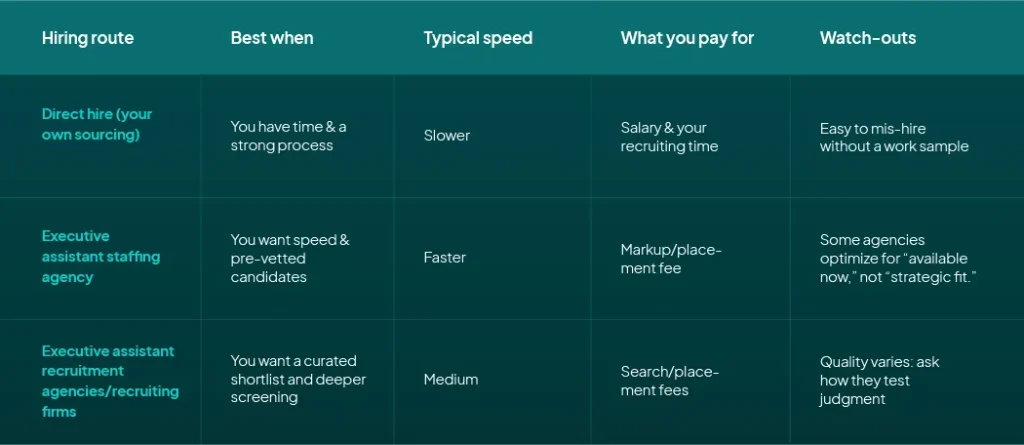
Rule of thumb:
- If you’ve never hired an EA before, an executive assistant recruitment agency reduces risk.
- If you already know exactly what you need and can run a strong work sample process, direct hire can be great.
Step 4: Run a hiring process that reveals reality
If you only do interviews, you’ll get the best interviewer, but you will not hire the best EA.
A strategic EA role needs a work sample. Non-negotiable.

A simple 3-stage hiring flow
Stage 1: Screen (20 minutes)
Goal: communication clarity + baseline professionalism.
Ask:
- “Walk me through how you run your week supporting an exec.”
- “What’s your approach when priorities change mid-day?”
Stage 2: Work sample (60–90 minutes, paid if possible)
Give a realistic mini-scenario:
- a messy calendar request chain
- 20 emails to triage
- a meeting that needs prep + agenda + follow-ups
- a stakeholder who keeps rescheduling
What you’re looking for:
- structure
- assumptions stated clearly
- good judgment on what to escalate
- clean writing
Stage 3: Deep interview (45 minutes)
Use scenario questions that force decision-making.
High-signal questions (the ones that change outcomes)
- “A client asks for a meeting that conflicts with a board call. What do you do?”
- “You see a calendar that has no deep work blocks. What do you propose?”
- “You get an email with sensitive pricing. Who do you share it with?”
- “What do you do when you don’t have enough context?”
If they can’t answer these clearly, they won’t be strategic in the role.
Step 5: Don’t “hope” onboarding works, design it!
Even if you hire the right person, the first month decides everything.

A strategic EA doesn’t magically know:
- your preferences
- Your “no” rules
- which stakeholders matter
- How do you want decisions surfaced?
So set the system early:
Week 1: one lane owned fully (calendar, OR inbox, OR follow-ups)
Week 2: add templates (follow-up scripts, recap format, scheduling notes)
Week 3–4: expand scope (second lane) & escalation rubric
Day 30: review what’s owned, what’s still dependent
If you don’t do this, the role becomes a daily stream of “quick questions,” and you’ll feel like hiring made things worse.
Local or Remote EA?
Go local if:
- You need in-person coverage (events, office coordination)
- Your day is high-touch and changes every hour
Go remote if:
- You want consistent execution with clear workflows
- You care more about output than proximity
Remote work best with clear systems.
How Anywhere Talent helps you:
- Anywhere Talent helps founders hire executive assistants without building the hiring machine from scratch.
- We run the sourcing, screening, and work-sample process, and we prioritize candidates who can own a lane, not just “help.”
- We’ll show you the shortlists and work-sample outputs so you can choose with confidence.
FAQs
Define outcomes (lane ownership), test judgment with a work sample, and screen for discretion and proactive structure, not just experience.
Use a staffing agency when speed matters, and you can validate quality with a work sample. Hire directly if you have time and a strong process.
Executive assistant recruiting firms and executive assistant recruitment agencies source, screen, and shortlist candidates, often with deeper vetting than general staffing.
Ask scenario questions that force prioritization, discretion, and stakeholder management, then verify with a real work sample.
With direct sourcing it can take weeks. If you need to hire executive assistant fast, use a work sample to keep quality high. With an executive assistant recruitment agency or a remote executive assistant service, it’s often faster because shortlisting is done for you, and you still validate with a work sample.
Hiring for tasks instead of judgment. The role fails when the EA needs you to confirm everything.