
Most founders who hire a remote assistant for the first time face the same problem within the first month: they have no idea how to measure whether the hire is actually working. The assistant seems busy. Tasks appear to be moving. But there is no structured way to evaluate output, quality, impact, and KPI metrics that drive results in 2026.
This is not a people problem. It is a measurement problem. And it is exactly what KPI metrics are designed to solve.
What is a KPI?
KPI stands for Key Performance Indicator, a quantifiable metric used to evaluate how effectively an individual, team, or organization is achieving specific objectives. In the context of remote assistants, KPI metrics serve a dual purpose. They give the founder visibility into what is being accomplished and the assistant a clear framework for what success looks like.
The problem is that most companies track the wrong things. Hours logged, emails sent, and tasks completed are easy to measure but tell you almost nothing about whether the work is moving the business forward. A 2025 report by Worklytics found that remote work productivity varies significantly by industry, but across sectors, outcome-based KPI metrics consistently outperform activity-based tracking in predicting actual business impact (Worklytics, 2025).
This article outlines the KPI metrics that matter for remote assistants, how to set them up without overcomplicating your workflow, and how to use them to build a feedback loop that improves performance over time.
Why Activity Metrics Fail for Remote Teams?
Before defining what to measure, it is worth understanding why the most common metrics fall short.
Activity metrics track volume: number of emails responded to, hours logged into a platform, and tasks marked complete. These metrics are popular because they are easy to capture, especially with time-tracking and project management tools. But they create a distorted picture.
An assistant who responds to 80 emails in a day sounds productive. But if 60 of those responses were unnecessary, if they did not resolve anything or move a conversation forward, the activity created an illusion of productivity while adding no real value. Worse, research from Stanford economist Nicholas Bloom’s team found that 63% of workers report that invasive tracking of activity metrics would drive them to look for a new job (Worklytics, 2025). So not only do activity metrics fail to capture real performance, they actively damage retention.
The shift that high-performing companies are making is from measuring effort to measuring outcomes. This requires more thoughtful KPI design, but the payoff is substantial: clearer expectations, less micromanagement, and better results.
What are KPI Metrics for Remote Assistants?
The best KPI metrics for remote assistants share four characteristics. They are specific to the role. They are tied to a business outcome. They are measurable without surveillance tools. And they are reviewed on a regular cadence, typically weekly or biweekly.
Here is a framework that works across the most common remote assistant roles, from executive assistants and virtual assistants to marketing coordinators and operations support.
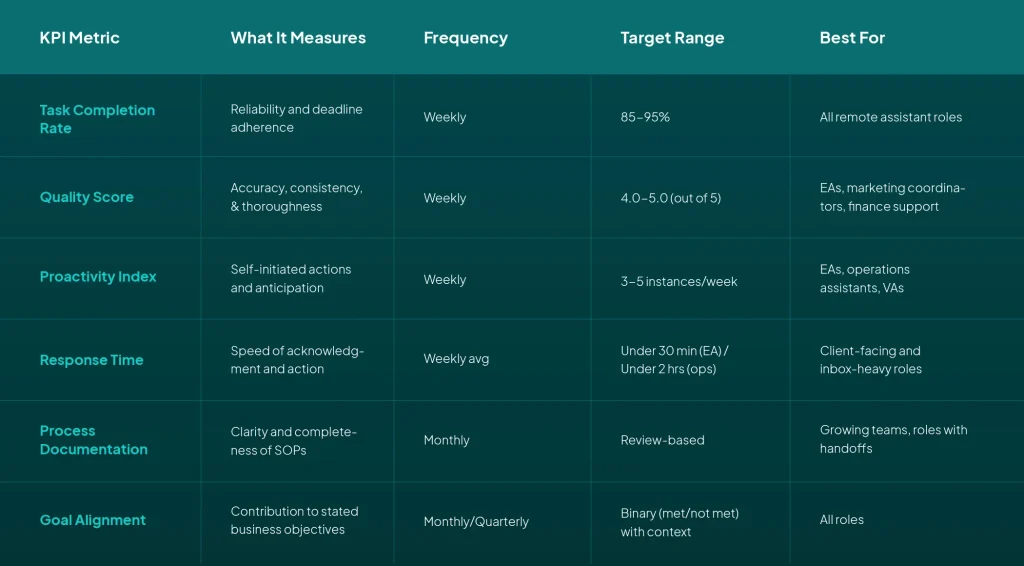
1. Task Completion Rate
This is the foundation. What percentage of assigned tasks are completed by the agreed deadline? It is simple, but it works because it captures reliability.
Track this weekly. The target should not be 100% from day one. A completion rate of 85-90% in the first month is healthy. If it is below 75%, the issue is usually unclear expectations or an unrealistic workload, not a performance gap.
Why These KPI Metrics Matter More Than Hours Logged?
There is a reason task completion rate is listed first among these kpi metrics. It directly answers the question every founder asks in the first month of working with a remote assistant: Is the work getting done?
But the broader point is worth stating clearly. The KPI metrics that matter for remote assistants are those tied to business movement, not activity volume. This is where most performance tracking systems fail. They collect data that feels productive to review, but does not actually tell you whether your assistant is contributing to growth, efficiency, or operational stability.
Consider the difference. A time-tracking dashboard might show that your assistant logged 42 hours last week. That number tells you nothing about impact. KPI metrics such as task completion rate, quality score, and proactivity index indicate whether those 42 hours moved the business forward.
The Teamcamp analysis of remote work measurement in 2025 emphasized that people will optimize for whatever you measure, and if you track hours, you get more hours, not necessarily better work (Teamcamp, 2025). The KPI metrics you choose signal to your assistant what you value. Outcome-based kpi metrics signal that you value results. Activity-based metrics signal that you value presence.
For founders using platforms like Anywhere Talent to hire remote assistants, the kpi metrics framework is part of the onboarding structure. Clear expectations, measurable outcomes, and regular check-ins are built into the first 30 days. This means neither the founder nor the assistant is guessing about what success looks like. The kpi metrics are defined, agreed upon, and tracked from the start, creating alignment that makes performance visible without making it adversarial.
The practical lesson here is simple. Choose kpi metrics that answer the question “did this work create value?” rather than “was this person busy?” The former drives improvement. The latter drives resentment.
2. Quality Score
Completion without quality is meaningless. Establish a quality rubric for the types of work your assistant handles. For an executive assistant, this might include accuracy of calendar management, formatting consistency in documents, and completeness of meeting follow-ups. For a marketing coordinator, it might include adherence to brand guidelines, error-free copy, and on-time campaign delivery.
Rate a sample of completed work each week on a 1-5 scale. Over time, this creates a trend line that shows whether quality is improving, stable, or declining.
3. Proactivity Index
This is the metric most founders overlook, and it is often the most revealing. A proactive assistant does not wait for instructions. They flag potential problems, suggest improvements, and anticipate needs before being asked.
Track proactivity by counting the number of self-initiated actions per week. These might include flagging a scheduling conflict before it becomes a problem, suggesting a process improvement, or drafting a document without being asked. This KPI distinguishes someone who owns outcomes from someone who simply completes tasks.
Research published by VAV Remote Workers found that proactivity is one of the strongest predictors of long-term success in virtual assistant roles because it reflects both engagement and operational understanding (VAV Remote Workers, 2025).
4. Response Time
For roles that involve stakeholder communication, client coordination, or inbox management, response time is a meaningful KPI metric. This measures how quickly the assistant acknowledges and acts on incoming requests during their working hours.
The target depends on the role. For an EA managing a founder’s inbox, a first-response time of under 30 minutes during working hours is a reasonable benchmark. For an operations assistant handling internal requests, a response within two hours may be appropriate.
The key is to measure average response time, not individual instances. Everyone has slow days. The trend matters more than any single data point.
5. Process Documentation and Handoff Quality
This KPI is critical for growing businesses. Can the assistant document their workflows well enough that someone else could pick up where they left off? Are handoffs between team members clean and complete, or do they create confusion?
Measure this by periodically reviewing the assistant’s documentation, such as SOPs, process notes, and project handoff summaries, and assessing clarity and completeness. This metric becomes especially important as you scale and add more team members.
6. Goal Alignment
Every KPI metric should ultimately tie back to a business objective. At the start of each month or quarter, define two to three specific goals that the assistant’s work should support. These might include reducing the founder’s time spent on email by 50%, ensuring all client follow-ups happen within 24 hours, or publishing content on a consistent weekly schedule.
At the end of the period, evaluate whether those goals were met. This keeps the assistant’s efforts anchored to outcomes that matter, rather than scattered across disconnected tasks.
The KPI Metrics Comparison
How to Implement KPI Metrics?
The biggest risk with performance metrics is that they become a surveillance tool rather than a growth framework. If your assistant feels monitored rather than supported, the metrics will backfire.

A 2025 Teamflect analysis on remote performance measurement emphasized that the best KPI metrics focus on outcomes and deliverables rather than hours worked or physical presence, noting that 42% of managers struggle with this transition (Teamflect, 2026). The fix is straightforward: involve the assistant in defining the metrics.
When you co-create KPIs with your assistant, they understand what success looks like from day one. They are not guessing at your expectations or performing for a dashboard. They are working toward clearly defined outcomes that you both agreed on.
Here is a simple implementation sequence:
Week 1: Define three to five KPI metrics based on the role and your current priorities. Share them openly and discuss them together.
Weeks 2-4: Track the metrics collaboratively. Use a shared document or a project management tool where both parties can see and update the data.
End of Month 1: Review the data together. Identify what is working, what needs adjustment, and whether any metrics should be added or removed.
Ongoing: Review KPIs biweekly. Adjust targets as the assistant ramps up and the role evolves.
This approach mirrors what companies like Anywhere Talent build into their onboarding process. Their PrecisionPath framework establishes clear workflows, expectations, and check-in cadences during the first 30 to 90 days of a placement, ensuring both the founder and the assistant have shared visibility into what good performance looks like from the start.
Common Mistakes You Should Avoid
Tracking too many metrics at once. Five KPIs are enough. More than that, neither you nor the assistant can maintain focus. Start lean and add complexity only when the basics are solid.
Using metrics punitively. KPI metrics should inform coaching conversations, not performance warnings. If the data shows a drop in quality or completion rate, the first question should be “what support do you need?” not “why are you underperforming?”
Ignoring qualitative feedback. Numbers tell part of the story. Regular one-on-one conversations where the assistant can share context, challenges, and suggestions are just as important as the data.
Setting targets before understanding the baseline. Do not define targets for the first two weeks. Instead, use that period to establish a baseline. Then set realistic, incremental improvement goals.
Making KPI Metrics Part of a Growth System
The companies that get the most value from their remote assistants are not the ones with the most sophisticated tracking tools. They are the ones who treat performance metrics as a growth system rather than a control mechanism.
Gallup research found that employees who feel connected to their organizations and receive regular, meaningful feedback demonstrate higher engagement and lower turnover (Gallup). For remote assistants, where the risk of isolation is higher than in an office setting, structured feedback tied to clear KPI metrics provides both accountability and connection.
Platforms like Anywhere Talent address this through dedicated Talent Coaches who work alongside each placement, providing training, mentorship, and ongoing upskilling so performance improves over time rather than plateauing. This kind of structured support turns KPI metrics from a static reporting exercise into an active development tool.
SimpleKPI’s research on remote work measurement reinforces that the most successful remote organizations track collaboration and well-being indicators alongside productivity metrics, creating a more holistic picture of performance (SimpleKPI, 2025). When you pair outcome-focused KPIs with genuine support, you do not just measure performance. You build a system that sustains it.
Building a KPI Metrics System in 2026
One of the most common concerns founders raise about kpi metrics is that they seem rigid. What works in month one may not apply in month six as the assistant’s role evolves, the business grows, and priorities shift. This is a valid concern, and the solution is to treat your kpi metrics as a living system, not a fixed scorecard.
Start with foundational kPI metrics that apply to almost any remote support role: task completion, quality, and response time. These are your baselines. They establish the minimum standard of performance and give both parties a shared language for discussing results.
As the assistant ramps up and takes on more responsibility, add role-specific kpi metrics. For an executive assistant managing stakeholder communication, add a metric for follow-up closure rate. For a marketing coordinator, add campaign delivery timeliness. For an operations assistant, add process documentation completeness. Each new kpi metric should reflect the expanding scope of the role.
The cadence matters too. Review your kpi metrics quarterly to assess relevance. Ask two questions: are we still tracking the right things, and are the targets still appropriate? If your assistant consistently exceeds a target for three consecutive months, it is time to raise the bar or replace that kpi metric with one that measures a higher-order outcome.
Anywhere Talent applies this principle through their ongoing Talent Coaching model. As the assistant’s capabilities grow, the coaching and the kpi metrics evolve together. This prevents the stagnation that happens when performance tracking stays static while the role becomes more complex.
The companies that get the most value from kpi metrics are the ones that treat measurement as an ongoing conversation rather than a quarterly report. When kpi metrics evolve alongside the business, they stop being a management overhead and become a growth tool that benefits everyone involved.
A final note on tools. You do not need expensive performance management software to track kpi metrics effectively. A shared spreadsheet updated weekly, a project management board with clear status labels, or even a simple shared document where both parties log results can work perfectly well. The discipline of tracking matters far more than the sophistication of the tool.
The Bottom Line
KPI metrics for remote assistants are not about control. They are about clarity. When both the founder and the assistant understand what good performance looks like, the relationship becomes more productive, more trusting, and more resilient.
Start with a small set of outcome-based metrics. Review them regularly. Adjust as the role evolves. And remember that the best metric of all is one that both parties agreed was worth tracking.
If you are looking to hire a remote assistant and want KPI metrics built into the onboarding from day one, Anywhere Talent structures every placement with clear expectations, measurable outcomes, and coaching support that keeps performance on track. It is a system designed for founders who want execution they can rely on, not another person to manage.
Ready to hire a remote assistant with a performance framework already in place? Anywhere Talent builds KPI tracking, structured onboarding, and ongoing coaching into every hire. Book a discovery call to learn more.