

As we head towards 2027, a remote work policy is more than just a written guide that explains how people work, communicate, stay secure, manage time, and stay accountable when they are not in the same office. A good remote work policy does not just say who can work from home. It explains how remote work should happen every day.
In the growing distributed teams I have worked with, the issue was rarely talent.
The issue was that every person had a different version of “remote.”
One manager expected instant replies. Another cared only about output. One team member worked late to match another time zone. Someone else did not know whether they were allowed to block focus time.
That is why the policy matters. It turns hidden expectations into shared rules.
Remote work policy: what should it solve?
A remote work policy should solve confusion before it becomes burnout, missed work, or manager frustration.

In a growing remote team, the same problems repeat:
- People are online, but no one knows what is urgent
- Meetings expand because decisions are not documented
- Global talent works late because time-zone overlap is unclear
- New hires do not know how to ask for help
- Managers track activity instead of outcomes
- Security rules depend on memory
The policy gives the team a simple operating system.
It should answer:
- Who can work remotely?
- What hours matter?
- How do we communicate?
- Which tools are used for what?
- How is performance measured?
- What boundaries protect focus and wellbeing?
This is why the best remote work policy examples are not only HR documents. They are practical working guides.
Why policy is not paperwork
The first mistake many companies make is writing a work-from-home policy only after something goes wrong.
A missed client reply. A security concern. A time-zone conflict. A burned-out employee. A manager saying, “I thought this was obvious.”
In remote teams, “obvious” is risky.
Microsoft’s 2025 Work Trend Index found that employees using Microsoft 365 are interrupted every two minutes during core work hours by meetings, emails, or chats. It also found that nearly a third of meetings now span multiple time zones. That kind of digital noise makes clear remote rules more important, not less. Adapting to these shifts in 2026 and beyond means your policy must proactively manage this digital overload.
The goal is not to create more rules.
The goal is to reduce guessing.
What should the remote work policy include?
A remote work policy should be short enough to use and clear enough to enforce.
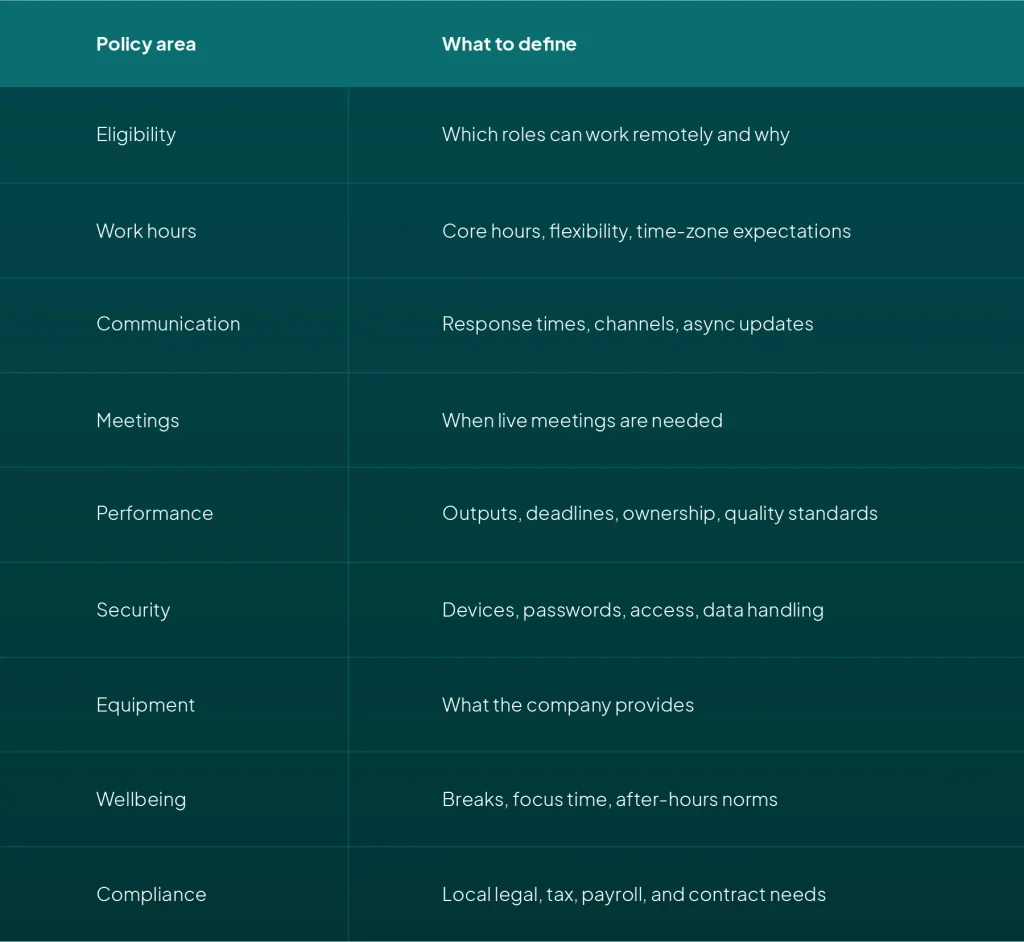
This remote work policy checklist helps founders avoid vague language.
“Be available” is not enough.
“Reply to urgent client issues within two business hours during your agreed working window” is much better.
How should working hours work?
Working hours are one of the most important parts of the policy.
For distributed teams, I do not recommend pretending everyone works the same day. They usually do not.
Define three things instead:
- Core collaboration hours
- Flexible work blocks
- Offline expectations
Example:
“Team members are expected to be available from 10 AM to 2 PM EST for collaboration. Outside that window, work can be completed flexibly as long as deadlines, meetings, and handoffs are maintained.”
That is clearer than saying “flexible schedule.”
A strong remote work policy protects flexibility without creating confusion.
How should communication work?
Communication rules are where remote team guidelines best practices become real.
The policy should explain what belongs where.
| Channel | Use it for |
| Slack or Teams | Quick questions and daily updates |
| Project tool | Task status, owners, deadlines |
| External communication and formal updates | |
| Shared docs | Briefs, SOPs, notes, and decisions |
| Video calls | Complex alignment, feedback, sensitive topics |
No one should have to search five places to understand what happened.
The policy should also define response times. Not every message needs an instant reply. If everything is urgent, nothing is urgent.
How do you protect deep work?
Remote teams fail when they confuse responsiveness with productivity.
The policy should say when people are expected to be reachable and when they can protect focus time.
Gallup has reported that fully remote workers can be more engaged than other groups, but they are also more likely to report high stress and lower overall thriving than hybrid workers. That tells us flexibility alone is not enough. Remote teams need boundaries around how work happens.
Useful rules include:
- No-meeting blocks for deep work
- Clear labels for urgent messages
- End-of-day handoffs for time-zone teams
- No expectation of after-hours replies unless agreed
- Meeting notes for anyone who cannot attend
This is how a remote work policy helps people stay productive without feeling always on.
How should security be handled?
Security cannot be casual in a distributed team.
NIST’s telework and BYOD guidance says organizations should secure telework and remote access technologies and create related security policies. NIST also notes that telework, remote access, and BYOD tools need security considerations because work is being performed from external locations.
The policy should include:
- Approved devices
- Password manager use
- Multi-factor authentication
- VPN or secure access rules
- Data download limits
- Public Wi-Fi rules
- Lost device reporting
- Access removal when a role ends
This does not need to be scary.
It needs to be specific.
If a remote hire handles customer information, finance records, passwords, or internal documents, the policy should explain exactly what is allowed.
How should wellbeing be included?
A sustainable remote work policy should protect people from silent overload.
WHO and ILO describe telework as having a significant impact on health, safety, and wellbeing, and their technical brief focuses on organizing telework in ways that protect physical and mental health.
In practice, that means the policy should mention:
- Break expectations
- Camera norms
- Meeting load
- Workload escalation
- Vacation handoffs
- After-hours boundaries
- Ergonomic setup where relevant
This is not soft.
It is operational.
A tired remote team makes more mistakes, communicates less clearly, and burns out faster.
What should managers own?
A remote work policy will fail if managers do not model it.

The policy should clearly state that managers are responsible for:
- Setting priorities weekly
- Documenting decisions
- Reviewing workload regularly
- Respecting offline time
- Keeping meetings purposeful
- Giving feedback clearly
- Watching for isolation or overload
- Making performance expectations measurable
This is where many work-from-home policy documents fall short.
They tell employees what to do, but they do not tell managers how to lead.
Remote management needs structure.
What should employees own?
The employee side should be just as clear.
The policy should explain that team members are responsible for:
- Updating task status
- Asking for help early
- Protecting company data
- Joining required meetings
- Communicating blockers
- Meeting agreed deadlines
- Keeping tools updated
- Respecting team response norms
This keeps the policy fair.
Remote work is not micromanagement, but it is not guesswork either.
Practical checklist before publishing
Use this remote work policy checklist before sharing the policy with your team.
| Question | Yes or no |
| Does it define eligible roles? | |
| Are core hours and flexibility explained? | |
| Are response times clear? | |
| Are meeting rules included? | |
| Are security rules specific? | |
| Are performance expectations measurable? | |
| Are wellbeing and boundaries included? | |
| Are manager responsibilities included? | |
| Are employee responsibilities included? | |
| Is there a review date? |
The review date matters.
A remote work policy should not be frozen forever. Your team, tools, roles, and customer needs will change.
How I would roll it out
If I were helping a founder roll this out, I would not drop a long PDF in Slack and hope people read it.
I would do three things.
First, explain the reason.
“We are creating this because our team is growing across time zones, and we need clearer expectations around communication, focus time, security, and handoffs.”
Second, discuss the practical rules with managers before launch.
Third, review the policy after 30 days.
The best remote work policy examples are not perfect on day one. They improve after the team actually uses them.
Where Anywhere Talent fits
At Anywhere Talent, we see the same pattern often.
Companies hire excellent global talent, but the team still struggles because the working system is unclear. The person is capable, but onboarding, communication, handoffs, and role ownership are not documented well enough.
A remote work policy helps fix that.
It gives global professionals a clearer way to integrate into the business. It also helps founders manage remote teams by outcomes instead of constant supervision.
The right hire matters. The right working structure matters too.
Final takeaway
A remote work policy should not feel like corporate paperwork.
It should feel like a practical guide for how the team works when people are spread across locations, time zones, and roles.
The problem is that many distributed teams hire globally and then leave expectations unwritten. That creates confusion around hours, meetings, response times, tools, security, and workload. Over time, confusion turns into delays, stress, and uneven performance.
A strong policy solves that by making the rules clear.
It protects flexibility, improves accountability, supports security, and gives global talent a better way to succeed inside the team.
If your company is building a distributed team and you want the people plus the structure to work better together, Anywhere Talent can help you find vetted global professionals and support clearer role alignment from the start.
Book a free consultation with Anywhere Talent to build a remote team that is easier to manage, easier to trust, and ready to grow sustainably.