

You hired a remote assistant because you wanted your week back. Then the delegation started… and suddenly your calendar filled up with clarifications, approvals, and “quick questions.” That’s not bad luck. That’s a broken handoff.

A Gallup study of 143 Inc. 500 CEOs found that those with strong delegation skills generated 33% more revenue than those without, posting average three-year growth rates 112 percentage points higher than their peers (Gallup).
Here’s the uncomfortable truth: most founders don’t struggle because they don’t know what to delegate. They struggle because they don’t know how to delegate in a remote environment where you can’t lean over and explain something in 10 seconds.
This guide is written from the operator side of the table. It breaks down the delegation mistakes that quietly break remote teams, and it gives you the fixes that make work move without you becoming the bottleneck again. You’ll also get a task-transfer checklist, authority rules you can copy, and a simple cadence that makes delegation sustainable.
How to delegate without rework?
Rework is rarely a “quality” problem. It’s usually a briefing problem.
When remote delegation fails, it fails in predictable ways:
- The outcome was fuzzy,
- The context was missing,
- The deadline was implied,
- The authority was unclear.
If you want to learn how to delegate without rework, use this standard: write every handoff as if the other person cannot ask you questions for 24 hours. That sounds strict, but it forces you to provide what matters up front.
Use this 3-line brief for every task:
- Outcome: “Done means…”
- Context: “This matters because…”
- Constraints: “Do not / must / escalate if…”
That simple format is the fastest way to upgrade delegation in remote teams.
How to delegate context?
Mistake #1: delegating tasks without delegating context.
Harvard Business School professor Kevin Sharer, in his work on management essentials, has emphasized that effective delegation requires alignment on what good looks like, by when, and how accomplishment will be measured (Harvard Business School Online, 2020).
Example: “Schedule a meeting with the investor.”
What your assistant still doesn’t know:
- Is this priority 1 this week or “sometime next month”?
- What meeting windows are acceptable?
- Is the relationship sensitive?
- Is this a pitch, an update, or a negotiation?
- Should they request an agenda?
In a remote setting, missing context creates a delay. One vague message can turn into a full day of back-and-forth. When you learn how to delegate context, speed goes up, and questions go down.
Fix: add one “priority sentence.”
- “This is the most important meeting this week.”
- “This is flexible; protect deep work blocks.”
- “Please keep the tone warm but firm.”
That one sentence prevents more rework than a long SOP.
How to delegate the right work?
Mistake #2: What to delegate based on what you dislike.
John Doherty, founder of EditorNinja, put it directly: the most common mistake people make when they start delegating is handing off things they love and keeping things they dislike. The better approach is to delegate the tasks that others can do better or that do not require your specific expertise (Todoist, 2026).
This is common. The tasks founders hate are often the tasks they never documented. That makes them the worst first tasks to hand off.
If you want to master how to delegate, start with work that is:
- recurring (weekly/daily),
- rules-based (can be documented),
- low blast radius (recoverable if imperfect),
- interruption-heavy (steals your attention).
Great first remote assistant tasks:
- calendar confirmations and reschedules,
- inbox triage into labels,
- meeting prep packs,
- follow-up nudges,
- research summaries with clear sources.
Once those are stable, you can expand into higher-context work.
How to delegate as a system?
Mistake #3: dumping tasks instead of building a protocol.
Remote teams are particularly vulnerable to this mistake because the physical distance makes it easy to assume that a sent message equals a completed handoff. But Toptal’s research on remote delegation found that managers of successful distributed teams tend to over-communicate rather than under-communicate, providing longer, clearer explanations to avoid confusion and build shared understanding (Toptal, 2024).
Dumping sounds like: “Can you handle this?”
Delegating sounds like: “Own this lane; here’s done; here’s when I’ll review; here’s what you can decide.”
If you want to know how to delegate to become reliable, you need a lightweight system. Here’s a simple protocol that works for founders:
- A standard task brief format (same fields every time).
- A predictable update cadence (daily async + weekly review).
- Clear decision authority (what they can decide vs what you approve).
- A weekly feedback loop (calibration, not criticism).
You don’t need a fancy process. You need consistency.
How to delegate authority?
Mistake #4: making yourself the approval bottleneck.
Founders “delegate” work but keep every decision. Then they wonder why delegation didn’t save time.
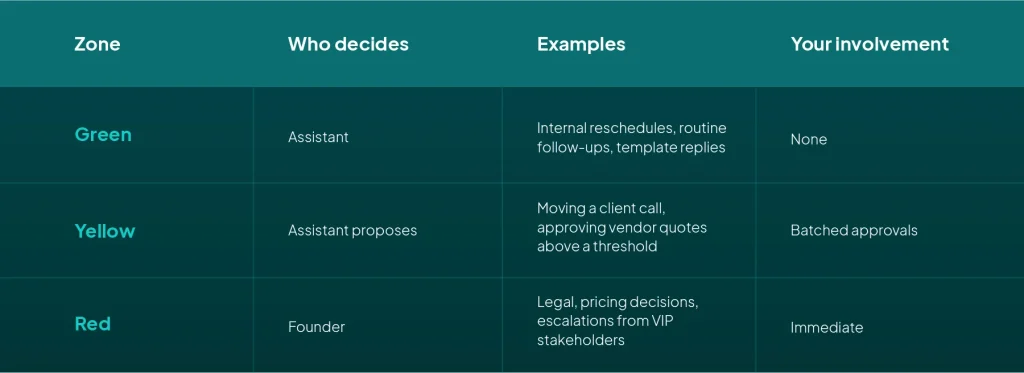
To learn how to delegate authority, define three zones for every lane:
- Green zone: assistant decides and executes.
- Yellow zone: assistant proposes, you approve in batches.
- Red zone: assistant escalates immediately.
Here’s what that looks like in real life:
Green: reschedule internal meetings within approved windows.
Yellow: move external calls that affect a key relationship.
Red: anything legal, revenue-critical, or reputation-sensitive.
This is the single biggest unlock for how to delegate without constant interruptions.
Authority Zones Table
How to delegate without micromanaging?
Mistake #5: micromanaging because you can’t “see” work.
Remote removes visual cues, so founders compensate with constant check-ins. It’s understandable, and it breaks trust. It also breaks focus. If your assistant is interrupted five times a day with “any update?”, output drops, and the founder concludes the assistant isn’t performing.
If you want to learn how to delegate without micromanaging, replace ad hoc check-ins with a visibility rhythm:
- Daily async update (end of day): 3 bullets: done / next / blocked.
- Weekly calibration (15 minutes): what worked, what broke, what we changed.
- Single dashboard: tasks and status live in one place.
That gives you control without surveillance.
When hiring through a structured staffing partner like Anywhere Talent, this matching happens before the hire starts. Their multi-stage vetting process evaluates candidates for specific skills, communication style, and working rhythm, so the person you hire is already aligned with the type of work you need delegated.
How to delegate across time zones?
Mistake #6: synchronous delegation in an async environment.
If you delegate at 5 pm your time and expect clarifying questions, you’ve built a 12-hour delay into execution. By the time they ask, you’re offline, and work stalls.
To master how to delegate across time zones, every handoff must be self-contained:
- Objective,
- Context,
- Resources,
- Deadline in both time zones,
- Authority zone.
A simple founder habit: write every brief as if you’re going offline for the next 24 hours. That habit makes delegation resilient.
How to delegate using tools?
Mistake #7: using task tools as storage instead of as a system.
Task management tools don’t fix unclear delegation. But they can enforce clarity if you use them correctly.
If you want to know how to delegate, every task card should contain:
- outcome (one sentence),
- owner (one person),
- deadline (specific),
- SOP link or example,
- authority zone (green/yellow/red).
Keep the tool stack simple: one board, one SOP home, one place for questions. Too many tools create confusion.
How to delegate and train?
Mistake #8: skipping the feedback loop.
Delegation without feedback is like navigation without a compass. The assistant can’t improve, so you keep correcting work forever.
If you want to know how to delegate to the compound, run a weekly calibration:
- What went well?
- What caused rework?
- What rule should we add?
- What should we stop doing?
One week of feedback can save months of frustration.
A founder-friendly feedback script:
- “This was solid because ____.”
- “Next time, add ____ so I don’t need to revise.”
- “Going forward, you can decide ____ without checking.”
That’s how to be clear without being harsh.
The Compound Effect
Good delegation compounds. Every clean handoff trains the system. Every clarified rule reduces future questions. Over a few weeks, your assistant becomes proactive because they understand your standards and boundaries.

This is the real payoff of learning how to delegate: your business stops being limited by your availability. You stop being the router for everything.
If setting this up feels like another project, a structured staffing partner can shorten the ramp. Anywhere Talent helps founders define what to delegate first, set authority boundaries, and install a working rhythm so delegation doesn’t collapse into micromanagement.
For founders hiring remote support for the first time, this matters: you don’t just need a person. You need a way to delegate built into the onboarding so the role can be leveraged quickly.
A Real Brief Example
Here’s what a self-contained handoff looks like. Copy the structure.
Task: Investor intro scheduling
Outcome: Investor call booked this week with a 10-minute buffer before and after.
Context: This is prep for next month’s raise; keep the tone professional and direct.
Constraints: Do not offer Friday. Do not move the board call.
Inputs: Calendar link, investor email thread, and current deck folder.
Authority: You can choose any slot Tue–Thu, 11 am–3 pm ET. Escalate only if they push for Friday.
This kind of brief prevents most quick questions and saves time each week.
The Task Transfer Checklist
This is the checklist that makes delegation repeatable. Copy it into your SOP tool.
- Outcome (“done means…”)
- Priority (P1/P2/P3)
- Deadline (include time zone)
- Inputs (links, files, access)
- SOP (steps or example)
- Constraints (do not / must)
- Authority zone (green/yellow/red)
- Update cadence (daily/weekly)
- QA (what you’ll check)
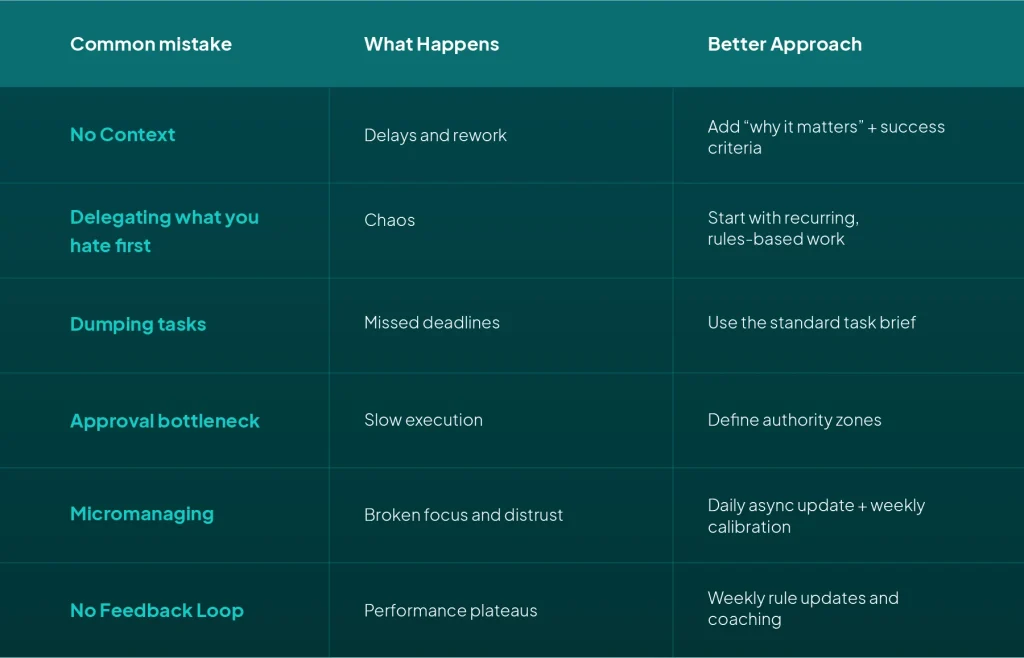
Mistakes vs better approaches
Looking to delegate with confidence? Anywhere Talent matches founders with vetted remote professionals and builds the delegation system around the hire, including workflows, check-in cadences, and coaching support. Start with a strategy call.
FAQs
It means transferring ownership of an outcome, not just assigning a to-do.
Define success criteria, set authority zones, and review in batches instead of reacting all day.
Use self-contained briefs, include deadlines and inputs, and set a predictable update cadence.
Most failures come from missing context, unclear authority, and no feedback loop.
Start with recurring, rules-based tasks that interrupt your day.