

Running an ecommerce store looks simple from the outside. A customer lands on the site, chooses a product, pays, and gets the order.
But anyone who has actually run an online store knows the backend is where the pressure builds. Product pages need updates. Inventory keeps changing. Customer questions come in at awkward hours. Returns need tracking. Discount codes break. Reviews need responses. Campaign assets need uploading. Orders need checking. And somehow, while all of that is happening, the founder is still supposed to plan growth, test offers, improve margins, and bring in more sales.
That is where the right ecommerce support starts to make sense.
The right hire is not just “extra admin help.” An ecommerce virtual assistant supports the daily store operations that keep revenue from leaking through small mistakes, slow responses, inconsistent product pages, and messy processes. For lean ecommerce brands, this role can become the difference between a store that is always catching up and a store that has enough support to grow.
This guide breaks down what an ecommerce virtual assistant handles, what the role can cost in 2026, and when it is the right time to hire one.
Why Ecommerce Needs Support?
Ecommerce has grown into a serious retail channel, but growth also means more operational pressure. The U.S. Census Bureau estimated total U.S. retail ecommerce sales at $1.233 trillion in 2025, up 5.4% from 2024, with ecommerce accounting for 16.4% of total retail sales.
That growth creates opportunity, but it also raises the bar. Customers expect accurate product information, fast replies, smooth checkout, clear delivery updates, and easy returns. A store can have strong products and still lose sales because the backend is disorganized.
An ecommerce virtual assistant helps keep that backend moving. They support the work that affects customer experience, marketing consistency, and store accuracy without forcing the founder or core team to manage every small update personally.
For Anywhere Talent, this is exactly where domain fit matters. A general assistant can help with admin, but an ecommerce virtual assistant understands store workflows, order rhythm, customer expectations, and the small details that affect sales.
What Is an Ecommerce VA?
An ecommerce virtual assistant is a remote assistant who supports online store operations. You may also see the role written as ecommerce VA, e commerce VA, e-commerce virtual assistant, virtual ecommerce assistant, ecommerce assistant, VA ecommerce, or virtual assistant ecommerce support.
The role can cover product uploads, order support, customer service, inventory updates, returns coordination, basic reporting, marketing admin, marketplace support, and store maintenance.
A general virtual assistant may know how to organize a spreadsheet or answer emails. An ecommerce virtual assistant understands why a wrong SKU, outdated product image, delayed reply, or missing tracking update can hurt the customer experience.
That is the difference. This role is not only about completing tasks. It is about supporting the flow of an online store.
What Can They Handle?
This hire can take over repeatable store tasks that are important but not always strategic enough for the founder, marketing lead, or operations manager to handle every day.
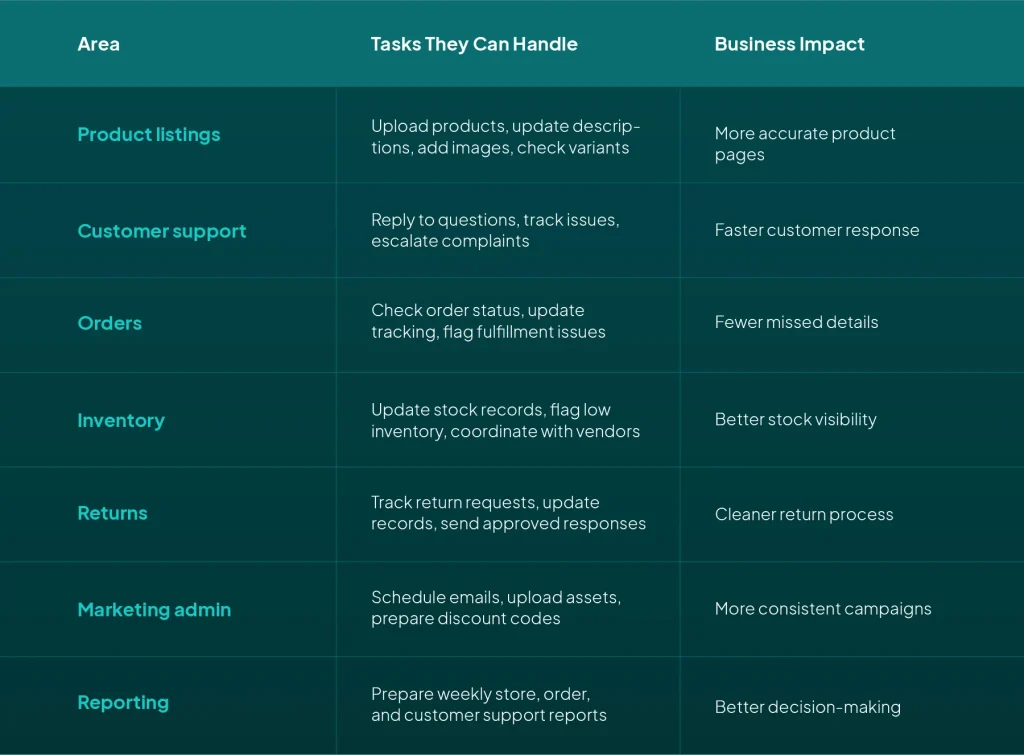
A strong ecommerce virtual assistant does not replace strategy. They protect execution. They keep the store moving while the business owner focuses on growth.
Product Listing Support
Product pages do a lot of selling before a customer ever talks to a human.
That means listing quality matters. An ecommerce virtual assistant can upload new products, update titles, write or format descriptions, check product images, organize variants, add tags, update pricing, and make sure product details match the brand’s standards.
This is especially useful for stores with seasonal drops, large catalogs, frequent inventory changes, or marketplace listings across Shopify, Amazon, Etsy, Walmart, eBay, or other channels.
Small listing mistakes can create big customer frustration. A wrong size chart, missing material detail, outdated image, or incorrect variant can lead to abandoned carts, returns, or support tickets. An ecommerce virtual assistant helps reduce those small errors before they become customer problems.
This is also where ecommerce virtual assistant services become more valuable than basic admin. The assistant is not just copying and pasting. They are helping maintain the storefront.
Customer Support Tasks
Customer support is one of the first areas many stores should delegate.
An ecommerce virtual assistant can answer common questions, send order updates, respond to shipping inquiries, check return status, escalate complaints, and organize support tickets by priority.
This matters because online shoppers do not always wait. If they ask about size, shipping, availability, or returns and do not get a reply quickly, they may leave and buy somewhere else.
Customer support is also closely tied to reputation. Reviews, refunds, repeat purchases, and customer trust are all affected by how quickly and clearly a store communicates.
A virtual assistant for ecommerce store support can use approved templates for routine replies while escalating sensitive issues to the business owner or manager. That keeps support moving without giving away control over important decisions.
Order and Fulfillment Support
Order management can become messy fast.
An ecommerce virtual assistant can monitor order status, check tracking updates, flag failed payments, coordinate with fulfillment partners, update customers, and keep internal order records clean.
They can also help catch patterns. If the same product keeps causing fulfillment delays, if a vendor is slow to update tracking, or if customers keep asking the same post-purchase question, the assistant can flag it.
This is one of the quiet benefits of hiring a virtual assistant for ecommerce. They are close enough to daily operations to see problems early.
The founder may only notice the issue when a customer complains. A trained ecommerce virtual assistant may notice it when the pattern starts.
Inventory and Vendor Admin
Inventory issues are expensive because they affect sales and trust.
An ecommerce virtual assistant can update inventory trackers, flag low-stock items, confirm vendor updates, organize purchase order records, and keep product availability aligned across systems.
This is not the same as owning an inventory strategy. The assistant does not decide what to buy or when to reorder unless the business has trained them for that level of responsibility. Their job is to keep information clean and visible.
For growing stores, this can prevent a lot of confusion. If inventory lives partly in Shopify, partly in spreadsheets, partly in supplier emails, and partly in someone’s memory, mistakes are almost guaranteed.
A good ecommerce virtual assistant brings structure to that information.
Marketing Support Tasks
A specialized e commerce assistant can also support marketing execution.
Ecommerce virtual assistant can schedule email campaigns, upload product images, create draft product collections, coordinate influencer lists, organize UGC, update promo calendars, prepare discount codes, schedule social posts, and pull basic campaign reports.
This is where the role starts to support growth, not just admin.
An ecommerce brand may already have a founder, marketer, or agency planning campaigns. But campaigns still need a lot of execution: links, product tags, coupon codes, assets, segments, landing pages, captions, launch dates, and follow-up reports.
This is especially valuable around launches, holiday sales, influencer pushes, or paid ad campaigns where small backend mistakes can affect revenue.
Returns and Review Support
Returns are part of ecommerce, but they need structure.
Ecommerce virtual assistant can log return requests, check whether the request fits the policy, send approved instructions, update return trackers, coordinate with fulfillment, and flag repeat product issues.
Retail returns are a major operational concern. NRF and Happy Returns reported that retailers expected 2024 returns to total $890 billion, with many retailers planning to use third-party logistics support or seasonal staff to handle higher return volume.
Reviews also need attention. An assistant can track new reviews, thank customers, flag negative feedback, organize testimonials, and share recurring issues with the team.
This does not mean the assistant owns the customer experience strategy. It means they help keep feedback visible and organized.
Marketplace Support
Many ecommerce brands sell beyond their own website.
An Ecommerce VA can help maintain product listings across marketplaces, update descriptions, organize images, track listing status, monitor customer questions, and help prepare marketplace reports.
This can be useful for Amazon, Etsy, Walmart Marketplace, eBay, and niche platforms.
Marketplace work often requires accuracy. The same product may need different title formats, image rules, keywords, categories, or fulfillment details depending on the platform.
A virtual assistant for ecommerce can help keep those details organized so the brand is not constantly fixing avoidable listing problems.
What Should Stay In-House?
Not everything should be delegated.
An ecommerce virtual assistant should not own pricing strategy, supplier negotiations, final brand direction, financial decisions, ad budget allocation, product development, or sensitive customer disputes without clear oversight.
You can delegate store execution, admin, and coordination. You should keep the final judgment where it belongs.
For example, an assistant can prepare a weekly product performance report, but the founder or marketing lead should decide which product gets more budget. An assistant can draft an email campaign setup, but the marketing owner should approve the offer and messaging. An assistant can log return reasons, but leadership should decide if the product, policy, or fulfillment process needs to change.
Good delegation does not remove control. It gives the right people better visibility.
What Does It Cost?
The cost of an Ecommerce Virtual Assistant depends on experience, location, hours, platform knowledge, and scope.
As a broad benchmark, Upwork lists virtual assistants at a median hourly rate of $13, with typical rates from $10 to $20 per hour. Ecommerce-specific support can cost more when the role requires Shopify, Amazon, inventory, customer service, marketplace, email marketing, or reporting experience.
It also helps to compare the role against in-house support. BLS reported that customer service representatives earned a median hourly wage of $20.59 in May 2024, while market research analysts earned a median annual wage of $76,950. Ecommerce work often touches both customer support and marketing coordination, which is why pricing depends so much on scope.
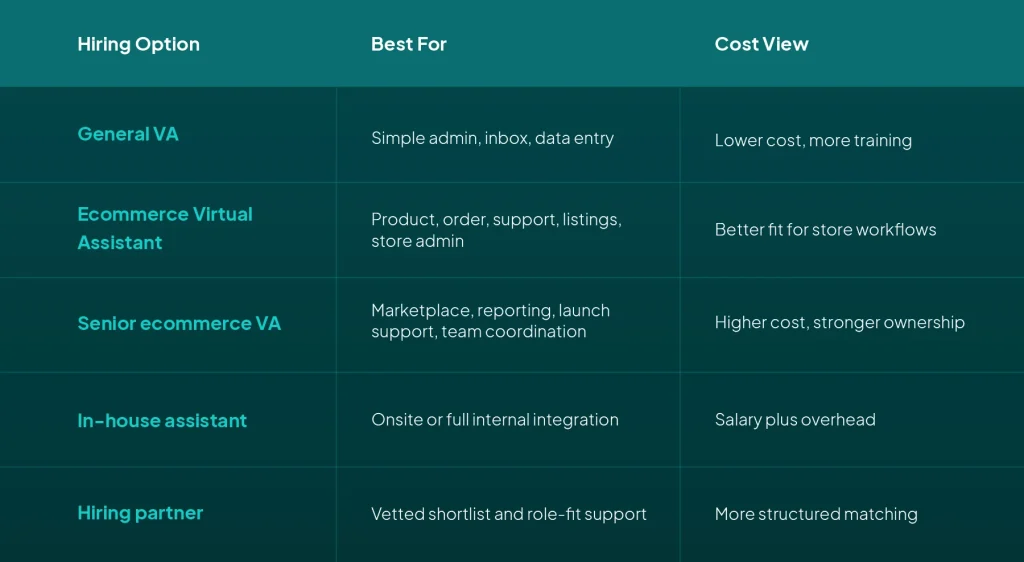
The cheapest option is not always the best hire. A low-cost assistant who needs constant correction may slow the business down. A stronger ecommerce virtual assistant should reduce founder involvement over time.
When Should You Hire?
The right time to hire is usually earlier than most founders think.

You may need an ecommerce virtual assistant if:
- Product updates are delayed.
- Customer replies are taking too long.
- Orders require too much manual checking.
- Your CRM, helpdesk, or store dashboard is messy.
- You are missing marketing launch deadlines.
- Returns and reviews are not being tracked properly.
- The founder is still doing routine store admin every week.
- You are preparing for a busy season, a new launch, or a marketplace expansion.
The clearest sign is this: growth work keeps getting pushed back because daily store tasks keep winning.
That is when you should hire ecommerce virtual assistant support.
Where ROI Shows Up?
The ROI of an ecommerce virtual assistant is not only measured in hours saved.
It shows up in cleaner product pages, faster customer replies, fewer backend mistakes, more consistent marketing, better reporting, and fewer delays around launches.
It can also show up in conversion support. Baymard Institute’s research places the average documented online cart abandonment rate at 70.22%, which means ecommerce stores already lose many shoppers before checkout is complete. While an assistant cannot fix every conversion issue, they can help maintain accurate product information, faster support, smoother promo setup, and better issue tracking.
Those small improvements matter. Ecommerce growth is often not one huge change. It is dozens of small improvements that make the store easier to buy from and easier to manage.
How To Hire Better?
Before hiring, define the role by workflow.

Do not only say, “We need help with ecommerce.”
Say:
“We need someone to upload products, check variants, update inventory, respond to routine support tickets, track returns, schedule campaign assets, and send a weekly store operations report.”
That level of clarity makes hiring easier.
Then identify the tools the assistant needs to know. This may include Shopify, WooCommerce, Amazon Seller Central, Etsy, Klaviyo, Mailchimp, Gorgias, Zendesk, Canva, Meta Business Suite, Google Sheets, ShipStation, or your preferred project management tool.
At Anywhere Talent, this is why matching matters. The best ecommerce virtual assistant is not just someone with remote work experience. It is someone with the right mix of communication, store operations awareness, tool readiness, and ownership.
First 30 Days
Start with one or two workflows, not everything at once.
A good first 30 days may include product page cleanup, support ticket templates, order tracking rules, inventory tracker updates, and a weekly reporting format.
Once the assistant proves accuracy, add more tasks.
This helps the ecommerce virtual assistant learn the store without overwhelming the business. It also gives the founder or manager a clear way to measure quality before expanding the role.
The goal is not to create another person to manage. The goal is to build support that becomes easier over time.
Final Takeaway
E-commerce virtual assistant is not just admin support for an online store.
The right person helps protect the details that affect sales, customer experience, and marketing execution. They keep product pages accurate, orders visible, support moving, returns organized, campaigns on schedule, and reports easier to review.
For small ecommerce brands, that can be the difference between reacting all week and finally having enough operational space to grow.
If your store is getting busier but your backend still depends on the founder, it may be time to hire ecommerce virtual assistant with real ecommerce context.
Anywhere Talent can help you find a vetted ecommerce virtual assistant with the communication skills, tool readiness, and store operations experience to support your next stage of growth.