
You are working harder than you ever have. The calendar is full. The task list is long. Your team is busy. And yet the business feels stuck. Revenue is not climbing the way it should. Projects finish late or not at all. Decisions pile up waiting for your input. The team is in motion, but there is no traction in business.
This is what it looks like when a business lacks traction. Not effort, not ideas, not ambition, but traction. The measurable, visible forward movement that turns plans into results and activity into outcomes. Nearly 50% of startups do not survive past their fifth year, according to the U.S. Small Business Administration, and a significant portion of those failures come not from bad products but from an inability to build business at the operational level (Siift, 2025).
This article breaks down what business actually means, why most founders confuse activity with traction in business, and how to build the execution systems that create real forward movement.
What Traction in Business Actually Means?
Traction in business is the measurable progress a company makes toward its goals through consistent execution. It is not a feeling. It is not how busy the team seems. It is the evidence that work is converting into results.

According to Forbes, business goes beyond interest or potential customers. It provides concrete evidence that people are willing to pay for your product or service, as demonstrated by metrics such as monthly recurring revenue, customer retention rates, and consistent sales growth (Siift, 2025). Harvard Business Review adds that the specific metrics matter less than their consistent upward trajectory. Business success is about direction and momentum, not any single number.
Gino Wickman, the creator of the Entrepreneurial Operating System (EOS) and author of the book Traction, defines traction in business as executing your vision with discipline and accountability (EOS Worldwide). His framework is positioned as one of six critical components every company needs to strengthen, alongside vision, people, data, issues, and process. Without direction in business, even the best strategy stays theoretical.
The distinction matters because founders often assume that effort equals traction in business. It does not. A team can work 60-hour weeks and produce very little Business momentum if the work is not aligned with clear priorities, measured against meaningful outcomes, and supported by systems that keep execution on track.
Why Founders Stay Busy but Lose?
There is a pattern that repeats across almost every growing company. The founder starts with a clear vision. They execute personally and build early traction in business through sheer force of will. Then the team grows, responsibilities multiply, and the founder gets pulled into a thousand small decisions and operational fires.
Slowly, the traction in business stalls. Not because anyone stopped working, but because the founder became the bottleneck. Every decision routes through them. Every question requires their input. Every project waits for its approval. The business has a single point of failure, and it is the person who is supposed to be driving operational momentum at the strategic level.
McKinsey identified a critical transition point around $10 million in annual recurring revenue where companies must shift from founder-led to systematic operations (First AI Movers, 2025). Companies that make this shift maintain their businesses. Companies that do not experience what Wickman calls “hitting the ceiling,” a stall that feels permanent because the founder is trapped in the operating model that created the initial traction in business.
The irony is painful. The harder the founder works to maintain momentum in business, the more they become a constraint on growth in business. The fix is not more effort. It is a different structure.
What is Activity vs. Execution?
To understand why traction in business disappears despite high effort, it helps to distinguish between activity and execution.
Activity is doing things. Responding to emails, attending meetings, completing tasks, posting on social media, and updating spreadsheets. Activity keeps people busy.
Execution is doing the right things, in the right order, with measurable outcomes. Execution requires priorities. It requires someone to define what matters most this week, this month, this quarter. It requires a system for tracking whether the work actually moved the needle.
EOS addresses this gap through what they call “Rocks,” three to five quarterly goals that represent the most important priorities for the business. Teams that implement this structured approach to business often report 88-90% goal completion rates, compared to 60-70% under their previous unstructured systems (Worxmate, 2025).
The difference is not talent or work ethic. It is structured. Sustainable growth comes from clarity about what matters, accountability for who owns it, and a rhythm of review that keeps everything moving.
How to Build a Business: A Practical Framework
Building traction in business does not require a complete business overhaul. It requires a few intentional changes to how work is organized, measured, and reviewed.
Define Three to Five Priorities Per Quarter
The number one enemy in expanding a business is trying to do everything at once. When everything is a priority, nothing is. Start each quarter by identifying the three to five outcomes that would make the biggest difference for the business. These become your “rocks” or focal points.
Assign Clear Ownership
Every priority needs one person who owns the outcome, not just the tasks. Growth breaks down when accountability is vague or shared across too many people. One owner per priority creates clarity and eliminates the “I thought you were handling that” problem that drains traction in business.
Establish a Weekly Operating Rhythm
EOS recommends structured weekly meetings, called Level 10 meetings, where the team reviews scorecards, checks progress on quarterly priorities, and solves issues using a structured process (EOS Worldwide). Whether you adopt EOS specifically or build your own version, the principle is the same: a consistent weekly rhythm keeps consistent progress visible and prevents small problems from becoming big ones.
Measure Outcomes, Not Activity
Traction in business requires measurable proof that work is producing results. Define the five to fifteen numbers that most accurately reflect business health, revenue, client retention, lead conversion, project completion rate, response time, and review them weekly. When the numbers are visible, the team naturally focuses on the work that moves them.
Delegate Execution, Not Just Tasks
This is where most founders lose traction in business. They delegate individual tasks but hold onto the execution layer: the follow-ups, the quality checks, the coordination. Real business requires delegating ownership of entire outcomes, not just line items.
Gallup’s research on high-growth CEOs found that those with strong delegation skills created 21 new jobs in three years compared to 17 for low-delegation CEOs (Gallup). Businesses scale when the founder builds a team that can execute without constant oversight.
The Traction in Business Comparison
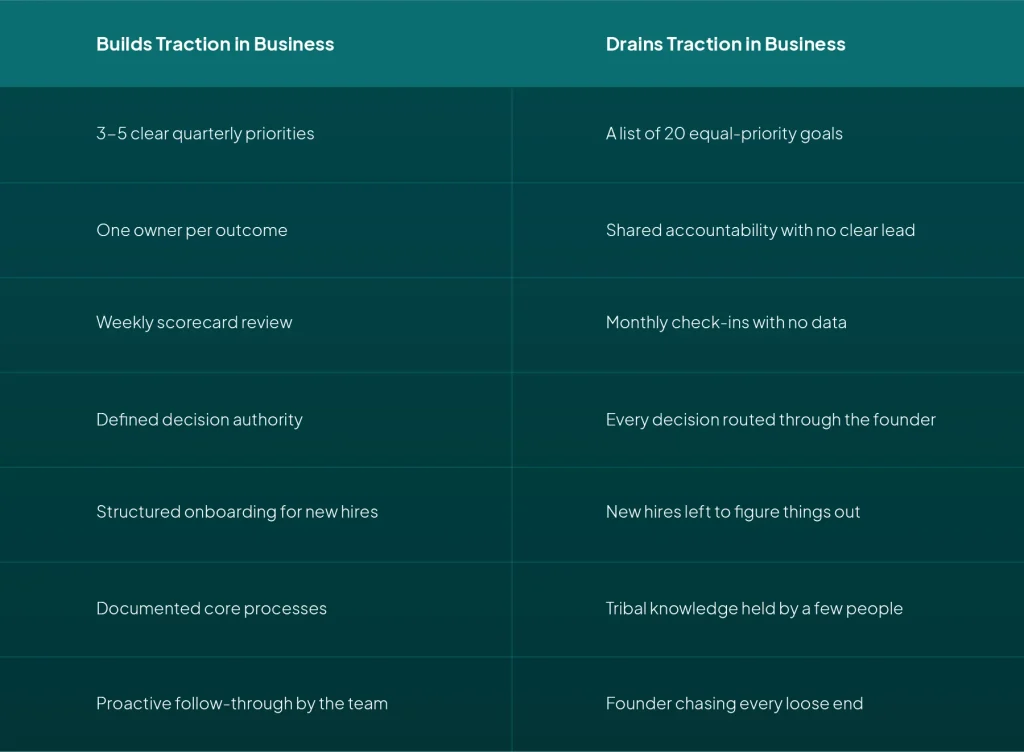
The pattern is consistent. Business progress comes from structure, not from speed. Moving fast without structure creates the illusion of growth in business while actually burning energy that could be directed toward meaningful outcomes.
Why the Right Hire Creates More
Technology helps. Project management software, communication platforms, and AI tools all reduce friction. But no tool creates traction in business on its own. Business success comes from people who own outcomes, follow through consistently, and operate within a clear system.
For founders who are stuck in the weeds of daily execution, the hire that creates the most momentum in business is usually an executive assistant or operations professional who can own the coordination, follow-ups, and administrative processes that consume the founder’s time.
Anywhere Talent approaches this by matching founders with dedicated global professionals and implementing a structured onboarding process that includes workflows, communication rhythms, and expectations. The result is a hire that contributes to the business from the first week, rather than adding another person the founder needs to manage.
The difference between a hire that creates traction in business and a hire that adds complexity is the system around them. When onboarding is structured, expectations are clear, and coaching support is ongoing, the hire becomes a source of operational support in the business rather than a new management burden.
Traction in Business Is a Daily Practice, Not a Destination
It is not something you achieve once and maintain forever. It is a discipline you practice every week. It requires regular review of priorities, honest assessment of what is and is not working, and willingness to adjust when the data says something needs to change.

Wickman’s EOS framework recommends quarterly and annual planning sessions in which the leadership team reassesses the vision, redefines priorities, and resets the execution cadence (Management Skills Daily, 2026). This ongoing rhythm of reflection and recalibration is what keeps traction in business alive as the company grows and the competitive landscape shifts.
For founders who feel like they are working harder than ever with less to show for it, the problem is rarely effort. It is the absence of a system that turns effort into success in business. The fix starts with clarity: what matters most right now, who owns it, and how you will know it is done.
Anywhere Talent helps founders build that clarity by providing not just a hire, but the operational structure that makes execution predictable. When the system is in place, business traction follows. And when business becomes consistent, growth stops feeling like a struggle and starts feeling like a rhythm.