
The fastest way to burn out as a founder is to keep running your company like a one-person helpdesk. If you’re constantly thinking, “I’ll just handle it,” you have a delegation system problem. This guide shows you exactly how to delegate tasks to a remote assistant without losing quality, speed, or control.
The modern workday is noisy: emails, pings, meeting requests, follow-up loops. The difference between founders who scale and founders who stall is not “discipline.” It’s whether they built a task transfer system that works even when the week gets messy.
This is a repeatable transfer framework and task checklist template you can reuse every week.
What does it mean to delegate a task?
To delegate a task means you transfer ownership of an outcome to someone else, along with the context and authority they need to deliver it. In plain English, delegating tasks means: you stop being the doer and become the approver (and eventually, not even that).
Most founders think delegation is “sending a to-do.” That’s task dumping. The real question is how to delegate tasks so the work comes back finished, not as another set of questions.
Why is delegating important?
Because your attention is a scarce resource. When leaders spend huge chunks of the week on non-core tasks, growth slows down, quietly. If you don’t learn how to delegate tasks, you pay in delayed decisions, missed follow-ups, and a calendar that becomes your enemy.
Delegation is also a quality move: the more you context-switch, the more mistakes you make. Researchers describe big switching costs; studies have found it can take around 23 minutes to fully resume an interrupted task after a distraction. The goal of delegation is to protect your focus so your best work actually happens.
What does delegating tasks mean?
What does delegating tasks mean in a founder context? It means your business stops depending on your brain to remember everything.
If you’re learning how to delegate tasks, this is the mindset shift: you’re not offloading work, you’re installing an operating system. Your remote assistant becomes the person who runs the system day-to-day.
How do you delegate tasks effectively?
If you want to learn how to delegate tasks effectively, use this four-part “Transfer Packet” for every new recurring task:
- Outcome: what “done” looks like
- Constraints: what must not happen (brand, security, timing)
- SOP: step-by-step, screenshots if needed
- QA: how you’ll check quality (and how often)

This is the difference between delegating tasks and building a system.
How to delegate tasks to remote assistants?
Remote assistants work best when the work is designed for async clarity. The best way to learn how to delegate tasks to a remote assistant is to start with one lane and transfer it end-to-end (not 10 scattered tasks).
Pick one lane for Week 1:
- Calendar and scheduling (great for a remote executive assistant)
- Inbox triage and drafting
- Follow-ups and reminders
- Research and summaries
- Admin processing (receipts, data entry, CRM cleanup)
If you’re hiring a remote executive assistant, start with a calendar or inbox; these are the fastest ways to get relief.
How to delegate tasks without micromanaging?
Micromanagement usually comes from fear: “If I don’t watch it, it won’t be done right.” The fix is not more checking; it’s better packaging.
When you’re figuring out how to delegate tasks, use these three controls instead of hovering:
- Definition of done: one sentence that makes success obvious
- Checkpoints: one mid-point update (not 10)
- Examples: show one “good” output so the quality is clear
Do that, and you’ll know how to delegate tasks without hovering while keeping standards high, especially with a remote executive assistant handling high-trust work.
What tasks should you delegate first?
Start with what repeats and drains you. A simple filter for how to delegate tasks in the right order:
- Repeating: happens weekly/daily
- Rules-based: can be documented
- Recoverable: low risk if wrong
- Revenue-adjacent: frees you for sales/product
Examples founders should delegate first:
- Scheduling + confirmations
- Invoicing follow-ups
- CRM hygiene
- Customer email triage
- Meeting prep packs
- Simple research (vendor options, competitor notes)
Avoid delegating “founder brain” tasks first (vision, hiring decisions, pricing) until your remote assistant has context.
What task management tools actually help?
Tools won’t fix unclear delegation, but the right stack reduces friction. If you’re stuck on how to delegate tasks and nothing is sticking, simplify the tools first.
For task management for teams, you only need three things:
- One capture inbox (Slack channel, email alias, form)
- One task management dashboard (Asana, ClickUp, Jira, Trello)
- One SOP home (Notion, Google Drive)
Use tools to enforce clarity. For example, every task inside your task management tools should include an outcome, a deadline, and an SOP link. If it’s missing, it’s not ready to delegate.
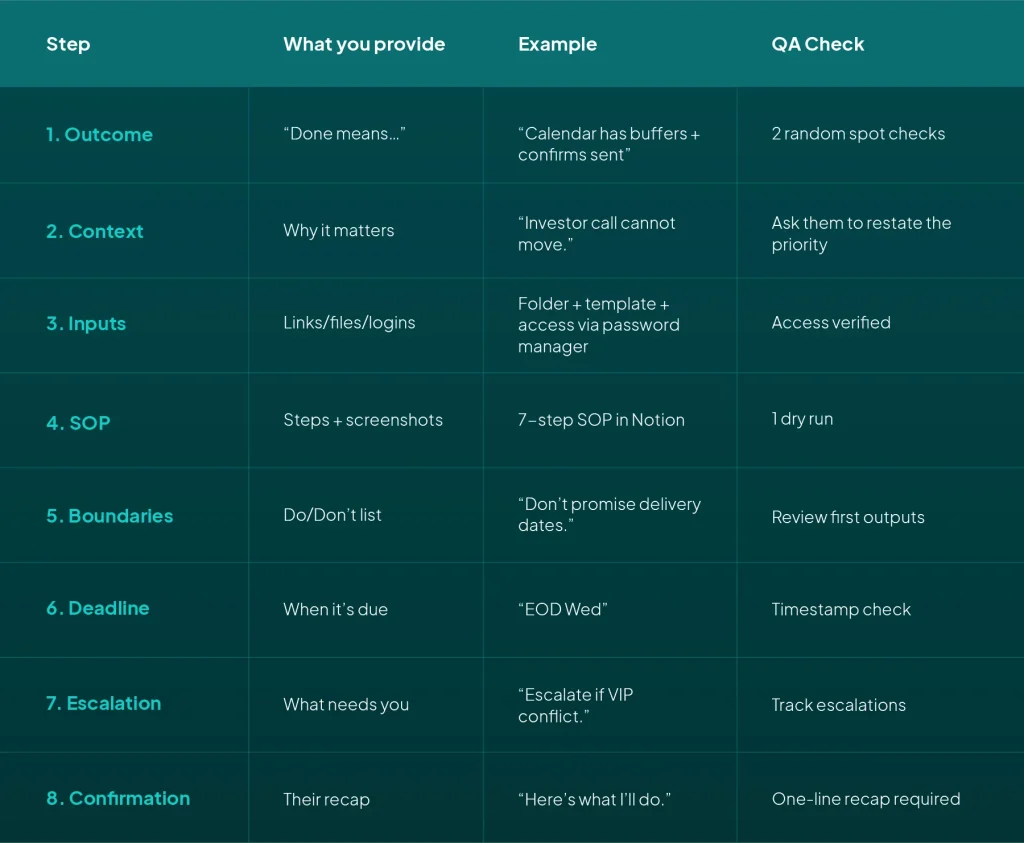
The Founder Task Transfer Checklist
Use this checklist as your default “task checklist” for every handoff. If you’re wondering how to delegate tasks consistently, this table is your baseline. It’s the simplest way to standardize delegation across a remote assistant, a remote executive assistant, or a broader virtual assistant services list.
How to delegate tasks as a manager?
If you lead a team, the job is not to “assign tasks.” It’s to create ownership. The best framework for how to delegate tasks as a manager is:
- Decide on one owner
- Define outcome (one sentence)
- Set deadline (specific)
- Provide resources (SOP, tools)
- Set review point (when you’ll check)
Avoid committee delegation. When everyone owns it, no one owns it.
The 5 Delegation Levels
A simple ladder helps you reduce involvement over time:
- Level 1: Do exactly as told
- Level 2: Do and report
- Level 3: Do and suggest improvements
- Level 4: Own the lane and inform me
- Level 5: Own and optimize
When founders complain that ” delegation “doesn’t work,” they’re often stuck at Level 1 because they never trained toward Level 3+. This is why how to delegate tasks is really a training system.
Delegating tasks: Task vs Lane
Most competitor posts list “tasks to delegate.” The gap is that they don’t teach you to delegate functions.
Task delegation: “Schedule this call.”
Lane delegation: “Own scheduling rules for all sales calls.”
If you want to know how to delegate tasks to create real leverage, shift from tasks to lanes as soon as the first lane is stable.
Virtual Assistant Services List
If you’re deciding what to hand off, a simple virtual assistant services list helps. Start with categories, then pick tasks.
Common buckets for a remote assistant:
- Admin processing (receipts, data entry, docs)
- Calendar and scheduling
- Inbox triage and drafting
- Research and summaries
- Customer support routing
- CRM updates and pipeline hygiene
- Travel planning and coordination
- Basic reporting dashboards
The point is not to delegate everything. The point is to choose what you can document once and repeat weekly. That’s how to delegate tasks in a way that scales.
Virtual assistant cost: What to Budget?
Virtual assistant cost varies by geography, skill level, and whether you hire directly or through an agency. Instead of chasing the cheapest rate, budget based on outcomes. When founders ask how to delegate tasks while keeping costs predictable, this is the only frame that stays true:
- Admin VA: rules-based admin + processing
- Executive VA / executive assistant remote: calendar, inbox, stakeholders
- Specialist VA: marketing ops, finance ops, project support
A better way to compare: what does one reclaimed founder hour unlock? If a remote assistant gives you back 5–10 high-quality hours/week, the ROI is usually immediate.
The “first week” playbook

Here’s how to delegate tasks in Week 1 without overwhelming anyone:
- Day 1: Pick one lane and share the checklist
- Day 2: Provide SOP + run a 20-minute walkthrough
- Day 3: Let them execute + you QA only
- Day 4: Tighten rules + add templates
- Day 5: Transfer the next recurring task
Keep Week 1 narrow. Width comes later.
The most common Delegation Failures
If your delegating tasks keep breaking, it’s usually one of these:
- Vague outcomes (“handle this”)
- No SOP or missing inputs
- No authority (“ask me for everything”)
- No QA cadence
- Too many tools
Fix the system, not the person. Better delegation is mostly better packaging. That’s why founders who master how to delegate tasks look “naturally organized”; they’re not. They’re systemized.
A Quick Delegation Audit
Try this 15-minute exercise today:
- List every task you touched yesterday.
- Mark each one as: Keep / Delegate / Automate / Delete.
- Choose only ONE item in the Delegate column.
- Build the transfer packet and assign it this week.
That’s how to delegate tasks without overwhelming your remote assistant or your own brain.
A Simple SOP template
Use this as your SOP starter for any recurring task:
Task name:
Goal:
When it happens:
Inputs needed:
Steps:
Edge cases:
Definition of done:
Escalate when:
Where to log updates:
With this, a remote assistant can operate without constant back-and-forth.
Delegation and Trust
Trust grows when you design for success. This is the missing layer in how to delegate tasks: you’re designing the conditions where delegation feels safe for both sides.
Give your assistant:
- clear rules
- a protected lane
- authority to execute
- a weekly review
That’s how a remote executive assistant becomes your right hand, not another inbox. If you want to hire a remote assistant or a remote executive assistant and install a delegation system fast,
Anywhere Talent can help. We match founders with vetted assistants and provide a clear onboarding and task transfer approach so you learn how to delegate tasks without losing quality or control. If you want a founder-ready checklist and a remote assistant who can run it, that’s what we do.
Frequently Asked Questions
It means you transfer ownership of an outcome, plus the context and authority needed to complete it, so you’re not the bottleneck.
To learn how to delegate tasks, delegate outcomes, attach an SOP, set a QA checkpoint, and use one dashboard to track work.
Because leaders lose major time to non-core work, and context switching destroys focus and quality.
Assign one owner, define “done” in one sentence, give resources, and agree on update cadence.
Repeating, rules-based, low-risk tasks: scheduling, inbox triage, follow-ups, admin processing, research.