

A compliance issue rarely starts with one huge mistake. It usually starts with a missed follow-up, a file saved in the wrong place, a form that was never completed, or a deadline that lived in someone’s memory rather than in a tracker.
That is why growing firms are rethinking how they delegate tasks in 2026. The goal is not to hand sensitive judgment to a virtual assistant. The goal is to move repeatable, document-heavy, process-driven work away from founders, attorneys, operators, finance leads, and senior managers who should be focused on decisions and revenue.
A compliance virtual assistant supports the workflow around regulated or detail-sensitive work. They help with intake, records, checklists, reminders, document organization, reporting prep, follow-ups, and administrative accuracy.
When you delegate tasks clearly, the business becomes calmer and more organized. When you delegate tasks loosely, you create more review work.
This guide breaks down how to delegate tasks, what to keep in-house, and what a compliance virtual assistant should cost in 2026.
What Is a Compliance VA?
A compliance virtual assistant is a remote assistant or online assistant who supports policy-driven, document-sensitive, or regulated workflows.
They may support law firms, finance teams, HR departments, insurance agencies, healthcare-adjacent teams, real estate teams, or any small business where missing details create risk.
This role is more specialized than general admin. A general virtual assistant may handle scheduling, email, research, data entry, and simple reporting. A compliance VA can still manage those virtual assistant duties, but they also understand confidentiality, file naming, deadline tracking, version control, and escalation rules.
The U.S. Bureau of Labor Statistics describes administrative assistants as professionals who maintain files, prepare documents, schedule appointments, and support staff. It also separates specialized support roles, including executive administrative assistants and legal secretaries, by responsibility and pay level.
That same logic applies when you delegate tasks remotely: the more sensitive the work, the more context the assistant needs.
What Can You Delegate?
The safest way to delegate tasks is to choose work that is repeatable, documentable, and easy to review.
These are not final decisions. They are the operational steps that help senior professionals make better decisions faster.
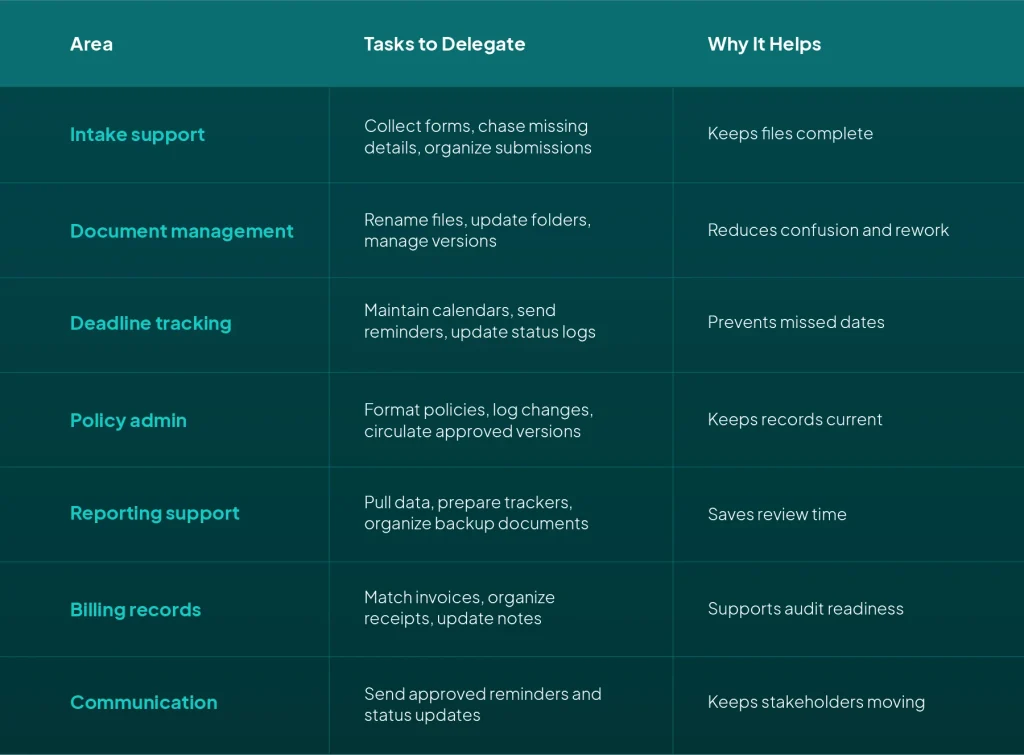
This is where delegation becomes practical. You delegate tasks that slow down senior people but do not require senior judgment at every step.
For example, a compliance VA can prepare a file for review, but the final review stays with the responsible professional. They can track missing information, but they should not decide the risk. They can prepare a task list, but they should not approve the outcome.
What Should Stay In-House?
Some work should not be handed to a virtual assistant without direct oversight.
Do not delegate tasks that involve giving advice, interpreting obligations, approving risk decisions, signing filings, setting fees, establishing client relationships, or making final calls that require a qualified professional.
You can delegate tasks related to around preparation, but with final accountability.
This is especially important for firms that handle client matters, regulated documents, or sensitive records. The American Bar Association says paralegals may not establish attorney-client relationships, set fees, or give legal advice. ABA Model Rule 5.3 also says lawyers with supervisory authority must make reasonable efforts to ensure nonlawyer assistants act consistently with professional obligations.
That does not mean you should avoid delegation. It means you should define the line.
A compliance VA can handle administrative task support, file hygiene, checklist movement, meeting coordination, and routine follow-ups. The responsible professional still owns the judgment.
How To Delegate Tasks?
The biggest mistake is hiring a remote assistant and saying, “Just help where you can.”
That is not delegation. That is dumping.
To delegate tasks well, define the workflow before the hire starts. The clearer the rules, the safer it becomes to delegate tasks without creating confusion.
Start with these questions:
- What process should feel lighter in 30 days?
- Which recurring admin task takes too much senior time?
- What needs review before it goes out?
- What information can the assistant access?
- What should be escalated immediately?
- What does “done” look like?
This matters because compliance support needs rules. Your assistant should know which templates to use, where documents live, how files should be named, who approves what, and how to flag missing information.
At Anywhere Talent, this is why role clarity comes before matching. A business may ask for virtual assistant services, but what it really needs is someone with document discipline, communication judgment, and role-specific experience.
If you want to delegate tasks safely, the assistant must understand the environment, not just the tool stack.
Tasks Worth Delegating
If you are building a virtual assistant task list, start with the work that happens often and creates drag when ignored.

You can delegate tasks like:
- Intake form collection
- Client or vendor follow-ups
- Document checklist updates
- Renewal reminders
- Approved email drafts
- CRM updates
- Folder organization
- Meeting notes
- Open-item reports
- SOP updates after approval
- Signature tracking
- Billing record organization
These are some of the most practical tasks to delegate to a virtual assistant when your team needs structure.
They also answer a common question: what do virtual assistants do in specialized roles?
They protect the details that keep the bigger work moving.
This is also where small teams often miss an opportunity. They assume support means calendar help or a virtual assistant, personal tasks only. In reality, there are many things a virtual assistant can do when the role is tied to a real business process.
When you outsource tasks to virtual assistants in a compliance-heavy area, the win is not just “more hands.” The win is fewer loose ends.
Executive Support Tasks
Compliance VAs often overlap with executive assistant responsibilities, especially when they support a founder, managing partner, operations lead, finance lead, or compliance manager.
Common executive assistant tasks include calendar control, meeting prep, inbox triage, travel coordination, stakeholder follow-ups, and document preparation.
These are smart places to delegate tasks when leadership is losing time to coordination.
In a compliance-heavy business, executive assistant tasks become more valuable because leadership time is tied to approvals, deadlines, and sensitive decisions.
You can delegate tasks such as preparing agendas, gathering documents before review calls, tracking action items, and sending follow-ups after meetings.
These tasks of executive assistant support do not replace leadership judgment. They protect leadership attention.
For a founder-led company, this can be the first real step from reactive operations to structured delegation.
General Admin Still Matters
A compliance VA should not be so specialized that basic admin falls apart.
General virtual assistant tasks still matter: scheduling, inbox organization, research, spreadsheet updates, data entry, contact management, and simple reporting.
The key is knowing which admin tasks to keep simple and which ones need more context before you delegate tasks.
For example, inbox support in a normal admin role may mean sorting messages. Inbox support in a compliance role may mean spotting missing forms, flagging deadlines, and routing sensitive messages properly.
This is why virtual assistant general admin tasks can sit inside a specialized role. The assistant is still doing admin, but with more awareness.
When people ask what a virtual administrative assistant does, the answer depends on the business. In a low-risk setting, they organize. In a compliance setting, they organize in a way that protects the process.
What does it cost in 2026?
There is no single 2026 price for a compliance virtual assistant.
Cost depends on location, experience, scope, hours, hiring model, and how much domain familiarity the work requires.
For a broad market benchmark, Upwork lists virtual assistants at a median hourly rate of $13, with typical hourly rates from $10 to $20. That is useful for basic virtual assistant administrative tasks, but compliance support often costs more because accuracy, confidentiality, and judgment matter more.
U.S. wage data also shows why companies compare remote support with in-house hiring. BLS lists the May 2024 median wage for secretaries and administrative assistants at $47,460, legal secretaries and administrative assistants at $54,140, paralegals and legal assistants at $61,010, and compliance officers at $78,420.
Those salaries do not include the full employer cost of benefits, payroll taxes, equipment, office space, recruiting time, or management overhead. A remote assistant model can reduce fixed costs, especially when you need structured support but not another full-time in-house employee.
| Support Type | Best Fit | Cost Expectation |
| General VA | Scheduling, inbox, basic admin | Lower-cost support |
| Compliance VA | Intake, files, deadlines, reporting admin | Mid-range specialized support |
| Senior compliance support | Complex workflows and stakeholder coordination | Higher specialized support |
| In-house hire | Full-time internal ownership | Salary plus overhead |
The goal is not to find the cheapest person. It is to delegate tasks at the right level, then delegate tasks consistently through a clear process.
If the assistant saves senior hours every week, reduces rework, and keeps deadlines visible, the ROI can be far higher than the hourly rate.
Where ROI Shows Up?
The ROI of a compliance VA usually appears in quiet ways.
Fewer missed follow-ups. Cleaner files. Faster intake. Better meeting prep. Less time spent searching for documents. More complete records before review. Fewer “Can you resend this?” messages. Fewer bottlenecks around the founder or senior team.
For firms with billable work, the opportunity cost is even clearer. Clio’s Legal Trends Report tracks utilization, realization, and collection rates as key productivity metrics and uses aggregated data from tens of thousands of U.S. legal professionals to benchmark firm efficiency.
If senior professionals spend too much time on admin, the business loses capacity.
This is why it makes sense to delegate tasks that do not require senior judgment, and to delegate tasks before the process becomes a bottleneck.
The work still gets done, but your highest-value people are not stuck inside the lowest-value steps.
Anywhere Talent sees this across support roles. The strongest hire is not always the broadest assistant. It is the person whose experience fits the workflow closely enough that delegation becomes easier after the first few weeks.
Who Should Hire One?

A compliance virtual assistant is a strong fit for:
- Small firms with growing admin pressure
- Founder-led companies managing sensitive paperwork
- HR teams handling employee documentation
- Finance teams tracking invoices, renewals, and audit records
- Insurance teams handling client file updates
- Real estate teams managing contracts and deadlines
- Healthcare-adjacent businesses coordinating forms and records
- Operations teams managing recurring documentation
You should consider this role when your team keeps saying, “We need someone to keep this organized,” but the work is too important for basic generalist support.
This is also the right time to revisit your virtual assistant tasks list. If your list includes sensitive records, recurring deadlines, policy documents, intake, reporting, audit preparation, or client follow-ups, the role needs more than availability.
It needs domain familiarity.
How To Hire in 2026?
Before hiring, write the role around workflows instead of personality traits.
Do not say:
“We need someone proactive.”
Say:
“We need someone to manage intake checklists, update the deadline tracker daily, send approved follow-up templates, organize documents by naming convention, and prepare a weekly open-items report.”
That is how to delegate tasks with less confusion.
During interviews, ask practical questions:
- How would you track missing documents across 40 active files?
- What would you do if a client sent incomplete information?
- How do you manage version control?
- When would you escalate a message?
- How do you protect confidential information?
- What systems have you used for task tracking?
These questions reveal whether the person can handle virtual tasks with judgment. They also help you compare a general VA, an executive assistant, and a specialized compliance assistant without relying only on resumes.
A vetted hiring partner can help because the hardest part is not finding people. It is finding people who match the work.
Anywhere Talent focuses on connecting businesses with global professionals screened for communication, tool readiness, ownership, and role fit, so the assistant is prepared for the kind of work your business needs to delegate tasks around.
Final Takeaway
A compliance virtual assistant is not there to make sensitive decisions for your business.
They are there to make sure the process around those decisions is organized, visible, and moving.
When you delegate tasks like intake, file organization, deadline tracking, reporting prep, meeting coordination, and routine follow-ups, senior people get more time for the work only they can do.
Your records get cleaner. Your clients get faster responses. Your business becomes less dependent on memory and last-minute effort.
In 2026, the question is not only what a virtual assistant can do.
The better question is:
What should your senior team stop doing manually?
If your team is ready to delegate tasks without losing control, Anywhere Talent can help you find a vetted remote assistant with the communication skills, role discipline, and specialized experience to support compliance-heavy workflows.