
If you’re a founder, you don’t wake up excited to “get more organized.” You wake up to 117 emails daily, thinking, “What’s going to break today? Well, the right EA stops a dozen things from breaking before you even see them. That’s why executive assistant skills are changing so fast in 2026: the baseline admin work is getting automated, but the messy, human, high-context work is getting heavier.
This isn’t a fluff list of “communication and time management.” This is a practical map of executive assistant skills that actually move your week: what great looks like, how to test it, and what to train if you already have an EA.
What does an Executive Assistant do?
When people ask “what does an executive assistant do,” they’re usually picturing calendar invites and travel. That’s part of it. But the real job is closer to that of an assistant CEO: protect the leader’s time, translate information into decisions, and keep follow-through alive when everyone else moves on. The best executive assistant skills show up in the places you feel pain: meetings that shouldn’t exist, inboxes that create anxiety, and tasks that bounce between people with no owner.
If you’re hiring an executive administrative assistant for routine administrative tasks, you can screen for speed and accuracy. If you want a strategic EA, you’re hiring for judgment, ops sense, and business partnering.
Which skills will win in 2026?
In 2026, the world doesn’t reward “busy.” It rewards clean execution. Employer surveys warn that nearly 40% of workplace skills will shift this decade, and the winners blend AI literacy with human judgment. Executive assistant expertise now sits right on that intersection.
Here’s the simple upgrade: AI handles repeatable work faster; humans are needed for prioritization, trust, and stakeholder dynamics. So executive assistant skills in 2026 look like a blend of tool fluency and operator instincts.
Executive assistant skills stack
Think of executive assistant skills as a stack. If the bottom layers are weak, the top layers collapse.
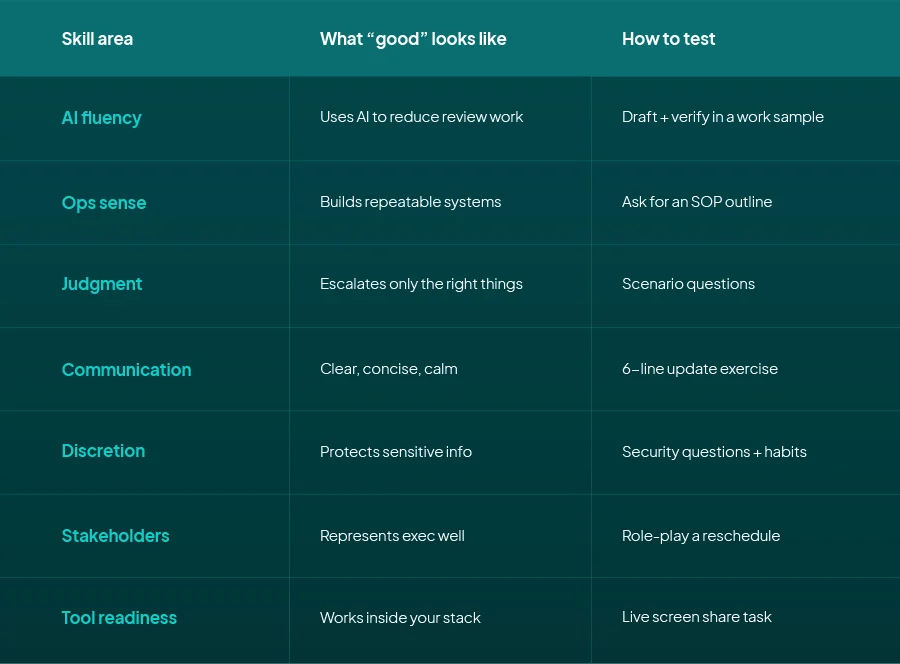
1) AI fluency
This is not “prompt engineering.” It’s knowing what to hand to AI, what to double-check, and what never to outsource. Executive assistant skills here include:
- Turning messy inputs into clear prompts (so you get usable outputs),
- Verifying facts before they go to a client,
- Building small automations that remove busywork (summaries, templates, routing rules).
The best EAs don’t brag about AI. They quietly use it to ship cleaner work.
2) Ops sense
Ops sense means you can spot friction and fix it once. These skills in ops show up as:
- A weekly planning rhythm that prevents surprise overload,
- A meeting system that forces agendas and decisions,
- A follow-up tracker that closes loops without chasing.
This is where founders feel relief first.
3) Business partnering
Business partnering is the difference between “helpful” and “trusted.” Executive assistant skills here include:
- Knowing what matters to different stakeholders,
- Protecting priorities without being rude,
- Translating the founder’s intent into action across the team.
A strategic EA doesn’t just execute; they make it easier to work with you.
AI tools, not hype
If AI is part of your support model, the question isn’t “does AI help?” The question is: does it reduce your attention cost, or add a new layer to manage?

Executive assistant skills with AI are practical:
- Meeting notes: summarize, extract decisions, assign actions.
- Email drafts: propose replies that match tone and priorities.
- Calendar triage: draft schedules with buffers and constraints.
- Research: pull options, then sanity-check sources and assumptions.
Virtual assistant skills often stop at “can use ChatGPT.” Executive assistant skills go further: can they apply AI without leaking confidentiality, hallucinating facts, or creating extra review work for you?
Ops that save hours
If you want the ROI version of executive assistant skills, look at these five ops systems:
- Daily brief: top priorities, risks, decisions needed, follow-ups pending.
- Calendar rules: buffers, deep work blocks, meeting types, no-go windows.
- Inbox triage: tag, draft, route, escalate, without flooding you.
- Meeting prep: agenda, context, goal, pre-reads, next steps
- Loop closing: action items tracked until done, not “sent.”
When someone asks what executive assistants do, this is the part that makes the role feel strategic.
Business partnering moves
Most founders don’t need more updates. They need better outcomes with less noise.

Executive assistant skills that signal business partnering:
- They can say “no” with context: “We can’t do Tuesday, but here are two better options.”
- They can escalate cleanly: “This blocks revenue; I need your decision by 2 pm.”
- They can protect focus: “This meeting has no outcome, do you want me to decline?”
- They can represent you: tone, boundaries, and clarity stay consistent.
If you’ve ever wondered how to be the best executive assistant, start here: make the executive easier to work with.
Communication that lands
Communication isn’t “friendly.” It’s compressing chaos into clarity.
Executive assistant skills in communication look like:
- Short updates with a clear ask,
- Summaries that surface decisions, not transcripts,
- Writing that matches the leader’s tone,
- Calm under pressure (no emotional spikes in Slack).
A surprisingly good test: ask candidates to write a 6-line update on a messy situation. If they can’t, they’ll create more noise later.
Judgment under pressure
This is the hardest skill to hire for and the reason many hires fail. A great EA doesn’t freeze. They state assumptions, propose a path, and escalate only what truly needs you.
Executive assistant skills in judgment show up when:
- Priorities change mid-day,
- A VIP wants a slot that conflicts with a board call,
- A team member is emotionally charged, and you need a calm response,
- You don’t have enough context.
Security and discretion
If an EA has access to your inbox, calendar, and stakeholders, they’re in the trust layer of the company. This is also where “remote” matters: remote doesn’t mean risky, but sloppy security does.
Executive assistant skills in discretion include:
- Never sharing credentials in chat,
- Using password managers and MFA without being asked,
- Understanding what should not be forwarded or copied,
- Knowing when silence is professionalism.
Skills that age well
Employer surveys keep ranking analytical thinking, resilience, and a learning mindset as durable skills. If you’re hiring for 2026 and beyond, you want someone who adapts without drama.
Tools change. The core executive assistant skills that age well are:
- Prioritization,
- Systems thinking,
- Writing,
- Stakeholder management,
- Continuous learning.
Skill gap audit
Before you hire, do this quick audit. It tells you which executive assistant skills you need most, and whether you’re hiring for the right level.
Ask yourself:
- Are you losing time to calendar churn, or to cross-team alignment?
- Do you need someone to represent you to stakeholders, or just to process tasks?
- Do you want real-time coverage, or can the work be done async?
- Do you have SOPs today, or will the EA need to build them?
- Do you need an “assistant CEO” vibe, or an “executive administrative assistant” lane?
Training in 30 days
If you already have an EA (or you’re hiring a high-potential candidate), here’s a simple 30-day plan to build executive assistant skills without turning your week into coaching sessions.
Week 1: Pick one lane and document it. Calendar rules, meeting buffers, how you want reschedules handled, and a daily brief format.
Week 2: Add templates. Meeting prep template, follow-up script library, and a “questions log” so you stop getting pinged all day.
Week 3: Add light automation. Recurring agenda requests, reminders, and a task tracker that surfaces deadlines without you chasing.
Week 4: Expand scope. Add inbox triage or stakeholder follow-ups once the first lane is stable.
This is also how to be the best executive assistant over time: build systems once, then improve them weekly.
Interview prompts
If you’re hiring, these prompts reveal executive assistant skills quickly. They’re short on purpose; great candidates will ask clarifying questions and state assumptions.
- “Two VIPs want the same slot. What’s your move?”
- “You get a vague ‘can you handle this?’ email. What do you do first?”
- “A stakeholder is late, and the next meeting is tight. How do you reset the schedule?”
- “You’re missing context, but a reply is due in 20 minutes. How do you draft it?”
And yes, if you’re from a virtual assistant background, these are skills for executive assistant work: prioritization, discretion, and business partnering.
How to test skills
If you only interview, you’ll hire the best talker. Test executive assistant skills with work samples.
Work sample 1: Inbox triage (30 minutes)
Give 20 emails. Ask them to label, draft, route, and escalate.
Work sample 2: Calendar rebuild (30 minutes)
Give conflicts and constraints. Ask them to propose a schedule and explain trade-offs.
Work sample 3: Meeting prep (20 minutes)
Ask for the agenda, pre-brief, and follow-ups for one meeting.
Scorecard table
Quick wins week one
If you want the process to be fast, pick two visible wins in the first week. One should be “behind-the-scenes” (so your day feels lighter), and one should be “public” (so stakeholders trust the new setup).
Behind-the-scenes ideas: rebuild your calendar with buffers, create a reschedule template, and set up a simple tracker for follow-ups. Public ideas: send crisp meeting recaps, confirm every meeting with an agenda, and own one standing update (weekly priorities or pipeline).
The goal isn’t to impress anyone. The goal is to create a rhythm that makes the next week easier than the last, with less friction and fewer surprises.
Hiring checklist
If you want to hire or upskill, keep it simple:
- Define outcomes (what changes in 30 days).
- Choose the lane they’ll own first.
- Test executive assistant skills with real scenarios.
- Onboard with SOPs and a daily brief.
- Review weekly; update systems, not people.
This is the best way to hire offshore employees, too: clarity first, then tools.
If you’re unsure, start with a trial week, measure interruptions, and expand the scope only after consistency appears reliably.
Why Anywhere Talent?
If you need executive assistant skills that match 2026, like AI fluency, ops structure, and business partnering, Anywhere Talent screens for those traits with work samples and role-fit scoring. The goal is lane ownership that actually reduces founder load.