

A generalist virtual assistant can save your week. A specialized virtual assistant can change the way your business runs. That difference matters.
When a founder hires support, the first instinct is usually simple: “I need someone to take things off my plate.” That might mean inbox clean-up, scheduling, research, data entry, travel coordination, or follow-ups. For that stage, a good generalist is valuable. They bring order to the noise.
But as the business grows, the work changes. The problem is no longer only volume. It is judgment.
A legal assistant needs to understand contract language. A finance assistant needs to know reconciliations, invoices, and reporting cycles. A marketing coordinator needs to understand campaigns, content calendars, approvals, analytics, and tools.
That is where domain expertise becomes the difference between help and real leverage.
For small businesses, this decision matters even more. The U.S. has 36.2 million small businesses, accounting for almost 46 percent of private sector employment, yet many still run with lean teams and stretched leaders. Hiring the wrong support role can create more training, more review work, and more operational drag. Hiring for Domain Expertise can shorten the ramp, reduce mistakes, and give your team someone who understands the work behind the task.
This guide breaks down generalist vs specialist hiring, what domain expertise actually means, and when a virtual assistant for a small business should be more than “good at admin.”
What Is Domain Expertise?
Domain expertise is practical, field-specific knowledge that helps someone understand the context behind a task, not just the task itself.
A domain expert does not simply follow instructions. They understand the language, tools, risks, standards, and working rhythm of a specific function or industry. In business support, domain expertise could mean experience in legal administration, bookkeeping, healthcare scheduling, real estate coordination, ecommerce operations, marketing execution, sales support, or executive operations.
That matters because most business tasks are not isolated. A simple invoice follow-up can affect cash flow. A calendar change can affect a sales call, a client deadline, or a founder’s focus block. A content upload can affect SEO, brand consistency, and campaign timing.
Domain expertise helps a virtual assistant see those connections before something slips.
A generalist can usually support broad admin needs. A specialist can support the function with more confidence, fewer explanations, and better judgment. This is also why businesses should be careful about hiring support based only on availability or hourly cost. A specialised virtual assistant with real domain expertise can often create more value than a cheaper hire who needs constant direction.
At Anywhere Talent, this is the difference we look for during vetting: not just whether someone can complete tasks, but whether they understand the role well enough to think through the work.
What Is a Generalist?
A generalist is someone with broad skills across many administrative or operational tasks.
A generalist virtual assistant may manage inboxes, schedule meetings, organize files, update spreadsheets, prepare basic reports, book travel, conduct research, coordinate vendors, or follow up with clients.
These tasks are important. The U.S. Bureau of Labor Statistics describes secretaries and administrative assistants as professionals who arrange files, prepare documents, schedule appointments, maintain databases, and support other staff.
For early-stage companies, a generalist is often the right first hire. They are flexible, adaptable, and useful when the founder needs support across a messy mix of tasks.
The limitation appears when the work becomes specialized. If your assistant needs to understand legal terminology, CRM pipeline hygiene, bookkeeping workflows, paid ad reporting, or customer success processes, broad admin skills may not be enough.
That is when domain expertise starts to matter more than general flexibility.
Specialist vs Generalist
The specialist vs generalist decision should not be framed as “one is better.” It should be framed as “what does the work require?”
A generalist is best when the work is varied, repeatable, and low-risk. A specialist is better when the work depends on judgment, functional knowledge, or industry-specific accuracy.
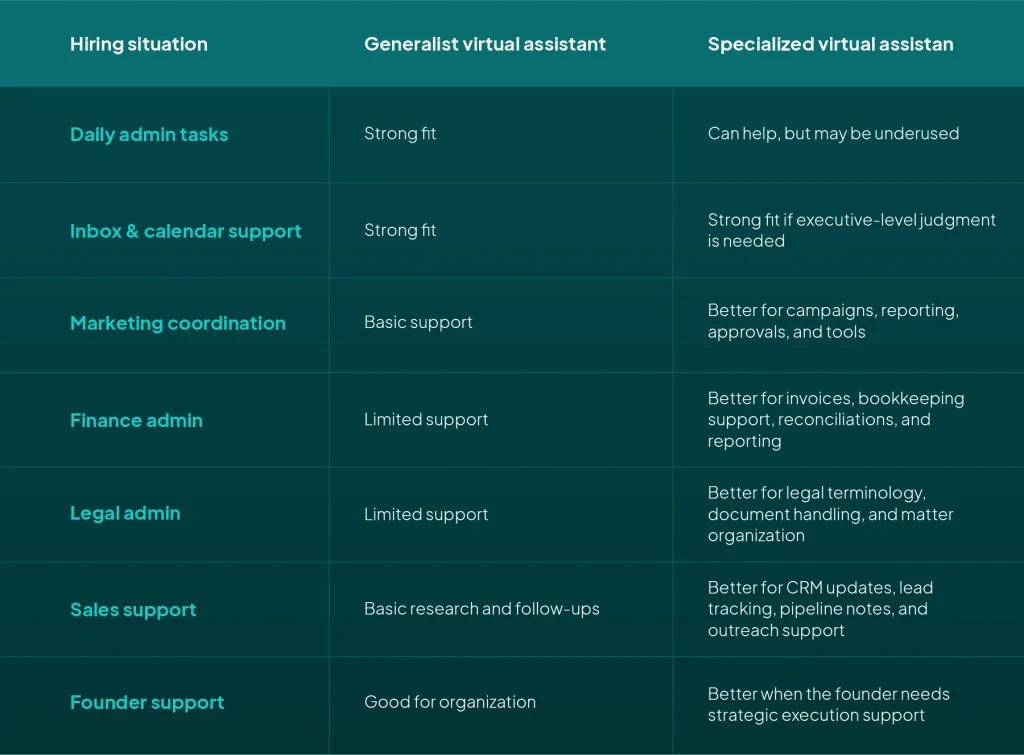
The more your work depends on context, the more domain expertise should influence the hire.
When Does Expertise Win?
Domain expertise wins when the cost of misunderstanding is high.
If a task is simple and easy to check, a generalist can usually handle it. If a task requires interpretation, prioritization, or functional accuracy, a specialist will likely perform better.
For example, a generalist can upload a blog. A marketing specialist can upload it, format it for readability, check metadata, confirm internal links, understand the content calendar, and flag missing campaign assets.

A generalist can organize invoices. A finance-focused assistant can organize invoices with an understanding of vendor records, payment timing, and reconciliation flow.
A generalist can file documents. A legal support assistant can organize documents while recognizing matter names, contract versions, and confidentiality concerns.
This is why domain expertise is not just a hiring preference. It is an operational safeguard.
Harvard Business Review has described knowledge work as work where productivity is hard to measure because people apply subjective judgment to tasks. That idea applies directly to specialized virtual support. The more judgment your assistant needs to use, the more domain expertise matters.
Why Small Teams Need It?
A small business virtual assistant is often hired because the founder or core team is overloaded.
But overload is not always caused by “too many tasks.” Often, it is caused by too many decisions being made by the wrong person. The founder becomes the reviewer, explainer, approver, editor, checker, and backup plan for everything.
A specialized virtual assistant can take ownership of a lane because they already understand the basics of that lane. They do not need every term explained. They do not need every tool introduced from scratch. They can spot obvious gaps before the founder sees them.
That is a much better kind of support.
This is especially important when hiring a virtual assistant for small business operations. Small teams rarely have the time to build long training systems from scratch. They need people who can plug into the role, understand the working rhythm, and start reducing pressure quickly. Anywhere Talent’s matching approach is built around that reality, connecting businesses with global professionals who bring both communication strength and domain expertise into the role.
What Do You Need a Specialist?
You probably need domain expertise if you keep seeing any of these patterns:
- Your team spends too much time explaining the same functional details.
- Your assistant completes the task but misses the business context.
- Your founder still has to review every small output.
- Mistakes are not huge, but they keep creating rework.
- Your work involves tools, terminology, or compliance-sensitive details.
- You need someone to manage a process, not just complete a checklist.
- You are hiring for marketing, finance, legal, sales, operations, healthcare, real estate, or customer support.
The simplest test is this: if the person needs to understand the “why” behind the task to do it well, hire for domain expertise.
Where Generalists Still Fit?
Generalists are still incredibly useful.
Many businesses do not need a specialist for everything. A strong generalist can bring structure to a founder’s day, clean up recurring admin, document processes, coordinate meetings, and keep basic operations moving.
In fact, the best support teams often combine both: a generalist for broad coordination and a specialist for function-specific execution.
A generalist is a smart choice when you need flexibility, when your processes are still forming, or when the work changes every day.
A specialist is a smart choice when the work has a clear function, clear tools, clear risks, and clear performance expectations.
The goal is not to replace every generalist with a specialist. The goal is to avoid using a generalist where domain expertise is clearly required.
How to Hire Better?
To hire the right specialised virtual assistant, start with the work, not the job title.

Instead of saying, “We need a VA,” define the lane:
- Do we need executive support?
- Do we need marketing execution?
- Do we need finance administration?
- Do we need legal support?
- Do we need customer support?
- Do we need sales coordination?
- Do we need operations support?
Then define what good judgment looks like in that lane.
A marketing assistant should know how to manage a content calendar, chase approvals, update campaign trackers, and understand basic performance metrics.
A finance assistant should understand invoice workflows, expense categories, vendor follow-ups, and reporting cycles.
A legal assistant should understand confidentiality, document versioning, matter organization, and legal terminology. BLS also notes that legal and medical administrative assistants may need additional training in industry-specific terminology.
This is how you move from “I need help” to “I need the right kind of help.”
Domain expertise should also show up in the screening process. Ask candidates to complete work-like tasks. Give them realistic scenarios. Test how they communicate when something is unclear. Check whether they can explain their reasoning.
A true domain expert will not only do the task. They will show how they think.
That thinking process is exactly what separates domain experts from task-only support. A strong specialist can explain why they prioritized something, what risk they noticed, or what they would improve in the process. Anywhere Talent screens for this level of role readiness because businesses do not just need someone available. They need someone who can bring domain expertise into real daily execution.
What To Ask?
The best interview questions reveal judgment.
Ask:
- What tools have you used in this function?
- What mistakes commonly happen in this type of work?
- How would you organize this process from scratch?
- What would you flag to the founder before moving forward?
- How do you handle unclear instructions?
- What reports, documents, or trackers have you managed before?
- What would you need from us in the first 30 days to succeed?
These questions help separate someone who has seen the work from someone who has only read the job description.
For a small business virtual assistant, this matters because the hire may be close to the founder, clients, vendors, and internal systems. You need someone who can communicate clearly, protect details, and understand priorities without constant hand-holding.
Domain expertise does not mean the person knows your company on day one. It means they understand enough of the function to learn your company faster.
Coursera describes subject matter experts as professionals who help companies with specialized tasks, projects, or challenges, creating value through both knowledge and communication. That same principle applies when evaluating domain experts for virtual support roles.
The Real ROI
The return on domain expertise is not only faster task completion.
The real return is less rework, better judgment, clearer communication, stronger ownership, and fewer dropped details.
It is the difference between a founder saying, “Did you do this?” and a founder saying, “Thank you for catching that.”
For lean teams, that shift is huge.
A specialized virtual assistant can protect the founder’s focus, support department leads, and bring structure to work that has outgrown casual delegation. They help businesses move from task dumping to real operational capacity.
A generalist can give you time back. The right specialist can give you confidence back.
Final Takeaway
Hiring support is easy. Hiring the right support is harder.
If your workload is broad, changing, and mostly administrative, a generalist may be the right move. If your workload requires functional judgment, industry language, tool familiarity, or process ownership, domain expertise should lead the decision.
The question is not only “Can this person do the task?”
The better question is:
“Can this person understand the work well enough to protect my time, my team, and the outcome?”That is where a specialized virtual assistant can beat a generalist. Not because they do more things, but because they understand the right things.
If your business is ready for support that goes beyond basic admin, Anywhere Talent can help you match with vetted global professionals who bring the skills, communication, and domain expertise your team actually needs.