

A real estate virtual assistant’s day rarely falls apart because of one big problem. It usually starts with the small things.
A buyer lead comes in while you are at a showing. A seller needs an update before the open house. The listing photos are ready, but the captions, flyer, MLS details, and email announcement still need to be pulled together. Your CRM has notes you meant to update three days ago. Someone needs to confirm the inspection time. Someone else is waiting on a document.
None of it feels like “high-level” work, but all of it affects the client experience.
And that is the part most agents feel but do not always say out loud: real estate is not just selling homes. It is follow-up, coordination, admin, marketing, reminders, files, deadlines, and dozens of moving pieces that have to stay in motion while you are still expected to prospect, negotiate, and close.
That is where a real estate virtual assistant starts to make sense.
The right support does not replace the agent’s expertise. It protects it. A real estate virtual assistant helps keep leads moving, listings organized, clients updated, and backend work under control so agents and teams can spend more time on the work that actually grows the business.
In this guide, we will break down what a real estate virtual assistant can do, what pricing looks like in 2026, and how agents, teams, and brokerages can measure the real ROI of hiring one.
What Is a REVA?
A real estate virtual assistant is a remote assistant trained to support real estate workflows. You may also see the role called a REVA, real estate assistant, virtual real estate assistant, virtual assistant for real estate support, or virtual assistant for real estate agents.
A REVA can handle admin, lead support, listing coordination, CRM updates, marketing tasks, database cleanup, reporting, appointment scheduling, and transaction-related follow-ups.
The difference is context. A general assistant may know how to update a spreadsheet. A real estate virtual assistant understands why a showing request, lead source, listing deadline, or client follow-up matters inside the sales cycle.
That matters because real estate is still relationship-led.NAR reported in April 2026 that 88% of buyers purchased through a real estate agent and 91% of sellers worked with an agent. When clients still depend heavily on agents, the agent’s time needs to stay close to client-facing work.
Why Agents Need One?
A REVA helps separate revenue work from support work. The agent stays focused on conversations, appointments, negotiations, referrals, and client trust. The assistant keeps the operational pieces moving.

This is useful for solo agents who are doing everything themselves. It is also useful for teams where tasks are spread across agents, coordinators, admins, and marketing support without one clear owner.
A strong real estate virtual assistant gives the business more structure. Leads are logged faster. Listings move through checklists. Files stay cleaner. Marketing becomes more consistent. Follow-ups stop depending on memory.
For Anywhere Talent, this is where role fit matters. A real estate hire should not only be available for virtual assistant services. They should understand the pace of real estate work, the importance of communication, and the details that affect client experience.
Tasks You Can Delegate
The best tasks to delegate are recurring, process-driven, and easy to document. A Real Estate Virtual Assistant should take work off the agent’s plate without taking professional judgment out of the agent’s hands.
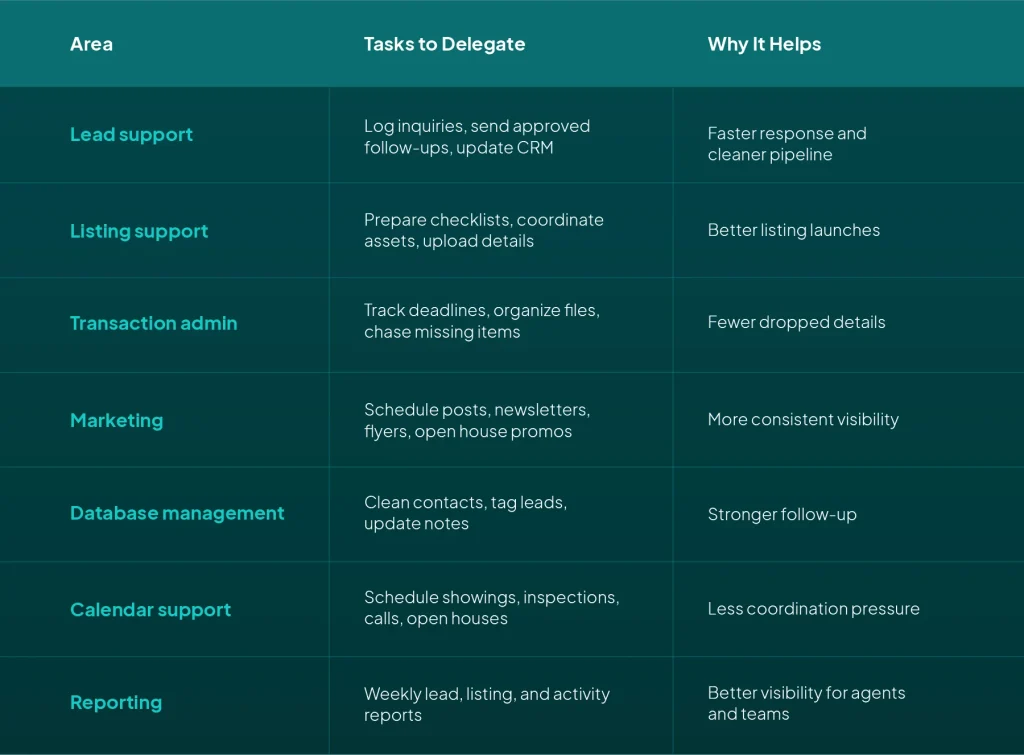
A real estate assistant can also help with vendor coordination, review requests, research, property notes, simple spreadsheets, and team meeting prep.
These are the exact tasks that often get pushed to nights and weekends. They matter, but they do not always need the agent’s direct time.
What Should Stay With the Agent?
A real estate virtual assistant should not handle licensed advice, pricing strategy, negotiations, contract interpretation, final approvals, or any task that legally requires a licensed professional in your market.
The assistant supports the workflow around the deal. The agent owns the client relationship and professional judgment.
For example, a virtual assistant for real estate can prepare listing materials, but the agent should approve pricing and strategy. They can organize transaction files, but sensitive details should still be reviewed by the right person. They can draft social captions or email templates, but the brand voice and compliance-sensitive language should be approved internally.
The safest model is simple: delegate the repeatable steps and keep the judgment calls.
Listing Support Tasks
Listing work is one of the clearest use cases for a real estate virtual assistant.
A listing launch can involve property details, photo coordination, MLS-ready copy, disclosures, showing instructions, open house materials, social posts, email announcements, flyer updates, and status tracking.
A REVA can turn that process into a checklist instead of a scramble.
They can maintain the listing tracker, confirm what is missing, coordinate assets, format descriptions, schedule marketing, and keep the agent updated. For busy agents and teams, this creates consistency and helps every listing feel more polished.
This is where real estate virtual assistant services become more valuable than broad admin support. The assistant understands that a listing is not just another admin task. It is a revenue event.
Lead Follow-Up Support
Lead follow-up is one of the highest-value areas for a real estate virtual assistant.
Agents often miss speed-to-lead moments because they are showing homes, driving, attending inspections, or sitting with clients. A virtual assistant for real estate can monitor new inquiries, enter leads into the CRM, send approved first-response messages, schedule calls, tag lead sources, and keep nurture lists organized.
They can also segment contacts by buyer, seller, investor, past client, referral partner, hot lead, warm lead, and long-term nurture.
This does not mean the assistant closes the lead. It means the lead does not disappear before the agent gets there.
For a virtual assistant for real estate agents, the goal is to protect the pipeline. The assistant keeps the system clean so the agent can focus on the conversation.
Transaction Admin Support
A transaction has too many moving parts to live in scattered emails.
A real estate virtual assistant can support transaction admin by maintaining checklists, organizing files, tracking dates, updating status notes, scheduling inspections, coordinating vendors, and sending approved reminders.
This is helpful for agents who manage their own transactions and for teams that already have a transaction coordinator but need extra daily support.
The assistant should not become the decision-maker. Their value is in keeping the transaction visible, organized, and easier to review.
They can reduce the “Where is that document?” problem, which saves time and lowers stress for everyone involved.
Marketing and Social Tasks
Real estate marketing becomes inconsistent when agents only post when they have free time.
Eeal estate virtual assistant can help maintain a steady presence by scheduling social posts, preparing listing graphics, updating email newsletters, formatting market updates, organizing testimonials, repurposing listing photos, and building simple content calendars.
They can also support open house promotion, review requests, past-client touchpoints, and basic video workflows such as uploading clips, drafting captions, and tracking posted content.
For agents and teams, this creates a marketing rhythm. You are not rebuilding your visibility every week from scratch.
This is one of the reasons many businesses compare real estate virtual assistant companies. They do not only want admin help. They want someone who can help the brand stay visible while agents stay focused on clients.
CRM and Database Tasks
A messy CRM is one of the most expensive hidden problems in a real estate business.
Contacts sit without tags. Past clients disappear. Seller leads are not followed up on. Referral partners are not organized. Notes are incomplete. No one knows which leads are active and which ones need nurturing.
A real estate virtual assistant can clean and maintain the database so the CRM becomes useful again.
They can remove duplicates, update contact records, add notes, tag leads, create reminders, log conversations, and prepare weekly pipeline summaries.
This work is not glamorous, but it compounds. Better data leads to better follow-up, better marketing, and better client retention.
For many agents, CRM cleanup should be one of the first tasks assigned to a real estate virtual assistant.
Pricing in 2026
The cost of a real estate virtual assistant depends on experience, location, hours, scope, tools, and whether the role is general admin or real estate-specific.
As a broad freelance benchmark, Upwork lists virtual assistants at a median rate of $13 per hour, with typical hourly rates between $10 and $20. A real estate-focused assistant may cost more if they bring CRM experience, listing coordination, transaction familiarity, and strong client communication.
It also helps to compare the cost against agent time. BLS reported May 2024 median annual wages of $72,280 for real estate brokers and $56,320 for real estate sales agents. A REVA does not replace that work. They protect higher-value agent time from being consumed by lower-value admin.
| Hiring Option | Best For | Cost View |
| General VA | Scheduling, data entry, simple admin | Lower cost, more training |
| Real Estate Virtual Assistant | Listings, CRM, lead support, transaction admin | Stronger fit for real estate workflows |
| In-house real estate assistant | Local support and deeper office integration | Salary plus overhead |
| Hiring partner | Vetted shortlist and role-specific matching | More structured hiring process |
The cheapest option is not always the best option. A lower-cost assistant who needs constant correction may create more management work. A stronger real estate virtual assistant should reduce that pressure over time.
Where ROI Shows Up
The ROI of a real estate virtual assistant usually shows up in saved time, faster response times, cleaner operations, and more consistent revenue activity.

A good hire can help agents spend more time on prospecting, listing appointments, buyer consultations, referral calls, negotiations, and client experience.
ROI can show up through:
Faster lead response.
Cleaner CRM records.
Better listing launches.
More consistent marketing.
Fewer missed reminders.
Less time spent searching for files.
More follow-up with past clients.
More client-facing hours each week.
The right question is not only, “What does this assistant cost?”
The better question is, “What revenue-producing work becomes possible when admin is no longer blocking the agent?”
Solo Agent vs Team
A solo agent usually needs a real estate virtual assistant for recurring admin, CRM updates, listing prep, social scheduling, lead support, and weekly reporting.
A team usually needs more structure. The assistant may maintain shared trackers, clean the database, prepare listing launch checklists, coordinate transaction updates, and help team leads see what is happening across the pipeline.
A brokerage may use real estate virtual assistants for agent onboarding, recruiting admin, document tracking, marketing coordination, or office support.
The right setup depends on volume. A solo agent may start part-time. A busy team may need dedicated support. A high-volume business may need multiple real estate virtual assistants across lead management, transaction admin, and marketing.
Wholesale and Investor Support
A virtual assistant’s wholesale real estate role can look different from traditional residential support.
Investors may need help with property research, CRM updates, seller lead follow-up, skip tracing coordination, cold outreach support, appointment booking, comp research prep, and pipeline tracking.
A real estate virtual assistant can support these workflows by keeping outreach organized and ensuring leads are not left untouched.
Strategy, offer decisions, negotiation, and market judgment should stay with the investor or licensed professional where required. The assistant keeps the process moving.
How to Hire Better?
Before comparing names like Reva Global or other real estate virtual assistant companies, define the role clearly.
Start with what the assistant will own in the first 30 days:
Lead response and CRM updates.
Listing launch checklists.
Transaction deadline tracking.
Social media scheduling.
Database cleanup.
Client follow-ups.
Weekly pipeline reports.
Then list the tools they need to know. This may include your CRM, transaction management system, Google Workspace, email marketing platform, Canva, social scheduler, spreadsheets, or project management tool.
At Anywhere Talent, this is where matching becomes important. Real estate virtual assistants should be screened for communication, ownership, tool readiness, and real estate context, not just general availability.
Onboarding Checklist
A real estate virtual assistant will perform better when onboarding is specific.
Give them your lead stages, listing checklist, transaction checklist, CRM rules, file naming structure, escalation rules, email templates, response-time expectations, weekly reporting format, and approved marketing language.
Do not hand over everything at once. Start with one workflow, measure accuracy, then expand.
A strong Real Estate Virtual Assistant should make the business feel more organized within the first few weeks. Over time, they should become part of the operating rhythm, not another person the agent has to constantly manage.
Final Takeaway
A real estate virtual assistant is not just someone who helps with admin. The right hire protects the agent’s most valuable asset: time.
They keep leads moving, listings organized, transactions visible, marketing consistent, and databases cleaner. They help agents and teams spend less time buried in coordination and more time doing the work that creates revenue.
For solo agents, that may mean consistent follow-up and marketing. For teams, it may mean cleaner operations and fewer dropped details. For brokerages, it may mean structured support across agents and systems.
In a market where clients still rely heavily on agents, the professionals who win are often the ones who protect their selling time best.
If your real estate business is ready for support that understands the workflow, Anywhere Talent can help you find a vetted real estate virtual assistant with the communication skills, role discipline, and real estate context to support your next stage of growth.