

A finance virtual assistant helps small businesses organize invoices, receipts, vendor records, payment follow-ups, and reporting prep without handing over final financial control. In 2026, the right hire should bring accuracy, privacy awareness, and clear communication, not just basic admin support.
Finance admin becomes a problem long before it looks like a finance problem.
It starts with invoices going out late, receipts sitting in inboxes, vendor records living in five different folders, and payment follow-ups depending on memory. The founder still checks the spreadsheet at night. The accountant keeps asking for missing documents. Month-end feels heavier than it should because the basic records were never organized on time.

A finance virtual assistant does not replace your accountant, bookkeeper, CPA, or finance lead. The role supports the admin around your financial workflow so the right people can make decisions with cleaner, faster, better-organized information.
For many small businesses, the real problem is not that financial work is too complex. It is that no one owns the small recurring steps until they become urgent. Invoices wait too long, receipts stay scattered, vendor follow-ups get missed, and the founder ends up fixing everything at the end of the month. The solution is not always a full-time finance hire.
Anywhere Talent helps businesses think beyond basic admin support. The goal is to match companies with remote professionals who understand accuracy, communication, and the kind of financial admin that keeps operations from slipping.
Tasks Finance VAs can handle
A finance virtual assistant is a remote finance assistant who helps with recurring financial admin. Their work usually sits between general admin and bookkeeping support.
They may track invoices, organize receipts, update expense records, prepare payment reminders, maintain vendor files, clean finance folders, and prepare weekly or monthly summaries for review.
The role is useful because a finance admin depends on accuracy. The U.S. Bureau of Labor Statistics describes bookkeeping, accounting, and auditing clerks as workers who help maintain complete and accurate financial records. That is the kind of order this role can support, as long as the scope is clearly defined.
The best tasks for a finance virtual assistant are repeatable, document-based, and easy for a manager, bookkeeper, or accountant to review.
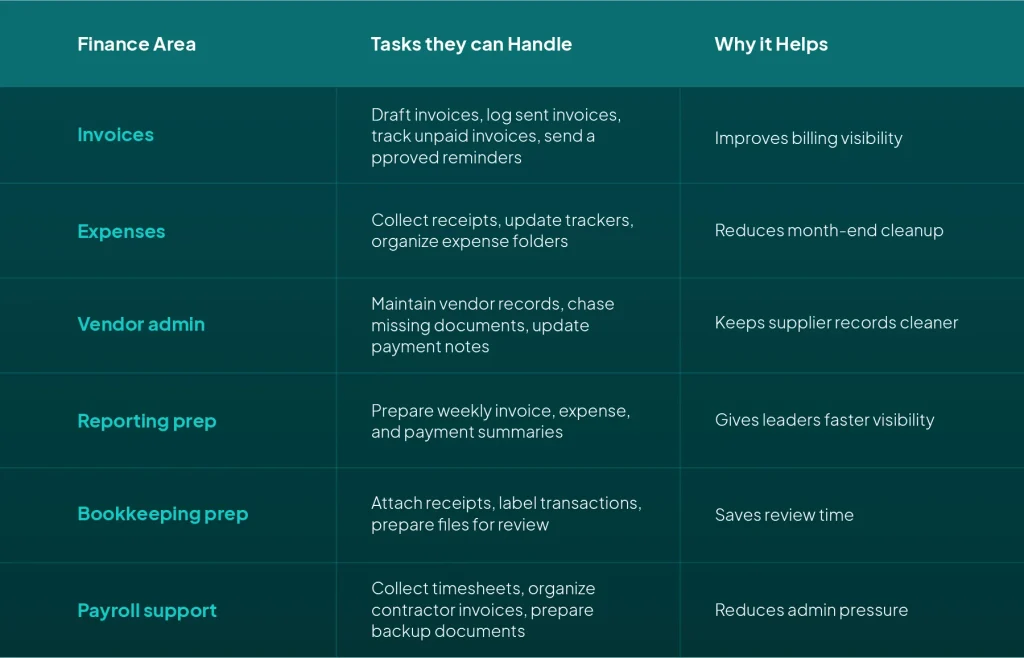
The biggest benefit is that the finance admin stops depending on whoever has extra time. A finance VA gives the workflow a clear owner. Instead of the founder checking unpaid invoices between meetings or searching for receipts at night, the assistant maintains the tracker, updates records, and flags what needs attention. That kind of support does not remove financial control. It creates better visibility around the work that was already happening informally.
What stays in-house?
A finance virtual assistant should not approve payments, make tax decisions, interpret complex financial statements, sign filings, change payroll rules, decide budgets, or give financial advice.
Those responsibilities should stay with the business owner, accountant, CPA, controller, or finance lead.
BLS describes accountants and auditors as professionals who prepare and examine financial records, identify risks, assess financial operations, and support tax-related work. That is a different level of judgment from assistant-level finance support.
- The assistant can prepare invoice records. Your finance lead approves billing rules.
- The assistant can organize receipts. Your accountant decides how expenses should be treated.
- The assistant can update a tracker. Your founder decides what action to take.
- That boundary keeps the role useful without creating risk.
Privacy basics before hiring
Finance support needs stronger access rules than normal admin support.
A finance virtual assistant may see invoices, vendor details, payment records, customer information, payroll documents, or expense reports. That does not mean they should have full access to everything.
The FTC advises businesses to restrict access to sensitive data and use separate user accounts so access can be controlled properly.
Before onboarding a finance virtual assistant, set these privacy basics:
- Give individual logins, not shared passwords
- Use multi-factor authentication
- Start with view-only access where possible
- Keep payment approval separate
- Limit folder access by role
- Use a password manager
- Document what they can and cannot download
- Remove access immediately if the role ends
What does good finance VA communication look like?
Most finance admin problems are not accuracy problems. There are communication problems. The assistant finds something unclear and does not flag it. A vendor record looks incomplete, but gets filed anyway. A receipt does not match the invoice amount, and nobody mentions it.
A strong finance virtual assistant communicates before problems grow. That means:
- Flagging unclear items the same day, not waiting for the weekly check-in
- Asking one specific question instead of leaving a task half-done
- Noting what was updated so the founder or accountant does not have to guess
- Confirming when a recurring task is complete rather than assuming it was noticed
- Escalating anything involving payment decisions immediately, without trying to resolve it independently
That kind of communication does not require daily meetings. It requires clear expectations set at the start and a simple system for flagging issues as they come up.
A good finance virtual assistant should understand confidentiality, access limits, documentation rules, and when to escalate instead of guessing.
Anywhere Talent’s role-fit approach is useful here because the right hire needs more than availability. They need discipline around financial records, comfort with tools, clear written communication, and respect for privacy boundaries. When those basics are screened early, the business can delegate finance admin with more confidence
AI or human support?

- An AI personal finance assistant can help summarize information, categorize simple expenses, or surface patterns from connected accounts. But business finance admin still needs human follow-through.
- The assistant can check whether receipts are missing, follow up with vendors, update trackers, organize documents, prepare reports, and flag unclear items before they become bigger problems.
- The best setup is not AI versus human support. It is AI for faster summaries, a finance assistant for daily organization, and a qualified professional for final judgment.
- A finance virtual assistant works best when the business already knows what it needs organized, not when it is still figuring out its own financial workflow.
What does Finance VAs cost?
- Cost depends on location, experience, hours, software knowledge, and scope.
- As a broad benchmark, Upwork lists virtual assistants at $10 to $20 per hour. Specialized finance admin may cost more because the role requires accuracy, confidentiality, spreadsheet comfort, and stronger process discipline.
- It also helps to compare this with internal finance admin roles. BLS reported that bookkeeping, accounting, and auditing clerks earned a median annual wage of $49,210 in May 2024.
- For many small businesses, a finance virtual assistant is not about replacing a full-time finance hire. It is about getting recurring finance admin handled before the work becomes an expensive cleanup.
When should you hire?
You may need a finance virtual assistant if invoices are going out late, receipts are scattered across inboxes and folders, your accountant keeps asking for missing documents, vendor records are incomplete, expense tracking is always behind, or the founder still manages payment reminders manually.
The strongest sign is simple: your financial admin is taking time away from decisions, sales, clients, or actual finance review.
That is when this role can create real operational relief.
The right finance support should make the business feel more in control, not less. If the assistant is only completing random tasks, the founder still carries the mental load. But when the role is structured properly, a finance virtual assistant can turn scattered admin into a repeatable workflow: invoices are tracked, receipts are attached, vendors are updated, reports are prepared, and missing items are flagged before they become a problem.
That is the practical value of specialized support. It gives the business cleaner records, fewer last-minute scrambles, and more time for the people who should be making decisions instead of chasing documents. For teams that are not ready for a full internal finance hire, Anywhere Talent can help bridge that gap with vetted remote finance support that fits the way the business actually works.
Final takeaway
A finance admin does not usually break a business overnight. It slows the business down quietly.
Late invoices affect cash flow. Missing receipts delay reporting. Messy vendor records create confusion. Unclear trackers make every review harder than it needs to be.
A finance virtual assistant helps solve that problem by keeping invoices, receipts, vendor records, payment follow-ups, and finance trackers organized, visible, and ready for review. They do not replace your accountant or finance lead. They make it easier for those people to do their work well.
If the finance admin is starting to slow down your team, the answer is not to keep pushing it to nights, weekends, or month-end cleanup. The better move is to give the workflow a clear owner while keeping final financial decisions with your accountant, finance lead, or founder.
Anywhere Talent can help you find a vetted finance virtual assistant who understands accuracy, privacy, communication, and the daily admin that keeps financial operations organized.