

If you’re still debating regarding hiring an EA, here’s the honest test: are you spending your best hours on work only you can do or on work that simply landed on your desk? Most founders burn out because they’re the default person for everything: scheduling, chasing, clarifying, and “just handling” the small stuff.
This guide breaks down what changes when you hire an EA the right way: what to delegate first, how to estimate ROI, what a great EA actually owns, and the traps that turn the role into “another thing to manage.”
Is an EA a luxury?
From the outside, hiring an EA can look like a perk. In reality, it’s usually the first real step toward a leadership operating system.
Microsoft’s Work Trend research described the “infinite workday”: people online early, email piles starting before sunrise, and 100+ messages arriving in a day. In that environment, your attention becomes the most expensive resource in the company.
So the actual question isn’t “Can I afford an EA?” It’s: “What does it cost me to keep doing this myself?”
When should you hire?
Most founders hire late. The usual sequence is: “I can handle it” → “I’m behind” → “I’m stressed” → “I need help yesterday.” The better sequence is hiring an EA before the chaos becomes normal.
You’re ready for hiring an EA if three or more of these are true:
- Your calendar changes daily, and you’re personally fixing it.
- Follow-ups slip unless you chase them.
- Your inbox feels like a second job.
- Meetings happen without agendas, and you keep “winging it.”
- You can’t get a clean 90-minute focus block in a week.
- You keep postponing strategic work because “operations happened.”
A recent Upwork survey of small business leaders reported that non-core work can take roughly 30% of the week, the equivalent of months each year. The point is the pattern: leaders are doing work outside their core role, and it’s blocking growth.
One thing we see again and again is founders hiring “an EA” without deciding what lane they need to own first. That’s where the role feels messy, and the ROI takes longer than it should. A quicker approach is to define the first 30-day lane (calendar, inbox, or follow-through), then hire for that outcome. That’s also how our team at Anywhere Talent sets up EA searches with clarity first, then candidate fit, so you feel relief early instead of slowly “training into it.”
What should you delegate first?
A common mistake in hiring an EA is dumping a messy pile of tasks on day one. Great delegation starts with a lane, a full loop with clear ownership.

Start with one lane for the first two weeks:
- Calendar ownership (scheduling, buffers, confirmations, reschedules)
- Inbox triage (sorting, drafting, routing, escalating)
- Follow-through system (action items, stakeholder nudges, reminders)
If you’re unsure which lane to pick, choose the one that creates the most interruptions. Hiring an EA should reduce “quick questions,” not create more.
If you want a fast start, here’s a practical “Week 1” task list you can hand over without risking the business:
- Scheduling + confirmations: book meetings, confirm time zones, send the “here’s the agenda” note.
- Reschedule handling: propose 2–3 options and protect buffers, so you aren’t doing calendar Tetris.
- Meeting prep packs: pull links, past notes, and the “decision needed” line into one brief.
- Follow-up drafts: write the first pass of follow-ups so you only approve or tweak.
- Admin loops: invoices that need nudging, vendor emails, document requests, and simple CRM updates.
And here’s what you shouldn’t delegate in week one (even with a great person):
- sensitive people conversations you haven’t framed yet,
- pricing decisions,
- performance feedback,
- anything that depends on your personal judgment but has no written rules.
One more founder truth: an EA is not the same as a general VA. A VA can execute tasks well; a great EA can run a lane with judgment. That’s why the handoff packet (outcome, constraints, SOP, QA) matters more than the tool you use.
How much time can you save?
There isn’t one universal number; it depends on how you work and what you hand off. But leadership writers consistently point out that a partnership model (not a transactional model) can save real time. One Forbes leadership piece notes the possibility of saving up to eight hours per week when the executive assistant relationship is treated as a partnership.
Now layer in switching costs. Cognitive science and workplace research repeatedly show that task-switching creates errors and lost time; one research-based summary notes productivity can drop significantly when people multitask and switch between tasks. In plain terms, every “quick interruption” steals more than the minute you see on the clock.
That’s why hiring an EA often creates a double win:
- Time reclaimed (fewer admin hours)
- Focus protected (fewer interruptions during deep work)
What does an EA actually own?
The difference between average support and true leverage is ownership. Hiring an EA doesn’t work if the EA waits for permission at every step.

A great EA owns:
- Time: calendar rules, buffers, meeting triage, time zones
- Information: inbox routing, drafting, prioritizing what you see
- Meetings: agendas, prep briefs, recaps, action items
- Follow-through: reminders, nudges, deadlines, “nothing drops.”
- Stakeholders: confirmations, coordination, tone, relationship hygiene
This is why the best EAs feel like a second brain: they reduce the surface area of decisions you have to make.
What changes by day 30?
If hiring an EA is working, your week feels different by day 30: not perfect, but measurably lighter.
You should notice:
- Fewer calendar surprises
- Fewer overdue follow-ups
- Better prepared meetings
- More uninterrupted focus time
- Decisions surfaced once (in a brief), not all day in pings
If none of that is true, the problem is usually scope and onboarding, not effort.
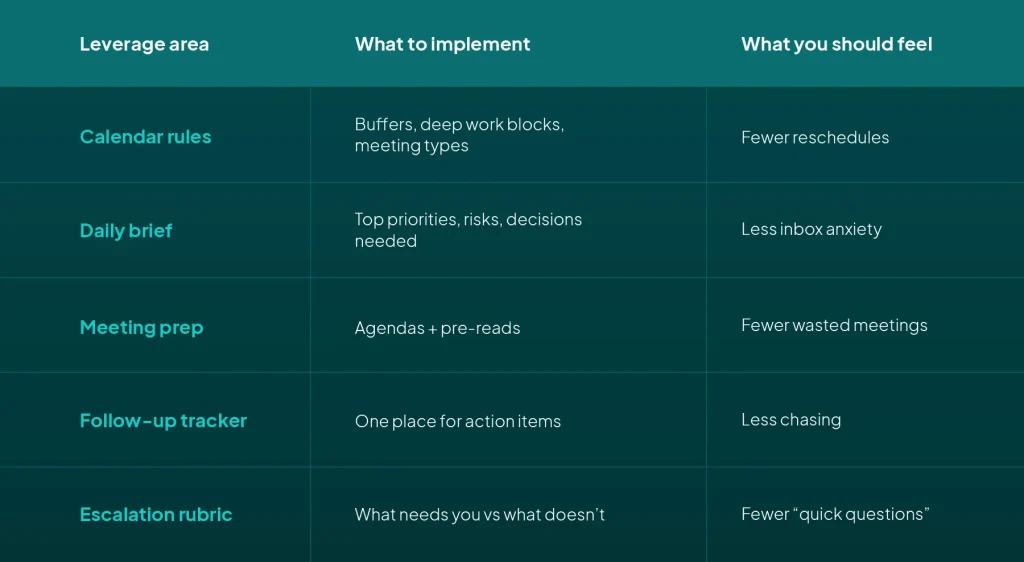
The leverage checklist
Use this as a quick “Are we hiring an EA correctly?” checklist.
The ROI calculator
If you want to sanity-check hiring an EA, use this simple calculation:
- Estimate the hours/week you spend on admin, coordination, and follow-ups.
- Multiply by your “executive hour” value (salary-based or opportunity-based).
- Compare to EA compensation.
Example (simple, conservative):
- 6 hours/week reclaimed
- Your hour is valued at $150
- That’s $900/week in recovered leadership time (~$46,800/year)
That calculation ignores the second-order value: the strategic work you actually do with those hours.
One more reality check: the cost of an EA is usually smaller than the cost of you doing EA work. Public labor data puts executive-level assistant pay in the mid-five figures to low-six figures in the U.S., depending on scope and market. Even if you pay for top-tier support, it’s still rarely the best use of founder time to spend hours per week on scheduling, chasing, and coordination.
If you want this to be financially clean, tie the role to outcomes: “calendar stabilized,” “follow-ups closed,” “meetings prepped,” “weekly plan ready.” When those outcomes happen, the cost stops feeling like overhead and starts feeling like capacity.
Make Hiring an EA Actually Work
If you’re reading this because your week is getting hijacked by calendar churn, inbox noise, and follow-ups you should not be chasing, we are here for you. Most founders don’t struggle to “work hard.” They struggle because there’s no system between decisions and execution.
Anywhere Talent helps you fix that end-to-end: we clarify the first lane you need owned (calendar, inbox, or follow-through), match you with an EA who can run it, and set a simple onboarding rhythm so the role starts paying you back in weeks, not months. Connect with Anywhere Talent
How to make it stick?
Here’s the truth most posts skip: hiring an EA is a relationship that improves when you design it.
Use this 30-60-90 structure:
Days 1–30: One lane owned
Pick one lane and transfer it end-to-end. Start a daily brief.
Days 31–60: Second lane + stakeholder system
Add a second lane and build a clean follow-up tracker.
Days 61–90: Proactive protection
Your EA starts flagging conflicts early, improving SOPs, and protecting priorities without prompting.
If you’re still answering 20 “quick questions” a day by week six, it’s not a talent problem. It’s a system problem.
Biggest mistakes to avoid
Most “Hiring an EA failed” stories fall into a few predictable buckets:
- No definition of done
You said “handle this,” but never defined success. - Too many lanes at once
Transfer one lane fully before adding another. - The founder overrides the system
If the EA creates a tracker, use it. If deep work is blocked, protect it. - No authority
If the EA can’t decline, confirm, or reschedule within clear rules, you remain the bottleneck. - No weekly reset
A 30-minute weekly review prevents a month of friction.
Remote vs local
Founders overthink geography. Fit matters more. Prialto’s Productivity Report found only 1.36% of leaders had a remote or outsourced EA, because most never formalize the system.
Go local when you need in-person coverage. Go remote for calendar, inbox, follow-through, and coordination, work that scales with docs.
Hiring an EA remotely works best when you define overlap hours, response expectations, and the escalation rubric in writing.
Remote support succeeds when expectations are written, and the rhythm is predictable. The founders who get the best results usually set overlap hours, decide escalation rules once, and run a weekly reset. When Anywhere Talent supports a remote EA hire, we push this structure early because the difference between a “helpful assistant” and real leverage is almost always the operating system, not the person’s résumé.
What to ask in interviews?
Hiring an EA is a judgment hire. Don’t rely on “years of experience” alone.
Ask scenario questions:
- Two VIPs want the same slot. What do you do?
- What do you escalate immediately?
- How do you protect deep work without being rude?
- What does your daily brief look like?
Then run a work sample:
- calendar rebuild with constraints
- inbox triage with drafts + routing
- meeting prep brief + follow-up email
Work samples prevent “great talkers” from slipping through.
The board-friendly framing
If you need to justify hiring an EA to a board or finance partner, don’t pitch it as “support.” Pitch it as capacity.
- Upwork’s research highlights how much time leaders spend on non-core work.
- Microsoft’s research shows the volume of messages and the early start to the day.
- Task-switching research highlights the hidden cost of interruptions.
The point: the company is paying executive rates for non-executive work. Hiring an EA is the correction.
If you’re considering hiring an EA but don’t want to spend weeks sifting through profiles, Anywhere Talent helps founders hire EAs who can actually own a lane. We focus on role fit, communication, and systems thinking. You’ll get a tight shortlist, onboarding support, and a clear operating rhythm so leverage shows up quickly.