


If you hired a remote executive assistant service and it finally felt like you could breathe again, you already know the scary part: losing them reopens every loop they quietly kept closed. Your calendar gets messy. Follow-ups slow down. “Quick questions” start eating your mornings. And the founder becomes the operating system again.

Retention isn’t a “soft” topic. Researchers and workplace studies consistently show replacement costs can be brutal, especially for trusted roles. When you lose your remote executive assistant service, you don’t just backfill a seat. You lose the person who knew how your week actually works. That’s why the goal here is not to “keep someone happy.” It’s to retain your remote executive assistant by making the role sustainable and respected.
This is the retention playbook founders rarely get: how to retain a remote executive assistant hired through a remote executive assistant service with the right pay structure, clear growth paths, and a few red flags you can spot before the resignation email lands.
You’ll also get a simple “stay interview” script and a 90-day retention plan you can implement immediately.
What is an executive assistant?
An executive assistant (EA) is the person who protects an executive’s time and follow-through so the business doesn’t run on reminders. A great assistant is not “admin help.” They triage what matters, keep meetings purposeful, and make sure decisions turn into action.
When you hire through a remote executive assistant service, the definition matters even more because the work is mostly invisible: the clean calendar, the calm inbox, the follow-ups that happen without you chasing. That invisibility is why founders sometimes underestimate the role, until it’s gone.
What makes a great EA?
If you ask ten founders what makes a good executive assistant, you’ll get ten different answers. But the top performers share the same three behaviors:
- Judgment over instructions. They can decide what to escalate and what to handle.
- Systems over hustle. They build templates, cadences, and rules so work repeats cleanly.
- Representation over “tasking.” They communicate like you, clear, calm, and professional.
An executive personal assistant can cover parts of this, but “executive assistant” implies higher discretion and ownership. The retention question is simple: are you giving your executive assistant the authority to operate, or are you keeping them stuck in permission mode?
Why do great EAs leave?
Founders often assume people leave for money. Money matters, but it’s rarely the only reason. The “quiet quit” drivers are usually structural.

One more retention trap is “shared support” without clear boundaries. In many companies, assistants get pulled in multiple directions unless leaders set rules and priorities. If your executive assistant supports multiple stakeholders, the role needs a triage system; otherwise, everything becomes urgent, and the EA becomes everyone’s shock absorber.
For a remote executive assistant service, the most common slow-burn exit drivers look like this:
- They became your shock absorber. Every urgent request lands on them, but nothing gets redesigned.
- They have responsibility without authority. They’re expected to “handle it” but can’t say no, can’t enforce rules, and can’t represent you.
- They’re trapped in reactive work. Calendar churns all day, no time to build systems.
- No growth path exists. They don’t know what “next level” looks like.
- The trust layer is weak. You don’t share context, but you expect outcomes.
If you want to retain your remote executive assistant service, you fix the system they’re working inside, not just the job title.
How much is an EA per hour?
A good remote executive assistant service will be transparent about pricing bands and what each band includes (admin lane vs executive lane vs strategic lane).
The best approach is to anchor your range to market reality, then pay for scope and autonomy.
A conservative benchmark: U.S. median wages for broad admin roles sit far below executive-level support, and they vary widely by specialization and location. Remote does not automatically mean “cheap,” especially when the role includes discretion, executive presence, and operations ownership.
Here’s how founders lose great people: they hire through a remote executive assistant service for tactical work, then expand the role into ops + stakeholder management without adjusting compensation.
A simple pay framework for the Remote Executive Assistant Service
Instead of one number, think in tiers based on scope:
- Tier 1 (Admin lane): calendar, travel, basic scheduling rules
- Tier 2 (Executive lane): inbox triage, meeting prep, follow-through, stakeholder coordination
- Tier 3 (Strategic lane): systems building, weekly planning rhythm, proactive prioritization, light ops ownership
When your assistant moves up a tier, pay should move too. If pay stays static while responsibility expands, churn risk rises.
Conservative comp moves that retain people without overcommitting:
- Adjust base when scope changes (not only at annual review).
- Use a small performance bonus tied to outcomes (not “effort”).
- Add a learning budget if you want them to grow into higher leverage work (tools, ops, AI workflows).
How to build growth for EAs?
Retention isn’t only “pay more.” Great EAs stay when they can grow in responsibility without burning out.
Here are three growth paths that work especially well after hiring through a remote executive assistant service:
Path A: Senior EA track
EA → Senior EA → Executive Operations Partner
Growth markers: better judgment, faster triage, stronger stakeholder confidence, more autonomy
Path B: Ops track
EA → Ops Coordinator → Executive Ops Lead
Growth markers: SOPs, dashboards, process redesign, cross-team coordination
Path C: Leadership support track
EA → EA Manager → Executive Office Lead
Growth markers: training other assistants, standardizing workflows, hiring, and onboarding
Your job is to define what “leveling up” looks like in writing. If you want an EA to stay, give them a visible next step that isn’t “work harder.”
What should you stop doing?
If you want to retain the talent you hired through a remote executive assistant service, stop doing these five things:
- Stop treating every request as urgent. Urgency without triage burns people out.
- Stop changing rules daily. Make rules once, update weekly.
- Stop bypassing systems. If they built a tracker, use it.
- Stop hiding context. Context is what enables good judgment.
- Stop making them the “yes” person. A great EA protects priorities, including declining.
These sound small. They’re not. Remote executive assistant service is the difference between “great assistant” and turnover.
What should you start doing?
Here are the founder behaviors that keep high performers longer, especially when you hire through a remote executive assistant service:
- Weekly priorities in one place. One doc, one source of truth.
- A daily brief format. Decisions needed, risks, and what’s moving today.
- An escalation rubric. What comes to you immediately, vs what they handle.
- Meeting standards. No agenda, no meeting (or at least a purpose).
- Quarterly reset. Review what they own, what should be automated, and what should be delegated further.
This is how to be a good executive assistant to the CEO and how to support them: reduce ambiguity, increase authority.
How top CEOs retain EAs
When you study leaders who keep great assistants for years, the pattern is boring, and that’s the point. They remove chaos, then they reward ownership.
Here are seven moves that consistently help you retain the EA you hired through a remote executive assistant service:
- They treat the calendar as a policy. If deep work is blocked, it stays blocked.
- They protect “build time.” One hour weekly where the EA improves templates, SOPs, and workflows.
- They give public authority. They tell the team: “My EA (supported by our remote executive assistant service) can confirm, decline, or reschedule.”
- They use one source of truth. One tracker, one recap format, one rhythm.
- They measure outcomes, not effort. Cleaner weeks, fewer misses, faster follow-ups.
- They do stay interviews early. Quarterly, the same five questions, then one change within seven days.
- They pay for the scope. When the role becomes more strategic, comp moves before the EA has to ask.
If you implement only two: authority + build time. Those two reduce burnout fast.
Remote-specific retention levers
Remote changes the relationship. Any remote executive assistant service will tell you the same thing: clarity beats constant check-ins.
- Overlap windows
Pick a predictable overlap block. Even two strong overlap hours daily can stabilize coordination. - Written decisions
Remote thrives on written clarity. A two-line decision beats a ten-message thread. - Trust signals
Give public authority: “Loop my EA in; they can schedule and confirm.” High-trust roles work when the organization understands the assistant represents the executive. - Tool hygiene
Remote work breaks when tools are messy. Keep one task system, one notes system, and one calendar rule set. - Security basics (remote)
If your EA comes through a remote executive assistant service and touches email, calendar, or CRM: MFA, password manager usage, and least-privilege access are baseline. Treat this as operational hygiene, not “IT stuff.”
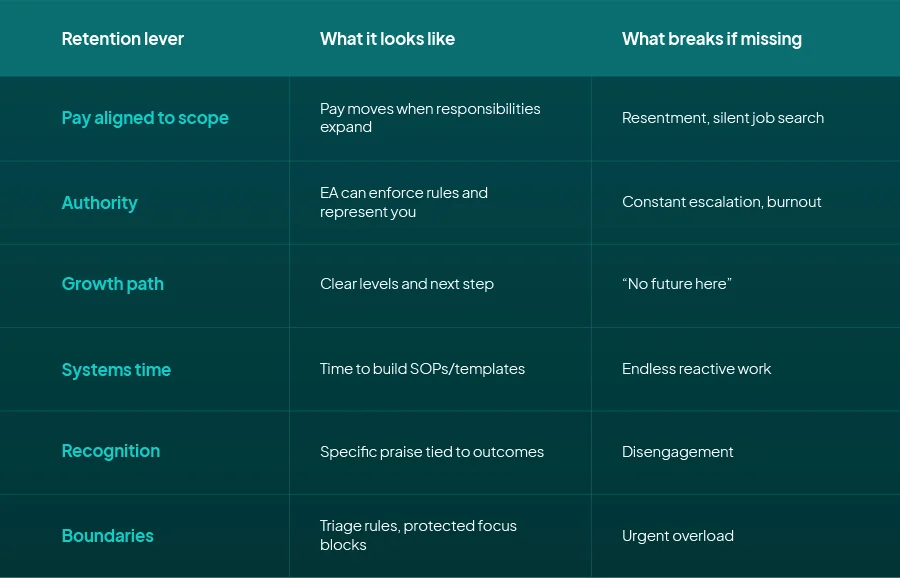
The retention table – Remote Executive Assistant Service
Red flags ahead
Here are the red flags I watch for when founders ask why their EA “suddenly” left.
Red flag 1: Everything is manual
If they’re still scheduling by back-and-forth emails, there’s no system. They’ll burn out.
Red flag 2: You’ve become the blocker
If they can’t send follow-ups, decline meetings, or confirm schedules without approval, they’ll get tired of permission work.
Red flag 3: Their updates shrink
Not “more concise”, shorter because they’ve stopped believing change will happen.
Red flag 4: Work only grows
If every new tool or process adds more steps, they’ll disengage.
Red flag 5: They stop improving
When a great EA stops suggesting better ways, they’re usually already halfway out.
If you want to retain the EA you hired through a remote executive assistant service, treat these as early warning signals, not personality issues.
The stay interview script
Do this once per quarter. Not as a performance review. As a retention check.
Ask your EA:
- “What part of your week feels like noise?”
- “Where do you feel stuck waiting on me?”
- “What’s one rule we should make permanent?”
- “What’s one skill you want to build next?”
- “If you were in my seat, what would you change about how we work?”
Then do the only part that matters: change one thing within seven days.
90-day retention plan
If your EA is good but fragile (high workload, rapid growth), run this plan.
Days 1–30: Stabilize
- Clarify one owned lane.
- Implement daily brief.
- Build escalation rubric.
Days 31–60: Systemize
- Create templates for the top 10 recurring tasks.
- Add a follow-through tracker.
- Set meeting standards.
Days 61–90: Grow
- Define next-level responsibilities.
- Add one growth project (automation, SOP build, stakeholder system).
- Adjust pay if the scope is expanded.
This is how to retain your remote EA after hiring through a remote executive assistant service, without turning retention into a “please stay” conversation.
Hiring for retention
When you’re choosing a remote executive assistant service, ask how they screen for judgment, how they onboard, and what happens if the match needs to change.
Retention starts in hiring.
If you hire for “help,” you get someone who needs you. If you hire for ownership, retention gets easier. When evaluating candidates, test for:
- judgment in messy scenarios,
- ability to write clean updates,
- comfort saying “no” with alternatives,
- systems mindset.
That’s how to be the best executive assistant and how to hire one.
If you’re evaluating a remote executive assistant service, treat retention support as part of the product, not an afterthought.
Where does Anywhere Talent fit?
- Anywhere Talent is a remote executive assistant service provider built for founders who want ownership, not more back-and-forth.
- We help founders hire executive support talent with a strong emphasis on ownership and communication.
- We can shortlist candidates, run work-sample tests, and help define scope so your pay, growth path, and expectations match from the start.
- Connect with Anywhere Talent to hire through our remote executive assistant service and retain your EA long-term without rebuilding the process from scratch.