
If you’re a founder or executive, you probably started your company to solve a problem or build something meaningful, not to drown in emails and calendar invites. Yet the modern workday often looks like a cascade of pings, meeting requests, and follow‑up loops. Top CEOs install a system that keeps decisions, meetings,s and follow-ups moving without constant founder attention. For many leaders in 2026, that system includes an executive virtual assistant.
These specialized assistants combine high‑level administrative expertise with digital fluency and operations sense to help CEOs scale without burning out. This guide explores how top CEOs use these assistants to move faster, explains the evolving skill set behind the role, and shows how you can implement similar workflows.
What Is an Executive Virtual Assistant?
An executive virtual assistant is not just a remote administrative helper. It’s a skilled professional who manages the executive’s time, information flow, and follow‑through to enable the organisation to scale.
Traditional virtual assistants often handle discrete tasks such as booking travel or handling simple data entry. In contrast, an executive virtual assistant operates with more autonomy, acting as the CEO’s right hand. They:
- Run the calendar like a strategy tool.
EVAs enforce buffers around deep work, prioritise key meetings, manage time zones, and block distractions. - Control communication.
They triage email, draft replies, route messages to the right team member, and prepare daily briefs summarising what matters. - Drive follow‑through.
They prepare agendas, capture decisions, track action items, and ensure commitments are completed. - Coordinate stakeholders.
EVAs communicate with investors, partners, and customers on behalf of the leader, maintaining tone and building rapport. - Manage special projects.
Many EVAs handle research, data analysis, or process improvements that free the CEO to focus on growth.
To perform these tasks, an executive virtual assistant needs judgment, emotional intelligence, and tech fluency: a combination that blends administrative precision with operational thinking.
Why Top CEOs Choose EVAs?
The reason is simple: leadership work is fragile. Interruptions compound, context gets lost, and the CEO becomes the router for every small decision.

Prialto’s Executive Productivity Report (2025) found that more than 70% of leaders lean on assistants. Pair that with research showing it can take 20+ minutes to fully resume a task after an interruption, and the math gets ugly fast: a few pings can wipe your best hour.
A strong executive virtual assistant reduces that tax by owning the messy middle: the scheduling, the triage, the prep, the follow-through, and the stakeholder nudges that keep momentum alive.
Market Growth and Industry Trends
The rise of the executive virtual assistant parallels the broader growth of the virtual assistant market. Future Market Insights predicts that the global virtual assistant services market will reach about $19.5 billion in 2025 and climb to $55.4 billion by 2035, representing an 11 percent compound annual growth rate.
Remote Coworker’s statistics show that nearly 49 percent of companies employing virtual assistants have more than 1,000 employees, indicating that large enterprises have embraced the model. The same dataset reveals that 37.7 percent of businesses use virtual assistants for administrative tasks and 20.5 percent deploy them for marketing activities, demonstrating the versatility of these professionals.
The market expansion coincides with the evolution of artificial intelligence. AI tools can automate routine tasks such as summarising meetings or sorting email, but research from MIT Sloan suggests that AI is likely to complement, rather than replace, human workers.
The EPOCH framework (Empathy, Presence, Opinion/Judgment, Creativity, and Hope) emphasises uniquely human capacities that remain critical. In other words, AI and automation empower executive virtual assistants to work smarter, but the human element, especially judgment and relationship management, remains irreplaceable.
What is the “lane” principle?
Here’s the pattern we see with top CEOs: they don’t hand over “a bunch of tasks.” They hand over a lane. That’s how an executive virtual assistant becomes useful instead of another teammate who needs constant direction.
A lane is a complete loop:
- it starts with intake (request, email, meeting need),
- runs through decisions (what to do, who owns it),
- ends with closure (confirmation, follow-up, done).
If you hire an executive virtual assistant and only delegate the middle, you’ll still get pinged at the start and end. Lane ownership is what makes the workload actually disappear.
EVA vs “basic VA.”
Not every virtual assistant is built for executive-level work. The difference is not “years of experience.” It’s the kind of problem they can solve without supervision.
A basic VA is great for task execution:
- data entry, formatting, booking, and simple research.
An executive virtual assistant handles executive flow:
- triage under ambiguity,
- sensitive stakeholders,
- decision timing,
- follow-through when priorities shift.
If you’re evaluating virtual executive assistants, ask for examples of lane ownership, not just tools they’ve used.
The ROI math

Most founders don’t need complicated math. They need a simple question answered: “If I add an executive virtual assistant, will my best hours come back?”
Start with three numbers:
- hours reclaimed per week (be conservative),
- your effective hourly value (revenue impact, decision value, or billable rate),
- EVA cost.
ROI (rough) = (hours reclaimed × hourly value) – cost.
This is why top CEOs keep hiring executive virtual assistants: even small reclaimed blocks compound across weeks, quarters, and product cycles. The best executive virtual assistant makes the gains measurable, not just felt.
Security basics
If your executive virtual assistant touches your inbox, calendar, or CRM, security isn’t optional. Keep it boring and consistent:
- MFA on email, password manager, and any customer system,
- no passwords in chat,
- least-privilege access (start small, expand after week two),
- clean offboarding (disable access, rotate shared credentials).
Teams that skip this step don’t “move faster.” They just build risk.
The CEO workflows that scale
Below are the workflows we see top CEOs rely on again and again. The pattern is consistent: they define one lane, hand it over fully, then expand the scope only when execution is stable.
Workflow 1: Calendar control
A CEO’s calendar is a strategy document. The job isn’t “book meetings.” It’s protecting priorities.
What the executive virtual assistant sets up:
- Meeting types (e.g., sales, 1:1s, internal reviews) with default lengths
- Buffers (10–15 minutes) between key calls
- Deep work blocks that are treated as non-negotiable
- A “triage rule” for requests: what gets accepted, what gets declined, what gets rescheduled
- Time zone checks for every external meeting
CEO outcome:
- Fewer surprise meetings
- Less rescheduling
- More usable focus time
Workflow 2: Inbox as pipeline
Most inboxes become unowned queues. CEOs don’t need more email time; they need a decision pipeline.
What the executive virtual assistant sets up:
- Labels: Decide / Delegate / Draft / Schedule / Later
- Draft rules: which emails get drafted vs escalated
- Delegation paths: who owns what category
- A daily brief: decisions needed, risks, and the top 5 messages worth reading
CEO outcome:
- Less inbox anxiety
- Fewer missed threads
- Decisions surfaced once, not all day
Workflow 3: Meeting prep system
Meetings create value only when they produce decisions and actions. Top CEOs treat prep as mandatory.
What the executive virtual assistant runs:
- Agenda request sent 24 hours before
- A one-page prep brief: purpose, participants, desired outcome, background links
- A note template: decisions, action items, owners, due dates
- A follow-up email within 2 hours, not “sometime this week.”
CEO outcome:
- Better meetings
- Less rehashing
- Clear ownership after calls
Workflow 4: Follow-through engine
This is the invisible superpower. The executive virtual assistant makes commitments real.
What they run:
- A simple tracker (task tool or spreadsheet) for action items
- Follow-up cadence: 24–48 hours after a decision, then weekly until closed
- Escalation rule: what comes back to the CEO vs what gets handled
- Stakeholder nudges that keep the tone firm but professional
CEO outcome:
- Fewer dropped balls
- Less chasing
- Faster execution
Workflow 5: Stakeholder handling
When you scale, your stakeholders multiply: investors, partners, customers, senior hires, and internal leaders.
What the executive virtual assistant controls:
- Confirmation templates (meeting confirmations, reschedules, thank-yous)
- Response standards (same day for key people, 24 hours for others)
- Relationship touches (reminders for birthdays, quarterly check-ins, recap notes)
CEO outcome:
- Faster response times
- Better trust
- Fewer relationship fires
Workflow 6: Ops “glue.”
Great EVAs quietly build systems that make the whole machine run smoother.
Examples:
- SOPs for recurring workflows (weekly priorities, board prep, hiring steps)
- A weekly planning doc that the CEO reviews in 10 minutes
- Dashboards that surface metrics without extra meetings
Virtual staff becomes leverage fast.
Location and time zones
Some leaders specifically want a virtual executive assistant USA for real-time overlap. That can be a smart choice if your day is unpredictable and you need instant back-and-forth.
But time zones aren’t a constraint. With the right overlap window, an executive virtual assistant can prep your day before you log in: briefs ready, calendar cleaned, follow-ups queued. That’s how some CEOs get “two shifts” of progress without hiring two people.
The key is to define your overlap expectation in writing (for example: 3–4 hours live overlap, plus async coverage).
How to Hire an Executive Virtual Assistant?
Decide What You Need
Define the outcomes you expect. Do you need someone to reclaim your time, coordinate cross-functional projects, or handle personal logistics? Clarify whether the role will be full-time, part-time, or on a project basis. Knowing the desired results helps you select the right skill set and structure.
Choose a Sourcing Method
As the Prialto report shows, leaders find assistants through different channels: 21.63 percent online, 28.07 percent via references, 20.71 percent through recruiters, and 17.17 percent via agencies or virtual assistant companies. Consider whether you need specialized recruitment help or if you can find talent through networks or job boards.
An executive virtual assistant in the USA may cost more than overseas talent, but time zone alignment and cultural familiarity can be worth the premium. On the other hand, working with a virtual executive administrative assistant abroad might provide cost advantages.
Test for Skills and Fit
Don’t rely on interviews alone; incorporate practical tasks into the hiring process. Ask candidates to triage a mock inbox, create a sample agenda, or prepare a research summary. Evaluate their ability to apply AI tools, communicate clearly, and demonstrate discretion. For example, you might ask how they would summarise a meeting using AI while ensuring confidentiality and accuracy.
Start with a Clear Onboarding Plan
Successful integration requires a structured ramp-up. Many CEOs implement a 30‑, 60‑, and 90‑day plan. In the first month, assign one lane (e.g., calendar) for the assistant to master. Gradually add responsibilities such as inbox management and project coordination. Provide templates for daily briefs, meeting notes, and follow‑ups to set expectations.
Build Trust and Autonomy
Delegation only works when you trust your assistant. Share context about priorities, stakeholders, and decision rules. Hold regular check‑ins to answer questions and refine processes. Over time, a capable executive virtual assistant will anticipate needs and protect your focus without micromanagement.
Measure Impact
Define metrics such as the number of rescheduled meetings avoided, the time reclaimed per week, or the percentage of follow‑ups completed on schedule. Use these metrics to ensure the assistant is delivering value and adjust responsibilities as necessary. When working with a virtual executive assistant or a global contractor, incorporate feedback loops to maintain alignment across time zones.
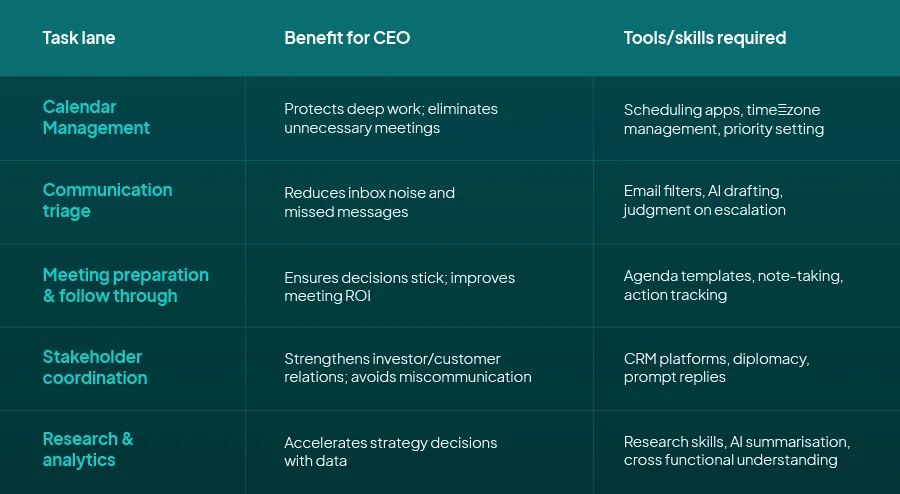
Tasks and Benefits
Use this table to decide the scope fast.
Where does Anywhere Talent fit?
Anywhere Talent places executive virtual assistant support designed for lane ownership. We don’t just hand you profiles; we help define the first lane, test for judgment with real work samples, and set a clean onboarding rhythm so you feel relief early, not three months later. If you want an executive virtual assistant who can run a calendar, inbox, and follow-through like an operator, connect with Anywhere Talent to simplify the setup and get matched faster.