

You can hire a Chief of Staff and still spend your week drowning in calendar chaos. That’s why chief of staff vs executive assistant is a “what problem are we actually solving?” decision.
Here’s the blunt truth: if you’re overwhelmed by logistics, inbox triage, meeting prep, and follow-ups, hiring a Chief of Staff first is usually the expensive wrong move. You don’t need more strategy meetings; you need your day back.
This guide will help you choose the right role: executive assistant, chief of staff, or secretary, based on what’s breaking right now, and what you’ll need next as you scale.
What is a Chief of Staff?
A Chief of Staff (CoS) is a senior operator who helps a leader turn priorities into coordinated execution across the business. In the most effective version of the role, the CoS becomes the “alignment engine” for leadership: clarifying ownership, leading strategic projects, and removing cross-team blockers.
If you’re wondering what a chief of staff is or what a chief of staff does, here’s the answer. A CoS typically:
- Drives cross-functional initiatives (the projects everyone touches but no one owns),
- Keeps leaders aligned when the org gets busy.
In the chief of staff vs executive assistant debate, the CoS is less about protecting the executive’s calendar and more about protecting the company’s flow.
What is an Executive Assistant?
An Executive Assistant (EA) is the person who protects an executive’s time, attention, and follow-through. They’re the “assistant CEO” for the day: the calendar, the inbox flow, the meeting prep, the follow-ups, the stakeholder coordination, all the things that quietly decide whether you spend your week on leadership or logistics.
HBR has written about how executive assistants evolved beyond the old stereotype and are often reserved for senior leaders because the role requires judgment and trust, not just admin.
In the chief of staff vs executive assistant talk, the EA is usually the fastest path to calmer days because they reduce calendar churn, inbox overload, and follow-up debt.
Chief of Staff vs Executive Assistant
Here’s the cleanest way to think about chief of staff vs executive assistant:
- The EA optimizes the leader’s time.
- The CoS optimizes the leader’s impact across the organization.
Chiefs of staff tend to focus on medium- to long-term strategic goals, while executive assistants focus on daily/weekly tasks that enable leaders to perform.
That doesn’t mean the EA can’t be strategic. The best EAs are extremely strategic about priorities, communication, and how meetings should work. And that doesn’t mean the CoS never does logistics; many do.
But if you’re stuck on chief of staff vs executive assistant, start with this: Do you need your day fixed, or the company fixed?
Where does a secretary fit in 2026?
The word “secretary” can mean different things depending on location and industry, but in modern business, it usually refers to administrative support with a narrower scope than an EA: clerical coordination, documents, scheduling, reception-style tasks, and office logistics.
Chief of staff vs executive assistant
Which problem are you actually hiring for?
This is the part competitors often skip. They describe the roles, but they don’t help you diagnose your bottleneck.
Use this quick self-check.
If you say “yes” to these, you need an EA
- Your calendar changes daily, and you’re the one fixing it.
- You miss deep work because meetings expand to fill the day.
- Follow-ups happen only when you remember.
- You’re doing meeting prep in the last five minutes.
- Your inbox is where priorities go to die.
That’s the chief of staff vs executive assistant comparison explained in plain language: if your week is chaos, start with the role that stabilizes the executive office.
If you say “yes” to these, you need a CoS
- Your top priorities are clear, but execution stalls.
- Cross-functional projects keep slipping.
- Leaders disagree on ownership, sequencing, or trade-offs.
- You need a weekly cadence that forces clarity.
- You’re spending time translating “the plan” across teams.
That’s chief of staff vs executive assistant from the org side: if your company is stuck, the CoS creates the flow.
A decision table you can use in five minutes
If you are a founder and stuck between the titles, below is the table for you. Read the “Best when” column like a mirror.
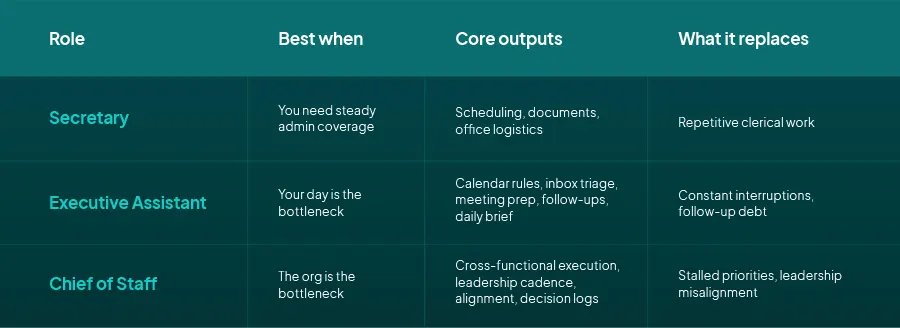
If you’re still thinking about chief of staff vs executive assistant, a helpful rule is: EA first when the CEO’s day is the pain; CoS first when execution across leaders is the pain.
Chief of staff vs executive assistant (Company stage)
Titles change with scale. So does the right hire.
Seed to early Series A (0–30 people)
If the CEO’s day is the bottleneck, the chief of staff vs executive assistant analysis usually points to the EA. A CoS is typically premature unless you have a single, urgent cross-functional initiative.
Series A to Series B (30–150 people)
If execution across teams is stuck, lean CoS. If the CEO’s day is stuck, lean EA. If both are true, hire the bigger bottleneck first.
150+ people
This is where the choice of chief of staff vs executive assistant often becomes “both,” plus added admin support.
What does a chief of staff do all day?

“Chief of Staff” doesn’t come with a universal checklist, which is part of why the role is misunderstood. LinkedIn Talent Solutions describes CoS responsibilities as leading teams, easing communications, and uniting people across organizations to keep them moving forward.
In real life, what does the chief of staff do?
- Runs priority reviews and decision logs,
- Drives cross-functional initiatives,
- Handles sensitive alignment across leaders.
If the work you’re trying to solve is cross-functional and messy, the chief of staff vs executive assistant points toward CoS.
What does an executive assistant do all day?
A strong EA spends their day preventing small problems from turning into founder interruptions.
They:
- Run the calendar with rules,
- Triage communication into decisions,
- Make meetings worth attending,
- Keep follow-through alive.
A common misconception about the chief of staff vs executive assistant is that an EA is “just admin.” In reality, they surface pattern problems early and prevent repeat chaos.
Can one person cover both roles?

Sometimes an EA grows into CoS responsibilities. Sometimes a CoS can temporarily cover EA gaps. But hiring one person to be “EA and CoS” from Day 1 usually creates a split-brain role: calendar chaos plus cross-functional chaos.
If you want a practical answer to chief of staff vs executive assistant, here: don’t combine roles until one lane is stable.
- Start with EA to stabilize time and follow-through.
- Add CoS when strategic execution needs a dedicated owner.
Hiring guidance that actually avoids mis-hires
Competitors often say, “CoS is strategic, EA is tactical.” That’s too simple. The real mis-hire happens when you buy a title to solve the wrong pain.
Here are two high-signal checks:
If you’re hiring an EA
Ask for a work sample that shows judgment:
- Inbox triage (20 emails: draft, route, escalate),
- Calendar rebuild (conflicts: propose swaps + rules),
- Meeting prep (agenda request & recap template).
If you’re hiring a CoS
Ask for proof of cross-functional execution:
- A project they drove across teams,
- How they set cadence,
- How they handled misalignment and decision rights.
ProAssisting warns that many executives rush to hire a chief of staff when they really need an executive assistant to reclaim time and reduce scheduling bottlenecks.
That’s the most common chief of staff vs executive assistant mistake, and it’s avoidable if you define the outcome before you post the role.
Three common scenarios (and the right answer fast)
Here are three scenarios we see most often and how the chief of staff vs executive assistant decision usually lands.
Scenario 1: “My calendar is a crime scene.”
You’re rescheduling constantly, and deep work never survives. In the chief of staff vs executive assistant, this is an EA problem first: stabilize calendar rules, prep, and follow-ups before adding org-level support.
Scenario 2: “We know the priorities, but nothing ships.”
Priorities are clear, but cross-functional work keeps slipping. In the chief of staff vs executive assistant, this is where a CoS earns their keep, ownership, and unblockers across teams.
Scenario 3: “I’m the interpreter between leaders.”
You’re stuck translating trade-offs between leaders. In the chief of staff vs. executive assistant debate, these points indicate that a CoS aligns leaders, drives decisions, and keeps execution moving.
What should feel different by Day 30?
A good hire should create a visible shift quickly. Day 30 should look different:
- EA: fewer interruptions, fewer meeting surprises, follow-ups happening without you chasing.
- CoS: clearer ownership, a weekly cadence, cross-team blockers surfaced and assigned.
- Secretary: Admin throughput improves, and small tasks stop dragging senior people into details.
If Day 30 feels the same, the issue is usually role scope, not effort. That’s another signal to revisit the chief of staff vs executive assistant thought and tighten the outcomes.
So… what do you need, and when?
Here’s the decision in one line:
- If your day is messy: hire an EA.
- If the company is messy, hire a CoS.
- If the work is clerical, hire a secretary.
And if you want a practical next step: write one paragraph that starts with “In 30 days, I will know this hire is working if…” Then hire to that.
That’s how you win the chief of staff vs executive assistant choice without overthinking it.
Where does Anywhere Talent fit?
If you’re stuck in the chief of staff vs executive assistant choice and want a next step, Anywhere Talent can help you define the lane first, then hire the role that matches it. (chief of staff vs executive assistant)
For many founders, that means starting with an EA who can stabilize the executive office (calendar, inbox, follow-ups). For others, it means bringing in a more senior operator when cross-team execution is the constraint. Either way, the goal is the same: the hire reduces your load, not adds another layer to manage.