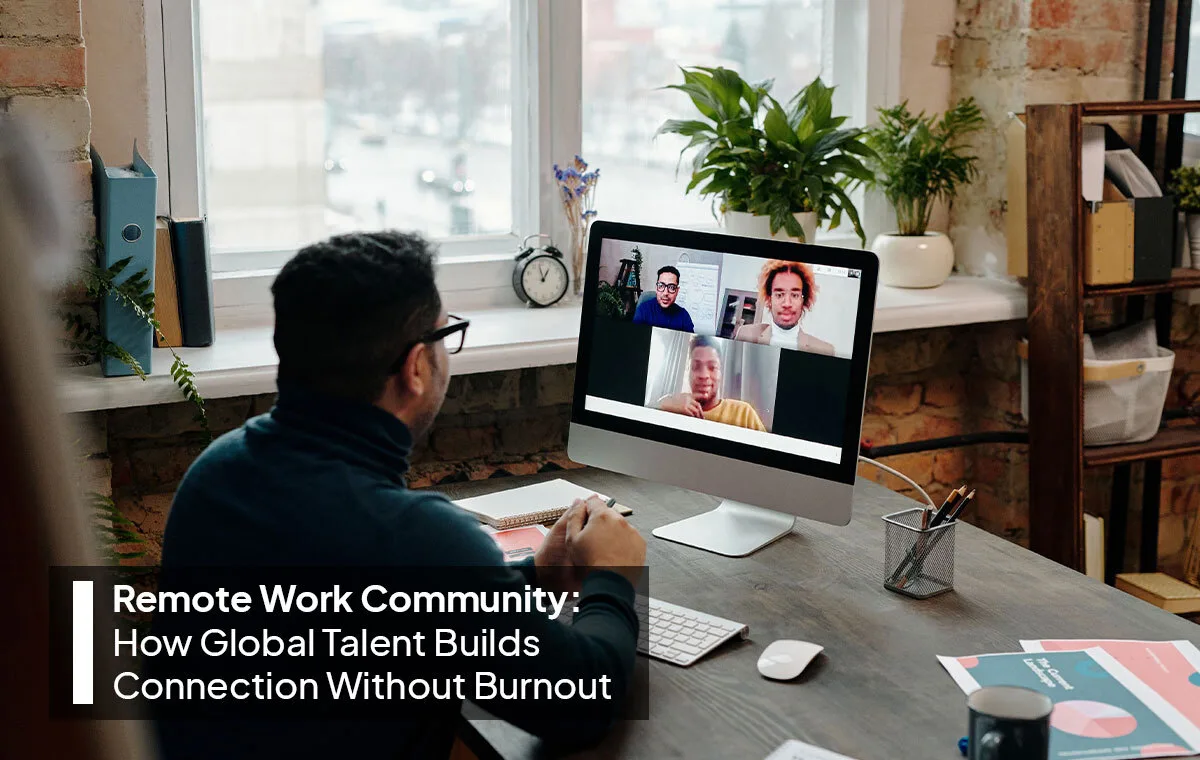
A remote work community is the set of habits, spaces, and communication rhythms that help people feel connected to the company while working from different locations. It is not just a Slack channel, a monthly social call, or a random virtual activity. A strong remote work community helps global talent understand the business, feel included in the team, and know how their work supports the bigger goal.
I have seen remote teams where the work looked fine on the surface.
Tasks were moving. Messages were answered. Meetings happened. But new hires still felt like outsiders. Remote assistants only heard from the team when something was needed. Wins were easy to miss. A founder became the person everyone depended on for context, connection, and follow-up.

That is when community becomes a business issue.
The question is not only how to build a community. The better question is how to build one without creating more meetings, more noise, or more invisible work for the same few people.
What is a remote work community?
A remote work community is how a distributed team creates belonging, clarity, and trust without relying on physical office presence.
It answers simple questions:
- Do people know where they fit?
- Do they understand company priorities?
- Are wins recognized?
- Can people ask questions without feeling awkward?
- Does communication feel clear across time zones?
- Are remote hires included in context, not only tasks?
This matters because remote work can be productive and isolating at the same time. Gallup found that fully remote employees can be highly engaged, but they are also more likely to report loneliness, anger, sadness, and stress than hybrid or onsite employees.
That is why remote work community should not be treated as a “nice extra.”
It helps people stay connected enough to do better work.
Why remote teams disconnect?
Remote teams usually disconnect quietly.
No one says, “I do not feel part of this team.” Instead, the signs are smaller.
A new assistant stops asking questions. A remote team member only replies when tagged. A customer support hire does not know where to share repeated client feedback. A coordinator is invited to tasks, but not to context. A founder assumes people understand the why, but they only know the deadline.
This is where a remote work community starts to weaken.
The problem is not distance alone. The problem is that connection depends on random effort.
If the founder remembers to share context, people get context. If a manager remembers to recognize good work, people feel seen. If nobody remembers, remote hires become task-takers instead of team members.
What should community solve?
A remote work community should solve the practical problems that make global talent feel disconnected.
| Problem | What community should create |
| New hires feel lost | Better onboarding and team introductions |
| Remote assistants feel invisible | Recognition and context |
| Teams repeat updates | Clear shared spaces |
| People miss decisions | Written notes and summaries |
| Too many pings | Better communication rules |
| One person carries culture | Shared responsibility |
This is important for founders because community is not only emotional.
It affects retention, communication, handoffs, customer experience, and how quickly global talent becomes useful inside the business.
Gallup’s 2026 workplace report found that only 20% of employees worldwide were engaged in 2025. Engagement matters because people do better work when they understand the mission, feel supported, and trust how the team operates.
A remote work community helps create that support in a distributed setup.
How to build community?
The first step is to stop treating community like an event.
Community is not one big virtual hangout. It is a rhythm.
A healthy rhythm may include:
- A short founder update
- A weekly wins thread
- Clear onboarding introductions
- Customer feedback shared with the team
- A place for questions
- Team rituals that do not require everyone online
- Recognition that does not depend on memory
This is how to build community in a way that feels natural.
People do not need constant calls to feel connected. They need to know what is happening, why it matters, and where their work fits.
That is especially true for global talent. A finance assistant should know why invoice follow-ups matter. A marketing assistant should know how campaigns affect pipeline. A customer support hire should know what kind of client experience the company wants to protect.
A remote work community becomes stronger when people understand the story behind the task.
What can assistants support?
Remote assistants and global support roles can help organize the systems that make community repeatable.
This does not mean they become responsible for everyone’s mood.
It means they help the team stay consistent.
| Area | What global support can help with |
| Onboarding | Schedule intros, prepare welcome notes, organize first-week context |
| Recognition | Collect wins, remind leaders to share praise |
| Communication | Turn scattered updates into clear summaries |
| Meetings | Keep recurring calls useful and documented |
| Knowledge sharing | Organize FAQs, SOPs, and project context |
| Team rhythm | Maintain weekly updates and check-in reminders |
This is where remote work community becomes operational.
A strong remote assistant can help leaders remember the small things that make people feel included. They can keep updates moving. They can notice when handoffs are unclear. They can help make new hires feel less like they are joining from the outside.
But they should not carry the whole culture alone.
How to avoid burnout?
A remote work community can create burnout if it becomes another job layered onto already busy people.
This happens when one assistant, coordinator, or people-focused team member becomes responsible for every birthday, check-in, team event, onboarding note, follow-up, reminder, and morale issue.
That is not sustainable.
Microsoft’s 2025 Work Trend Index found that employees are interrupted every two minutes during core work hours by meetings, emails, or chats. More connection cannot mean more interruption.
A healthier approach is simple:
| Burnout risk | Better approach |
| Too many social calls | Fewer, more useful touchpoints |
| One person owns community | Leaders and managers share responsibility |
| Constant chat activity | Clear response-time expectations |
| Recognition depends on memory | Wins are tracked weekly |
| Every update needs a meeting | Async notes handle simple context |
The goal is to build community without making people feel always available.
What should leaders own?
Leaders cannot outsource community completely.
A remote assistant can organize the rhythm, but the founder still sets the tone.
The founder should own:
- Direction
- Values in action
- Recognition that matters
- Difficult conversations
- Workload decisions
- Team expectations
- The quality of communication
This distinction matters.
If a founder asks how to build a community, the answer is not “give it to the assistant.” The better answer is to use support roles to make leadership more consistent.
A remote work community works when leaders show up with context, not just tasks.
For example, instead of saying, “Please update this tracker,” a founder can say, “This tracker helps delivery and sales stay aligned, so client follow-ups do not get missed.”
That one sentence makes the work feel connected to the business.
How to build online spaces?
How to build an online community inside a company is different from how to build a community on social media.
On social media, the goal is audience engagement.

Inside a remote company, the goal is clarity, belonging, and trust.
Useful internal spaces may include:
- A wins channel
- A customer feedback thread
- A new hire resource hub
- A weekly priorities space
- A project handoff channel
- A founder updates channel
- A knowledge base for repeated questions
Each space should have a clear purpose.
If every channel becomes a place for everything, people stop using it well.
Harvard Business Review has reported that virtual meetings can strengthen trust and authenticity when they give coworkers more human context. The same idea applies to internal online spaces. People do not need endless chatter. They need meaningful visibility into the work, the people, and the company’s direction.
How does this help customers?
A remote work community is not only internal.
Customers feel it too.
When global teams are disconnected, customers may experience slow replies, repeated questions, unclear handoffs, or mixed answers.
When teams are connected, customers get better follow-through.
A marketing assistant understands the campaign goal. A customer support hire knows which tone to use. A sales assistant knows what promises were made. An operations coordinator knows where a handoff should go next.
Community improves service because people understand more than their own task.
That is why founders should connect remote work community to business outcomes, not just culture.
Where Anywhere Talent fits?
At Anywhere Talent, we see this pattern often.
A company hires strong global talent, but the person is only given tasks. They are not given enough context, communication rhythm, or visibility into the team. The hire may be capable, but the system around them is not ready.
That is why role fit and integration both matter.
The right global professional should understand the work, communicate clearly, and settle into the team without adding more pressure to the founder.
Anywhere Talent helps businesses find vetted global professionals who can support operations, communication, admin, marketing, customer support, finance, sales, and executive workflows.
A remote work community becomes easier to build when global talent is hired with clarity, not just availability.
Where should founders start?
Start with the places where people already feel disconnected.
Ask:
- Do remote hires know why their work matters?
- Are wins visible across the team?
- Is onboarding mostly tools, or does it explain culture too?
- Are decisions shared outside the main time zone?
- Is one person carrying all connection work?
- Are assistants included in context or only assigned tasks?
- Do customers feel handoff gaps?
The answers will show where to begin.
Sometimes the fix is a better onboarding flow. Sometimes it is a weekly update. Sometimes it is clearer handoffs. Sometimes it is hiring support because the founder is stretched too thin.
A remote work community grows when the team stops relying on random memory and starts building repeatable habits.
Final takeaway
A remote work community is not built by forcing people into more calls.
It is built by making people feel informed, included, recognized, and connected to the work that matters.
The problem is that many companies hire global talent and expect connection to happen naturally. Sometimes it does. Often, it does not.
Remote professionals need context. They need clear communication. They need recognition. They need useful spaces where work, wins, and decisions are visible. They also need boundaries so community does not become another reason to stay online all day.
If your remote team is growing and you want global talent to feel more connected without creating burnout, Anywhere Talent can help you find vetted professionals who bring communication strength, ownership, and role discipline into your team.
Book a free consultation with Anywhere Talent to build a global team that feels connected, supported, and easier to manage.