
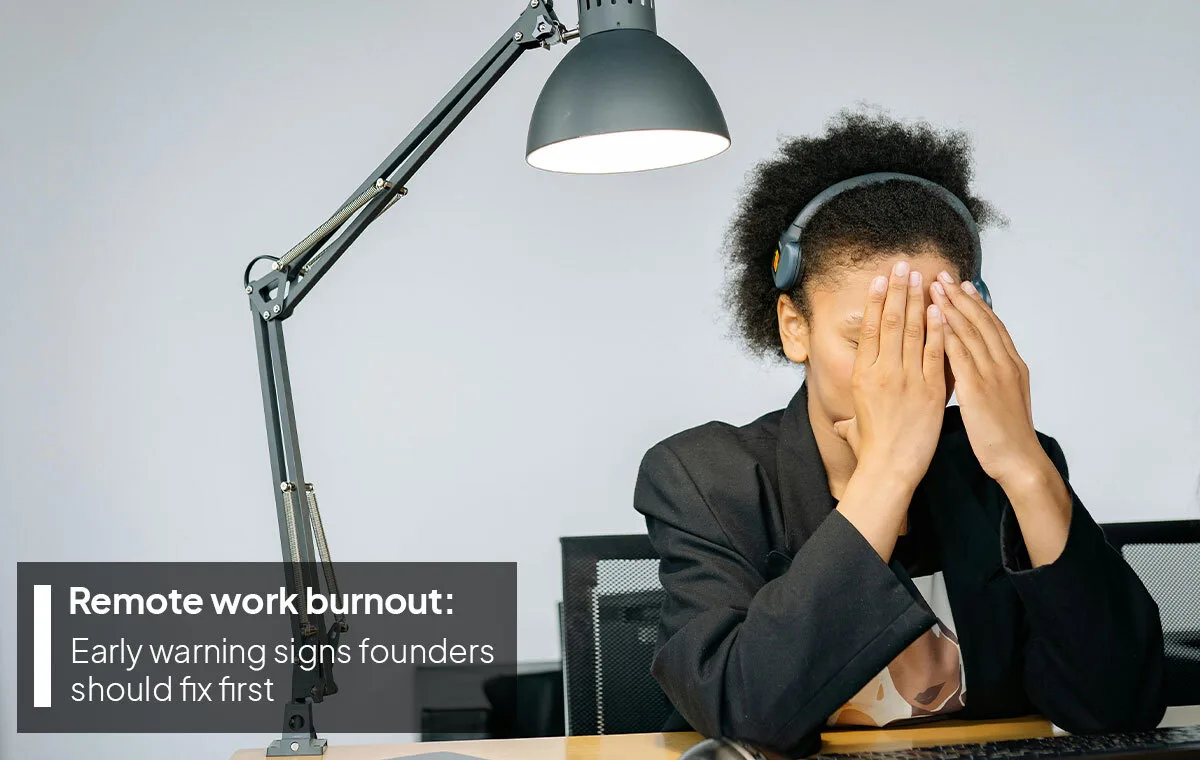
Remote work burnout is the physical, mental, and emotional exhaustion employees feel when remote work becomes too always-on, unclear, or poorly supported. It often happens when people have flexible work on paper. Still, in reality, they are dealing with constant messages, unclear priorities, too many meetings, invisible overtime, and little separation between work and home.
For founders, the problem is that remote work burnout does not always look dramatic at first. A team member may still attend meetings, reply to messages, and complete tasks, but their energy, focus, and communication skills slowly begin to decline. By the time someone says they are burned out, the issue has usually been building for weeks or months.
The solution is to build a remote work system with clearer boundaries, better workload visibility, stronger delegation, and support roles that stop high performers from carrying everything alone.
This guide explains the early signs of remote work burnout, why it happens in distributed teams, and how founders can prevent it before it affects performance, retention, and customer experience.
Remote work burnout: what it means
Remote work burnout is ongoing work-related exhaustion caused by remote work conditions that are not being managed well.
The World Health Organization defines burnout as an occupational phenomenon linked to chronic workplace stress that has not been successfully managed. It includes exhaustion, mental distance or cynicism toward work, and reduced professional effectiveness.
In remote teams, those signs can look quieter.
Someone may not complain. They may just respond slower, stop volunteering ideas, miss small details, or sound unusually flat in updates.
That is why founders need to look for patterns, not one bad day.
Why remote work burnout happens
Remote work burnout often grows because the boundaries are invisible.

In an office, leaving the building creates a signal that work is done. At home, the laptop is still there. Slack is still there. The phone is still there.
Microsoft’s 2025 Work Trend research found that Microsoft 365 users are interrupted every two minutes on average by a meeting, email, or notification. It also found that nearly half of employees say work feels chaotic and fragmented.
That kind of digital noise makes remote work burnout more likely because people are constantly switching between deep work, messages, meetings, and urgent requests.
The main causes usually include:
| Cause | What it looks like |
| Always-on communication | People feel guilty for not replying quickly |
| Too many meetings | Focus work gets pushed into evenings |
| Poor documentation | Employees repeat the same explanations |
| Uneven workload | High performers become the backup system |
| Weak delegation | Managers keep adding tasks without removing any |
| Time-zone pressure | People stretch their day to match everyone else |
Remote work burnout is rarely about one long week. It is usually the result of small pressure points repeated for months.
Early signs founders should watch
Remote work burnout is easier to prevent when leaders catch it early.
Here are the signs to look for:
| Early sign | What it may look like |
| Slower replies | Messages sit longer than usual |
| Lower energy | The person speaks less in calls |
| More mistakes | Small details get missed repeatedly |
| Less initiative | They wait for direction more often |
| Meeting fatigue | Calls feel draining or avoided |
| Shorter updates | Written communication becomes vague |
| Irritability | Normal requests create frustration |
These signs do not always mean burnout. Someone may be dealing with a personal issue, health concern, workload spike, or unclear priority.
The point is not to diagnose. The point is to notice when remote work burnout may be building and start a useful conversation.
Why high performers burn out first
This is where founders often miss the problem.

The most reliable people usually get more work because they are reliable. They answer faster. They fix issues. They remember client details. They support other team members. They quietly absorb tasks that should have become a new role months ago.
That is how remote work burnout reaches high performers first.
They do not always look overwhelmed. They look capable until they suddenly disengage, reduce effort, or leave.
Gallup’s 2026 workplace report found that global employee engagement fell to 20% in 2025, with low engagement creating a major productivity cost. Gallup also reported that fully remote workers are the most likely to be engaged, but they are more likely to report high stress than on-site workers.
That combination matters. Remote employees can be engaged and still under serious pressure.
Work from home burnout vs office burnout
Remote work burnout and office burnout have different pressure points.
| Office burnout | Remote burnout |
| Commute stress | No separation between home and work |
| In-person interruptions | Digital interruptions all day |
| Visible overtime | Invisible overtime |
| Office politics | Isolation or missing context |
| Meeting overload | Meeting overload plus async pressure |
Remote work burnout is often harder to see because no one can observe the late-night catch-up, the constant checking, or the employee who keeps working through lunch.
This is why remote managers need better visibility into workload, not just task completion.
How founders accidentally create burnout
Most founders do not create remote work burnout on purpose.
It happens through normal habits that seem harmless.
They send “quick” messages after hours. They reward the person who always responds first. They add recurring meetings without removing old ones. They assign work without explaining priority. They let one employee become the default owner of everything that has no clear owner.
Over time, this tells the team that availability matters more than focus.
A healthier remote team needs different signals:
| Instead of rewarding | Reward this |
| Instant replies | Clear, useful updates |
| Always being online | Reliable ownership |
| Taking every task | Flagging workload honestly |
| Late-night fixes | Better planning and delegation |
| More meetings | Better documentation |
Preventing remote work burnout starts when founders stop treating constant availability as commitment.
How to prevent burnout without lowering performance
Remote teams can stay ambitious without burning people out.
The goal is not to make the work easy. The goal is to make the work clear, fair, and sustainable.
Start with these systems:
- Define response-time expectations
- Protect blocks for focus work
- Limit recurring meetings
- Create written handoff rules
- Track workload, not only deadlines
- Clarify what is urgent and what is not
- Permit people to flag overload early
- Delegate admin and coordination before key people drown in it
NIOSH has noted that organizational change should be a top priority for reducing job stress. Its guidance includes aligning workload with workers’ capabilities, clearly defining roles, improving communication, and providing opportunities for social interaction.
That is the real remote work burnout prevention work. Not one wellness session. Not a random mental health day after months of overload. Remote work burnout prevention starts inside the operating system of the team.
When support is the real solution
Sometimes the problem is not that the team needs better time management.
Sometimes the team simply needs more support.
If one person is managing customer follow-ups, internal reporting, admin work, scheduling, inbox cleanup, documentation, and project coordination, the workload is already too broad.
This is where founders need to ask a better question:
“What work should this person stop doing?”
At Anywhere Talent, we often see remote work burnout risk when strong employees carry tasks that should be delegated to a virtual assistant, coordinator, executive assistant, marketing assistant, finance assistant, or customer support hire.
The right support structure does not reduce ambition. It protects the people who are helping the business grow.
A simple prevention check
Founders can use this once a month.
Ask:
- Who is carrying invisible admin?
- Which meetings can become written updates?
- Which tasks keep returning to the same person?
- Who has been online late too often?
- Which role needs support before performance drops?
- Which customer issues are caused by internal overload?
If the same name appears repeatedly, that person is not just dependable. They may be overloaded.
This is where prevention becomes practical. Remote work burnout becomes less likely when pressure is seen early, and work is redistributed before someone has to break down to be heard.
Final takeaway
Remote work burnout is not a sign that people cannot handle remote work.
It is usually a sign that the system around them is unclear, overloaded, or too dependent on a few strong employees.
The early signs are often small: slower replies, vague updates, missed details, lower energy, or less initiative. Founders who notice those signs early can fix the real problem before it affects retention, customer experience, or team trust.
If your remote team is growing and key people are carrying too much admin, coordination, or follow-up work, Anywhere Talent can help you build a healthier support structure with vetted remote professionals. Book a free consultation with Anywhere Talent to reduce workload pressure and build a remote team that can perform without burning out.