
There is a common misconception about scaling a business that traps founders for months, sometimes years. The misconception is that scaling a business requires doing more: more selling, more hiring, more marketing, more meetings, more decisions. In reality, scaling a business requires doing less of what got you here and more of what will get you to the next stage.
Around 70% of startups fail at the scaling stage, not because the idea was bad or the market was wrong, but because the founder could not make the operational transition that scaling a business demands (The Recursive, 2025). The skills that build a company from zero to one are fundamentally different from the skills required for scaling a business from one to ten. And the hardest part of scaling a business is not learning new skills. It is unlearning the old ones.
This article identifies the specific things founders should stop doing if they are serious about scaling a business, and the systems and hires that make the transition possible.
Stop Being the Only Person Who Can Make Decisions
The number one obstacle to scaling a business is the founder who insists on being involved in every decision. In the early days, this made sense. The founder had the most context, the most stake, and the most capability. But what worked with five people becomes a bottleneck at twenty.

When every decision routes through one person, two things happen. First, the speed of execution drops because the team cannot move without approval. Second, the team stops developing judgment because they never get the opportunity to make decisions and learn from the outcomes.
Research on scaling companies shows that approximately 35% of Series A startups fail before reaching Series B, often because founders cling to decision-making patterns that worked early on but constrain scaling a business at the next stage (First AI Movers, 2025). Scaling a business requires distributing decision authority deliberately. Define which decisions require your input and which can be made by others. Then trust the framework.
Gallup’s study of Inc. 500 CEOs found that those with strong delegation skills generated 33% more revenue and grew their businesses 112 percentage points faster over three years (Gallup). Scaling a business is not about making better decisions. It is about building a team that can make good decisions without you.
Stop Doing Work That Someone Else Could Own
Founders who are scaling a business often hold onto operational tasks long after they should have let go. They are still managing the calendar, responding to routine emails, coordinating vendors, updating spreadsheets, and handling client follow-ups. Because nobody else can do it, but because it feels faster and easier to do it themselves.

In the short term, that is true. In the long term, it is the single biggest constraint on scaling a business. Every hour the founder spends on $20-per-hour tasks is an hour not spent on the strategic work that only the founder can do: building key relationships, setting direction, and making the high-impact decisions that drive growth.
A study published in Harvard Business Review found that leaders who fail to delegate spend up to 60% of their time on tasks that could be handled by someone else (Medium – World of Leadership, 2024). That is more than half of the founder’s week consumed by work that does not require their expertise. For a company trying to achieve scaling a business, this is an enormous waste of the most expensive resource in the organization: the founder’s time.
The fix is straightforward but requires discipline. Audit your weekly tasks. Identify everything that does not require your specific judgment, relationships, or authority. Then hire someone to own those tasks with clear expectations, documented workflows, and regular check-ins.
Anywhere Talent was built for exactly this moment in a founder’s journey. They match founders with dedicated remote professionals, from executive assistants to marketing coordinators and operations support, and build a structured onboarding around the hire. The goal is not to add a task-taker. The goal is to add capacity that supports scaling a business by freeing the founder to focus on the work that matters most.
Stop Running the Company From Your Inbox
Email is where scaling a business goes to die. When the founder’s inbox is the central hub for decisions, updates, approvals, and coordination, everything moves at the speed of one person’s ability to read and respond.
Scaling a business requires moving communication and coordination out of the founder’s inbox and into structured systems. Project management tools, shared dashboards, and defined communication rhythms replace the reactive nature of email with proactive, visible workflows.
A 2023 Jitterbit study found that 87% of business leaders cite manual processes and data silos as key barriers to growth, and 74% of companies lack fully integrated software solutions (The Recursive, 2025). For companies serious about scaling businesses, the shift from inbox-driven operations to system-driven operations is not a nice-to-have. It is a requirement.
The practical implementation looks like this: move task assignments to a project management platform. Move status updates to a weekly team scorecard. Move client communication to a shared inbox or CRM. Move scheduling to a dedicated assistant. Each of these shifts reduces the founder’s operational load and builds the infrastructure a business needs to scale.
Stop Hiring Without a System for Making Hires Successful
Scaling a business almost always involves adding people. But adding people without a system for integrating them into the business creates more problems than it solves. The founder hires someone, hands them a laptop, and hopes they figure it out. Three months later, the hire is underperforming, and the founder concludes that they made a bad hire.
More often than not, it was not a bad hire. It was a bad onboarding. The person had no documented workflows to follow, no clear expectations for what success looks like, no structured check-ins to surface problems early, and no coaching to help them improve. They were set up to struggle, and they did.
The Mercury 2025 startup economics report found that among companies with $10 million or more in revenue, 50% had 100 or more employees (Mercury, 2025). Scaling a business at that level is impossible without a repeatable system for bringing people in and getting them productive fast.
Anywhere Talent addresses this directly through its structured onboarding framework. Every placement comes with a 30-day ramp-up plan that includes access setup, workflow documentation, communication standards, and weekly check-ins. The assistant is also supported by a Talent Coach who provides ongoing training and development. This approach to business development through strategic hiring turns each new person into a net positive from week one, rather than a project the founder needs to manage.
Stop Treating Every Quarter Like a Fresh Start
Scaling a business requires consistency. Too many founders treat each quarter as if it has no connection to the last. They set new goals, start new initiatives, and abandon the projects that were 80% complete in favor of something that seems more urgent.
Gino Wickman’s EOS framework addresses this through a system of quarterly Rocks (priority goals) that connect to a longer-term vision. Teams that implement this structured approach to scaling a business maintain focus across quarters rather than starting over every 90 days (EOS Worldwide). The result is compounding progress rather than repeated restarts.
For scaling a business to work, the leadership team needs to commit to three to five priorities per quarter, track them weekly, and complete them before moving on. This discipline is what separates companies that scale from companies that just stay busy.
The Scaling a Business Comparison
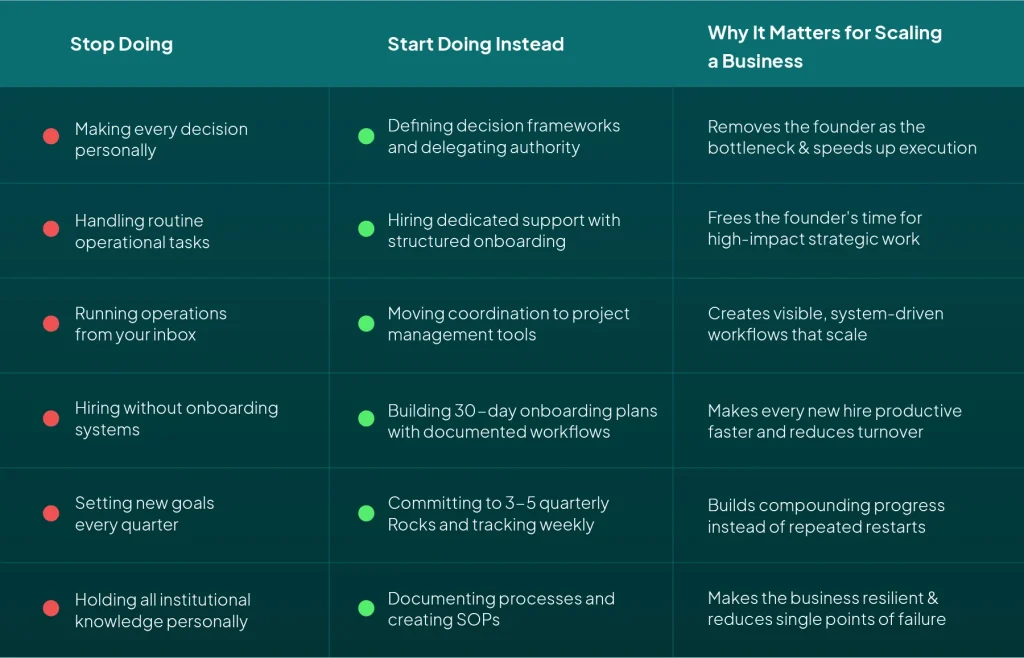
Each item in the left column feels productive. Each item in the right column actually advances in scaling a business. The shift is not about working less. It is about redirecting effort toward the activities that produce compounding returns.
Stop Thinking Scaling a Business Means Scaling Yourself
This is the most important mindset shift of all. Scaling a business does not mean scaling your personal output. It means building an organization that can produce results independently of your direct involvement.
Stanford economist Nicholas Bloom’s research on remote work productivity found that structured remote teams, those with clear expectations, defined workflows, and consistent support, outperform unstructured teams by 13% or more (Stanford GSB). The variable is not the people. It is the system. Scaling a business follows the same principle: the quality of the system determines the quality of the output, regardless of whether the founder is personally involved.
For founders who recognize that they have become the constraint on their own company’s growth, the path forward starts with one question: What would need to be true for this business to run well for two weeks without me?
The answer to that question reveals exactly what needs to change. Maybe it is hiring an executive assistant to manage the operational layer. Maybe it is documenting the processes that currently live in your head. Maybe it is defining the decision-making authority for each member of the team. Whatever the answer, the action required is the same: build the system that makes business growth possible without scaling yourself.
Scaling a Business Starts With What You Stop
The counterintuitive truth about scaling a business is that the path forward starts with subtraction, not addition. Before you add new revenue channels, new products, or new team members, subtract the activities that keep you stuck in execution mode. Stop making every decision. Stop doing work someone else could do. Stop running the company from your inbox. Stop hiring without systems. Stop restarting every quarter.
Anywhere Talent helps founders make this transition by providing the operational support and structure that a business requires. They match you with a dedicated professional, build the onboarding framework around the role, and provide coaching support to keep performance consistent as you grow. It is a system designed for founders who are ready to stop doing everything and start building something that scales.
Scaling a business is not about becoming a bigger version of what you already are. It is about becoming a different kind of leader, one who builds the machine rather than being the machine. And that starts with deciding what you should not be doing anymore.
Anywhere Talent exists to support that decision. When you are ready to hand off execution and focus on what only you can do, the system is there to expand a business practically, not just aspirationally.
If scaling feels like it requires more of your time instead of less, the problem is the operating model, not your effort. Anywhere Talent builds the support system that makes scaling a business sustainable.